

Christmas Window Lights: The Window-by-Window System for a Lit-Up Home
Most Christmas windows do not look dark because the house has no lights. They look dark because the lights are still in a box in the loft, tangled from last January, with no plan for which window gets lit first and no rule for when they switch off. A new strand, a new timer, a new set of clips, and the house still feels unlit at dusk: the lights are up, but they are not a system. A list of christmas window lights does not fix that, because a list has no map, no timer and no rule for how many windows a house needs. The house gains strands faster than it gains glow.
Christmas window lights are not a string of bulbs. They are a system: a map that decides which windows get lit, a timer that decides when they glow, rules that decide what never mixes, and a timeline that decides which evening lights which window. Five window zones in map order — front-facing windows, living-room window, bedroom windows, kitchen/dining window, door & porch outline — so the street-facing windows run before the private rooms. One light style for the whole house, picked once and never mixed. A timer rule — dusk to 10:00 PM, off overnight — so no zone is ever left on all night. And a take-down rule — every strand comes down Jan 2–15 — so window lights never become January clutter. That is the whole system — and it is the reason this post exists now: christmas window lights are up 1,500% on Pinterest (Pinterest Trends Spotlight, Home Decor interest, US, data 8/20–11/12/2026, read live 15 Nov 2026), so a system built now is ready while the search is climbing, three weeks before the Christmas search peak on Mon 7 Dec 2026, not after it has passed. No rule here is presented as research: the zones, the one-light-style rule, the timer rule, the one-window-per-evening rule, the indoor/outdoor rule, the no-nails rule and the take-down rule are this post’s own system rules, labeled as such.
The system at a glance
Five steps, in order. Then a printable, and a challenge.
- Step 1 — The five window zones: front-facing windows, living-room window, bedroom windows, kitchen/dining window, door & porch outline — one window at a time, in map order, so the street-facing windows run before the private rooms.
- Step 2 — The timer station: one timer per zone, dusk to 10:00 PM, off overnight — the timer decides, you do not switch them by hand.
- Step 3 — The rules that keep the lights one system: one light style for the whole house, indoor lights indoors and outdoor lights outdoors, clips only — never nails or staples through a wire.
- Step 4 — The five-evening timeline: Friday front windows, Saturday living-room window, Sunday bedrooms, Monday kitchen/dining, Tuesday door & porch — five evenings, 20 minutes each, and the house is fully lit.
- Step 5 — The window-lights map + timer checklist: every window mapped before it is lit, every timer set before the first bulb glows.
Six rules govern the whole system: the front windows run first, because they set the glow the street sees; one light style for the whole house, because a second style is a second house’s worth of lights on one home; dusk to 10:00 PM, because lights that burn all night are wasted glow; one window per evening, 20 minutes maximum; indoor lights indoors and outdoor lights outdoors, because ratings never swap; and clips only, never nails or staples through a wire. A house that follows the christmas window lights rules glows in one style, on one timer, in five evenings; a house that ignores them has a strand in every window, a different colour on every floor, and a light bill it never planned — and this system exists so that never happens.
Step 1 — The five window zones, in map order
Five zones. Front-facing windows, living-room window, bedroom windows, kitchen/dining window, door & porch outline — in that order, and never starting with the private rooms.
- Zone 1 — Front-facing windows: the show windows — the glow the street sees. One strand per window, same style as the whole house, hung with clips only. This zone runs first because the front windows set the glow for the whole house — everything else is lit to match them.
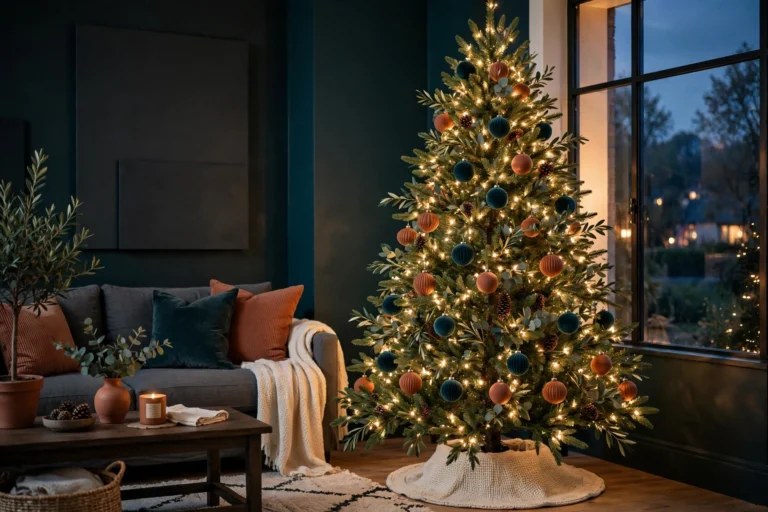
- Zone 2 — Living-room window: the tree window — matched to the tree’s lights from #119, so the tree glow extends to the room without lighting every window. The tree already has its own system and its own rules, and the living-room window matches those lights — it does not re-wrap the tree: the Christmas Tree Ideas post runs five zones around one tree, and its light layer is the tree’s lights; this post is the lights on the windows, not tree styling, so no tree content lives here. This is the window that makes the whole house feel like one system instead of five separate strands: the tree glow reaches the room, and the room reaches the street.
- Zone 3 — Bedroom windows: soft, low glow — one short strand per window, warm white, on the same dusk-to-10 timer as the rest of the house. A bedroom window is for the people inside the room, not for the street — so it glows quietly, and it goes dark with the rest of the house at 10:00 PM.
- Zone 4 — Kitchen/dining window: warm, single strand — the window above the sink or table, lit for the evening meal and off with the timer. The handmade twin to this post is the DIY Christmas Decor System — #125 dresses windows with paper stars, #126 lights them — so the window dressing stays flat and light, never blocking the light.
- Zone 5 — Door & porch outline: the entry frame — one outdoor-rated strand outlining the door and porch rail, on its own outdoor timer. The outline runs last because it is the frame around everything else: the windows are lit first, and the door finishes the house.
The zones decide the lighting before the lighting decides the house. In christmas window lights, a house that starts at Zone 1 has a glow on the street before it has a strand in a bedroom — the front windows are lit, the living-room window matches the tree, and the house already feels like Christmas before a single private window is touched. A house that starts at the back bedroom has lit the room nobody sees and left the street dark. The zones run in map order for a reason: front first, tree window second, bedrooms third, kitchen fourth, door and porch last — and a zone that is skipped is a zone that shows up later as a rushed evening and a half-lit house.

Step 2 — The timer station: dusk to 10:00 PM, off overnight
One timer per zone — or one multi-outlet outdoor timer for the outdoor zones — every timer set once, at install, and never touched again until take-down.
- One timer per zone: every zone gets its own timer, set once at install. A zone without its own timer is a zone that gets switched by hand — and a zone switched by hand is a zone that gets left on all night, or never switched on at all.
- Dusk to 10:00 PM, every zone, every night: the timer decides, not the household. Lights that burn all night are wasted glow, not Christmas glow — the timer switches them on at dusk and off at 10:00 PM, and nobody in the house has to remember either one.
- The timer checklist records each setting first: the timer checklist on the printable records each zone’s timer setting before the first bulb glows — no zone is lit without its timer already set. A timer set after the lights are hung is a timer set in the dark, on a ladder, in December.
- Timers are packed away Jan 2–15: with the strands, on the take-down timeline from the When to Take Down Christmas Decorations post. Window lights that linger past January are January clutter, not Christmas lights.
The timer is the reason christmas window lights work as a system instead of a nightly chore. Without a timer, every evening is a round of the house — switching strands on at dusk, remembering to switch them off before bed, finding one still burning at 2:00 AM — and a house with five separate switching jobs has five chances to leave a light on all night. With a timer, every zone is the same job done once: set at install, glowing at dusk, dark at 10:00 PM, and never touched again until January. The closest cousin to this station is the timer discipline in the Cozy Home Decor System — layers that switch on together and off together — and the timer station borrows its rule: one setting, every zone, no nightly decisions. The difference is the job: that post layers a room, this post times its windows.

Step 3 — The rules: one style, indoor/outdoor, clips only
Three rules, one job between them: keep the whole house one system, not five separate lighting jobs.
- The one-light-style rule: warm white OR multicolour — pick ONE for the whole house, never mix them. A second style is a second house’s worth of lights on one home. The one-light-style rule is the rule that stops christmas window lights from becoming a jumble: one style, picked once, on every window, so the front windows, the tree window and the porch all glow like one house, not three.
- The indoor/outdoor rule: indoor-rated lights indoors only, outdoor-rated lights outdoors only. Ratings never swap, and no strand crosses the threshold in either direction. An indoor strand on the porch is a strand that will fail in the first rain; an outdoor strand in a bedroom is a strand built for weather the bedroom will never see.
- The no-nails rule: clips only, never nails or staples through a wire. A pierced wire is a dead strand — and a strand that must be replaced, not repaired. Clips hold the strand, the strand holds the light, and the window frame stays undamaged for January, when every clip comes off and every strand comes down.
The rules are where christmas window lights stay a system instead of a collection of strands. A house that mixes warm white and multicolour has two houses’ worth of lights on one home; a house that runs an indoor strand across the porch has a strand that will fail in the first rain; a house that staples a wire has a dead strand and a repair job in the dark. And the same budget discipline already runs elsewhere in this house: the Budget Home Decor System caps a room at $100, and window lights are the cheapest glow in that budget — one strand per window, one style, one timer, and the room is lit for the price of a single strand.
Step 4 — The five-evening timeline: Friday to Tuesday, 20 minutes a night
Five evenings, 20 minutes each. Friday front windows, Saturday living-room window, Sunday bedrooms, Monday kitchen/dining, Tuesday door & porch — and the house is fully lit.
- Friday evening (20 minutes): Zone 1 — map the front windows, hang the first strand with clips, set its timer. The front windows run on Friday so the glow is up before the weekend starts: a house with its show windows lit is a house that already looks like Christmas from the street.
- Saturday (20 minutes): Zone 2 — living-room window, matched to the tree’s lights. One strand, clips only, timer set — the tree glow extends to the room in the same evening it is hung.
- Sunday (20 minutes): Zone 3 — bedroom windows, soft low glow. One short strand per window, warm white, on the same dusk-to-10 timer — the quietest evening of the five, and the one that finishes the private rooms.
- Monday (20 minutes): Zone 4 — kitchen/dining window, one warm strand. The window above the sink or table, lit for the evening meal and off with the timer — the last indoor window, done in one sitting.
- Tuesday (20 minutes): Zone 5 — door & porch outline, outdoor-rated strand on its own timer. The house is fully lit in five evenings, 20 minutes each — the outline frames everything that came before it.
The timeline is what keeps christmas window lights to five evenings. Lights without a timeline spread across December — a strand hung on the 5th, a timer set on the 12th, a porch outline that never quite gets hung — and lights that spread across December are lights that are still half-hung when the guests arrive. Lights with a timeline are finished on Tuesday, and the rest of December is for enjoying them. Before any zone starts, one job runs first: the pre-season bin audit. The Declutter Your Christmas Decorations post is the audit that runs before the lights come out of storage — the bins are sorted, the broken strands are binned, and the window zones light up from a clean cupboard, not from last year’s tangled box.

Step 5 — The window-lights map + timer checklist
The checklist is the christmas window lights system in two pages: the zones, the timers, and every window mapped before it is lit.
The checklist has one line per zone — front-facing windows, living-room window, bedroom windows, kitchen/dining window, door & porch outline — and one checkbox per zone, checked only when the zone is lit and its timer is set, not when it is started. A zone checked off before it is lit is a zone that gets forgotten in the dark. The timer checklist has one line per timer — each zone’s dusk-to-10 setting recorded before the first bulb glows — so no zone is lit without its timer already set. Every window is mapped before it is lit, every timer is set before the first bulb glows, and the take-down date — Jan 2–15 — is written on the checklist the day it is printed, so the end of the season is decided at the start of it.
The checklist is also the record that makes the system repeatable. After one Christmas, the checklist shows the pattern: which window took the full 20 minutes, which window finished in 10, which zone the street loved most, and which strand never got used. A system that is not written down is a system that is re-invented next December; a system on two pages is a system that runs next year in five evenings, again.
Before you start: print the checklist tonight
Print the window-lights map and timer checklist tonight, not on Friday, so your christmas window lights weekend starts organised. Map the five windows — front, living room, bedrooms, kitchen, door and porch — pick the one light style for the whole house, and set out one timer per zone before the weekend starts: clips, strands, timers, in one spot. The challenge is simple: light one window tonight, in 20 minutes — the map decides, you just follow the card. Five evenings, 20 minutes each, and by Tuesday the house is fully lit, glowing in one style, and ready three weeks before the Christmas search peak.
The free printable: window-lights map + timer checklist
The printable for this post is a window-lights map and a timer checklist: the map has one line per window zone with a checkbox that is ticked only when the zone is lit and its timer is set, and the checklist has one line per timer with the dusk-to-10 setting recorded in advance — so the whole system fits on two pages.
Print it, map your five windows, set your timers, and start your christmas window lights week — the checklist is the only plan you need. The challenge is simple: light one window tonight, in 20 minutes — the map decides, you just follow the card.
Frequently asked questions
What is the Christmas Window Lights System?
Five window zones in map order (front-facing, living-room, bedroom, kitchen/dining, door & porch), one light style for the whole house, and a dusk-to-10 timer rule — five evenings, 20 minutes each.
How many windows should I light?
Five zones, one strand per window — the front windows first, the living-room window matched to the tree. A lit window in every room is over-lit, not festive.
Should the window lights match the tree lights?
Yes — the living-room window matches #119’s tree lights, so the glow extends from the tree to the room. The other windows follow the same one-style rule.
Can I use indoor lights outside?
No — indoor-rated lights stay indoors, outdoor-rated lights stay outdoors. Ratings never swap, and no strand crosses the threshold.
How long does each window take?
One evening, 20 minutes maximum. A window that takes longer gets simplified — fewer strands, same glow — never extended.
When do the window lights come down?
Jan 2–15, on #94’s take-down timeline — lights that linger past January are January clutter.



One Comment