4th of July Party Ideas: The Outdoor Hosting System (5 Zones, 1 Timeline)
4th of July Party Ideas: The Outdoor Hosting System (5 Zones, 1 Timeline)
Every list of 4th of July party ideas reads the same way: a hundred clever touches, no order to them, and a host who spends the whole afternoon running. Someone is always at the grill, someone is always in the kitchen getting ice, the drinks are in three places, the chairs are in the wrong corner, and by the time the fireworks start the host is still carrying things inside.
That is not a party problem. It is a system problem — and it has a system answer.
The 4th of July Hosting System turns the outdoor party into five zones, one main dish and a day-before timeline. Guests arrive through one gate, drinks serve themselves, food moves in one line, shade waits in one calm corner, and everything is packed away before the fireworks start. The host watches the sky. The party actually gets celebrated.
Here is the whole system.
The system at a glance
Five zones, one main, one timeline. That is the entire method, and every part of it exists so the party runs itself while the host enjoys it.
- Zone 1 — Arrival: one gate, one welcome table, shoes and bags out of the way before anyone steps onto the lawn.
- Zone 2 — Drink station: one self-serve station, ice in one place, cups in one stack — nobody opens the host’s fridge.
- Zone 3 — Food line: one main + two stations, served in a line so the grill never jams.
- Zone 4 — Shade zone: one shaded rest spot, chairs and blankets in one place — the party’s calm corner for the hottest hour.
- Zone 5 — Pack-away: everything in by dark, one box per zone, before the fireworks.
- The one-main rule: one main dish carries the food line; everything else is a station, never a second main.
- The day-before timeline: the party is planned backwards from the day — zones set the day before, food line the morning of.
- The indoor-backup zone: one room kept clear as the weather fallback, so a storm moves the party inside without a re-plan.
Independence Day falls on Sunday 4 July 2027, and the best 4th of July party ideas are not the ones with the most decorations — they are the ones with the clearest zones. Pinterest’s own Summer 2026 Trend Report points the same way at report level: summer food is getting a game-day upgrade, with “Pantry Watch Party” spreads that are “easy to assemble, easy to share, and still feel styled”, and a “Dockside Americana” thread running through the season. That is a mood, not a number for this keyword, and this system keeps the Americana in the zones instead of letting it spill across the lawn. Seasonal searches peak roughly 30 to 45 days before the event, so this post publishes early on purpose — the runway is the play, and a seasonal system recurs every July once it is indexed.
Zone 1 — Arrival: one gate, one welcome table
Zone 1 is the first five minutes of the party, and it decides the next three hours. One gate is the party gate. One welcome table stands beside it. Shoes and bags go out of the way before anyone steps onto the lawn — not on the porch steps, not in a pile by the back door, not on the one chair everyone wants to sit in.
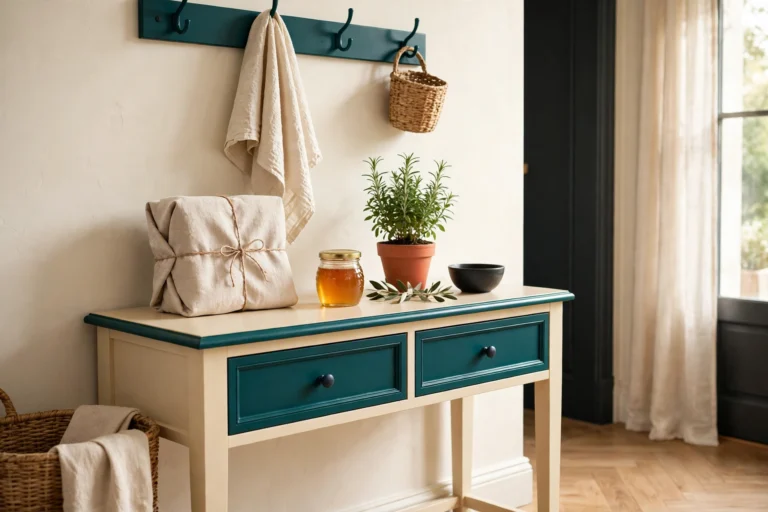
The welcome table holds four things and nothing else: a small stack of napkins, a pen for the guest list or card, a small vase or plant, and a basket for sunglasses and sunscreen. That is the whole table. It is not a second food station and it is not a drink station. The moment it collects anything else, it stops being a welcome table and starts being a pile.
The gate rule is simple: guests enter through the party gate and leave through the party gate. If the yard has a side gate that guests naturally drift toward, close it for the afternoon and put a small note on it. One gate means the host always knows where the party is — and where it is not.
Shoes and bags need one home, decided before the first guest arrives. A low bench by the gate, a row of hooks on the fence, or a single basket per family — pick one and point everyone to it. The rule is written into the system: a thing in the wrong zone is moved the same day. A bag on the food table is a bag in the wrong zone.
Zone 1 is also where the party’s flow is set. Guests who arrive to a clear gate, a calm table and an obvious place for their things relax in thirty seconds. Guests who arrive to a jammed porch spend the first hour apologising for being in the way. The welcome is the zone.
Zone 2 — Drink station: one station, self-serve
Zone 2 is the station that saves the host’s afternoon. One self-serve drink station, in one place, and nobody opens the host’s fridge. The host is not the bartender — that is the whole point of the zone.
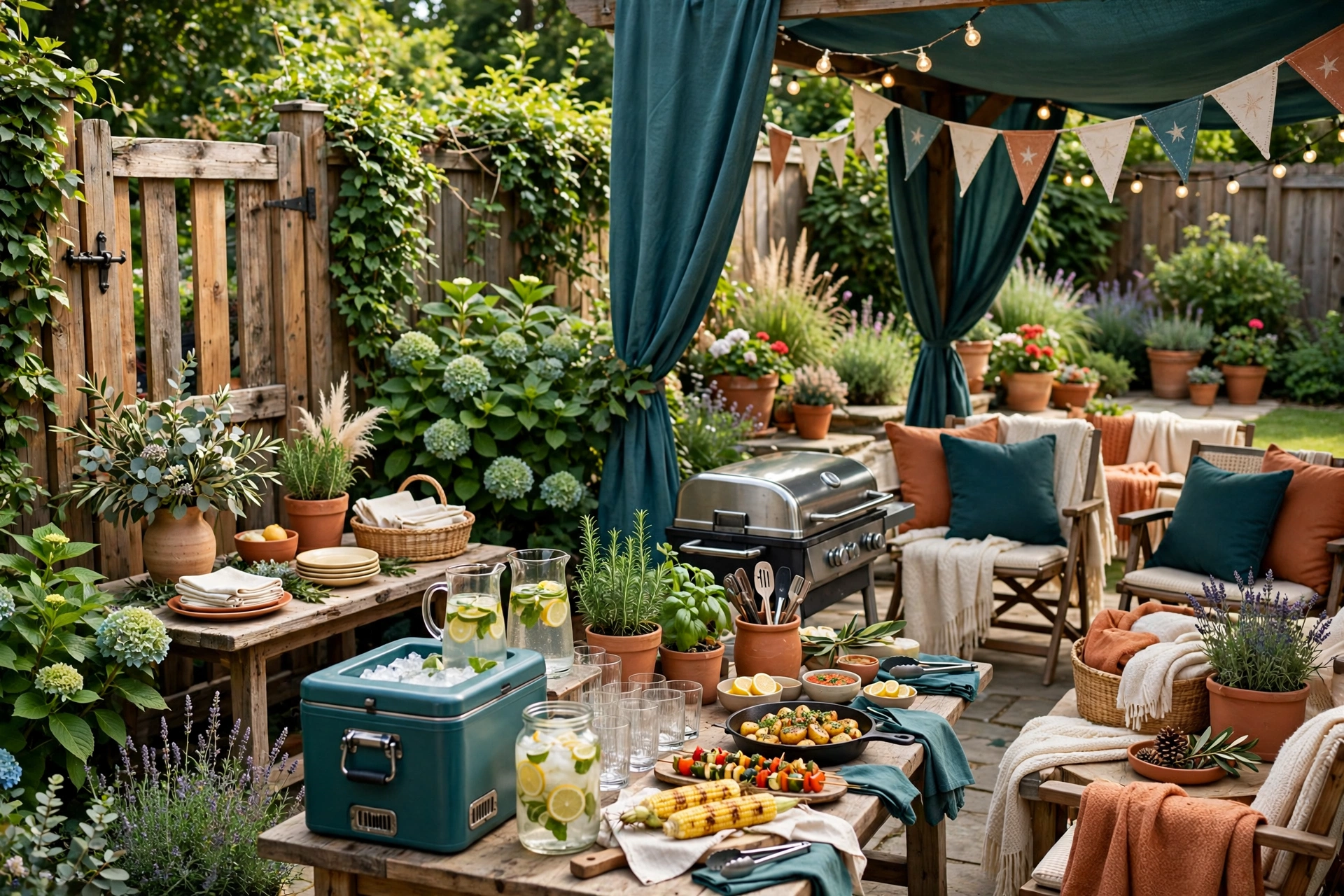
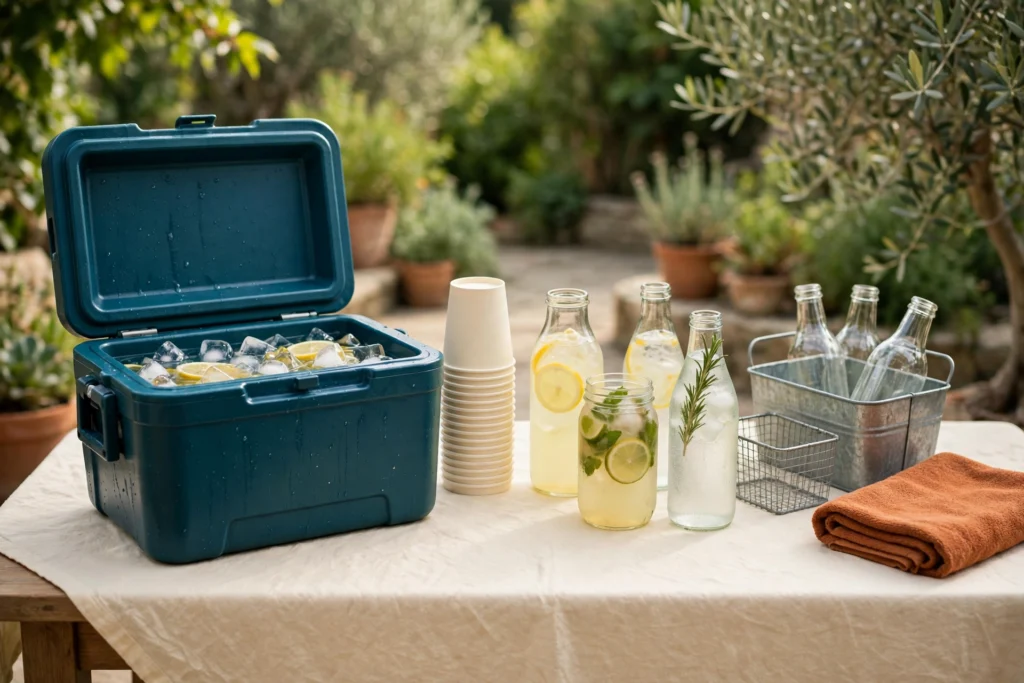
The station holds five things: a cooler or tub of ice in one place, cups in one stack, the drinks themselves, a small bin for empties, and a towel. Ice lives in one place only. The moment ice appears in a second spot, guests start wandering, and wandering guests are guests the host has to redirect.
The drink rule is the strictest in the system: the station serves itself. A guest walks to the station, takes a cup, takes a drink, drops the empty in the bin, and walks back to the party. Nobody goes inside for a glass, nobody asks the host where the cups are, nobody opens a fridge that is not theirs to open. If a guest does ask, the answer is one sentence — “the drink station is by the gate” — and the system does the rest.
Keep the station in the shade and near the food line, but never in the food line. A drink station inside the food line is a queue inside a queue, and a queue inside a queue is a jam. The station stands beside the line, close enough that a guest can hold a plate in one hand and a cup in the other, far enough that the two lines never merge.
The bin matters more than it looks. One bin for empties, emptied once mid-party, keeps cups off the lawn, off the tables and out of the flower beds. A party with no bin is a party the host cleans for an hour after dark. A party with a bin is a party that packs away in twenty minutes.
Zone 3 — Food line: one main, two stations, no jam
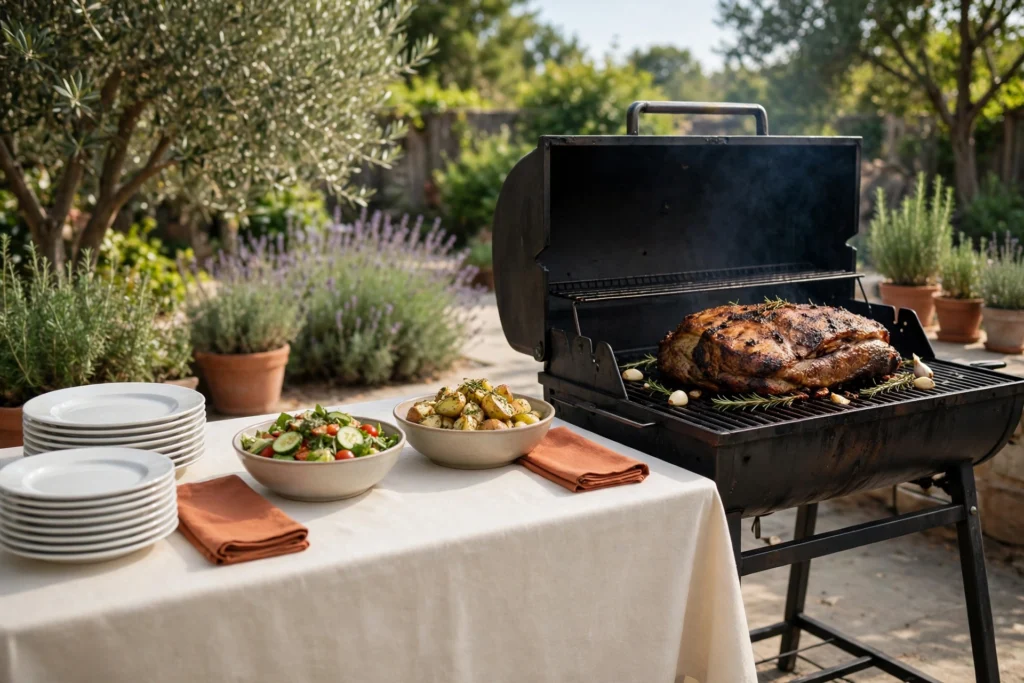
Zone 3 is the heart of the party, and it runs on the one-main rule: one main dish carries the food line, and everything else is a station, never a second main. The grill is the main. The two stations sit beside it — one cold, one simple — and the line moves in one direction.
Pick the main first, then stop. A grill main means burgers, chicken or skewers — one of them, not all three. The moment a second main joins the grill, the grill jams, the cook stops talking to guests, and the food line becomes a wait. One main, cooked in batches, served as it comes off the grill. That is the whole main.
The two stations are named by their job, not by their recipes. Station one is cold: the salads, the fruit, the things that sit in a bowl and wait patiently. Station two is simple: the bread, the chips, the things a guest grabs with one hand. Food is named here only as station contents — this post is a hosting system, not a recipe list, and the system works with any main and any two stations.
The line itself is laid out in serving order: plates first, then the main, then station one, then station two, then napkins and cutlery at the end. A guest picks up a plate, walks the line, and sits down with a full plate and nothing missing. The cutlery goes last for a reason — a guest holding cutlery at the start of the line has no free hand for the rest of it.
The grill gets a boundary too: one person runs it, or the host runs it in timed batches. A grill with three cooks is a grill with no cook. The host grills for twenty minutes, then steps away, then grills for twenty more — the food line never stops, and the host still gets to be a guest.
Zone 4 — Shade zone: the party’s calm corner
Zone 4 is the zone every outdoor party forgets until the hottest hour — and then it is the only zone anyone wants. One shaded rest spot, chairs and blankets in one place, the party’s calm corner.
Pick the shade first, not last. A tree, a canopy, the shadow side of the house — one spot, claimed before the party starts, with chairs set out and a basket of blankets beside them. The shade zone is not the leftover corner after the food line and the drink station take the good spots. It is chosen first, because at two in the afternoon it is the most valuable real estate in the yard.
The shade rule is simple: the shade zone is for resting, not for storing. It is never used for storage, never used for the food line, never used as the place where the extra chairs pile up. A shade zone that collects boxes stops being a rest spot and starts being a shed. Chairs, blankets, and a small table for drinks — that is the whole zone.
This is also the zone that keeps the party long. Guests who can sit in the shade stay for the fireworks. Guests who have nowhere cool to sit leave at four o’clock, tired and sunburnt. The shade zone is not decoration. It is the reason the party lasts until dark.
Keep one blanket per chair in the basket, and keep the basket in the shade zone, not in the house. A guest who feels a chill at dusk takes a blanket from the basket and stays. A guest who has to go inside for a blanket does not come back out.
Zone 5 — Pack-away: everything in by dark
Zone 5 is the rule that makes the whole system worth it: everything in by dark, one box per zone, before the fireworks. The party ends calm, not cluttered — and the host watches the sky instead of carrying things inside.
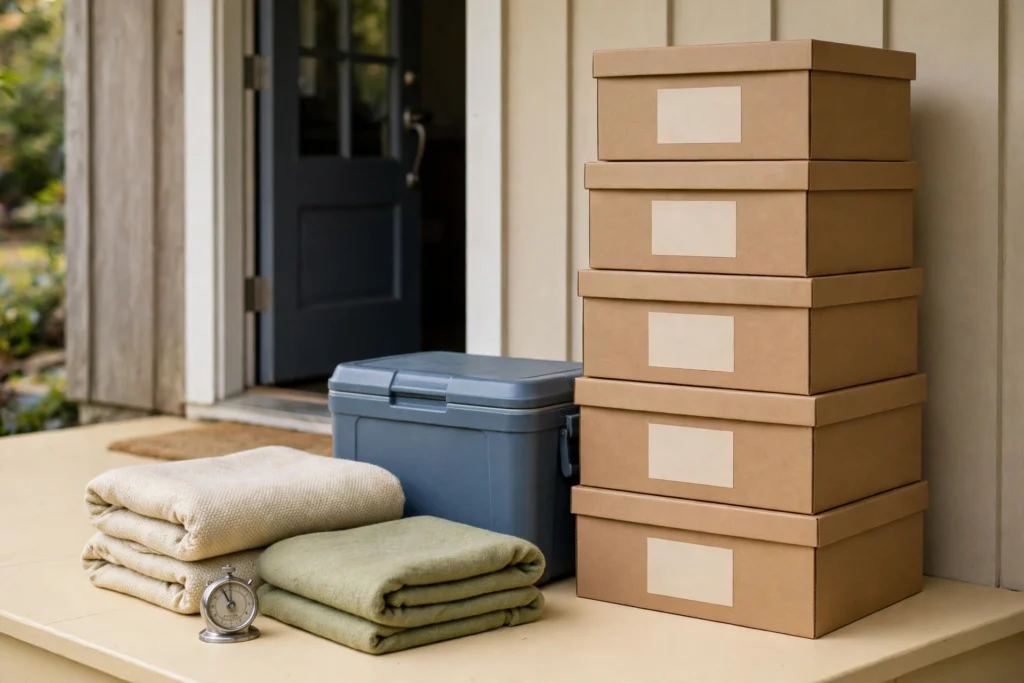
The pack-away boxes are ready before the party starts: one box per zone, labeled by zone, stacked by the back door. Arrival box, drink-station box, food-line box, shade-zone box. When the pack-away hour comes, each zone is cleared into its own box — no sorting, no decisions, no “where does this go”. A thing in the wrong box is a thing in the wrong zone, and the zones only work if they stay honest.
The pack-away hour is decided in advance: one hour before dark. Not “when the party winds down”, not “after the fireworks” — one hour before dark, written into the timeline. At that hour, the food line closes, the drink station is drained, the shade chairs are folded, and the boxes are filled. The party does not end. The party moves — to the front lawn, to the blankets, to the sky — with nothing left behind it.
Leftovers go in one cooler, not five containers scattered across the kitchen. The cooler is the only leftover zone. A guest who wants to take food home takes it from the cooler, in one container, and leaves. The host does not spend the night matching lids to boxes.
The fireworks rule is the last line of the system: when the first firework goes up, the host’s hands are empty. No carrying, no clearing, no “just one more trip inside”. The boxes are in, the cooler is shut, the lawn is clear, and the host is sitting down. That is what the system is for.
The one-main rule, the day-before timeline, and the weather backup
Three rules hold the five zones together.
One main, or the grill jams. One main dish carries the food line; everything else is a station, never a second main. This is the rule that protects the host’s afternoon: a second main doubles the cooking, halves the conversation, and turns the host into a short-order cook. One main, two stations, one line.
The day-before timeline. The party is planned backwards from the day. The day before: zones are set — the gate table is out, the drink station is placed, the shade chairs are set, the pack-away boxes are labeled and stacked. The morning of: the food line is laid out, the ice goes in the cooler, the main is prepped. The party itself: the host follows the zones instead of improvising. The same night, before the fireworks: pack-away, one box per zone. A party with a timeline is a party the host enjoys. A party without one is a party the host survives.
The indoor-backup zone. One room stays clear as the weather fallback, so a storm moves the party inside without a re-plan. The room is never used for storage before the party — no boxes, no extra chairs, no “just for now” pile. If the sky turns, the food line moves to the kitchen counter, the drink station moves to the table, the shade zone becomes the living room, and the party goes on in the same zone order. Rain is not a cancellation. It is a relocation, decided in advance.
The free printable: your zone map + day-before timeline
The system fits on one page. The free printable for this post is the outdoor zone map plus the day-before timeline: the five zones with their one-line rules, the one-main rule, and the pack-away-by-dark hour — everything above, in the order you will use it.
Print it the day before the party and walk the yard with it once. Mark the gate, mark the drink station, mark the shade, stack the boxes. The walk takes ten minutes. It is the difference between a party that runs itself and a party that runs the host.
The challenge is the same one this blog always sets: run the system once, exactly as written, for one party. One gate, one drink station, one main, one shade spot, everything in by dark. Then keep the parts that worked and tell the next party what they were. The system is not a performance. It is a habit — and habits are what a calm house is made of.
FAQ
What is the 4th of July hosting system?
Five outdoor zones (arrival, drink station, food line, shade zone, pack-away), one main dish, a day-before timeline and an indoor-backup zone for weather — built for Independence Day, Sunday 4 July 2027.
How do I set up a 4th of July party outside?
By zone, not by ideas list: one gate and welcome table, one self-serve drink station, one food line, one shaded rest spot, and pack-away boxes ready before dark.
What is the one-main rule?
One main dish carries the food line; everything else is a station, never a second main — so the grill never jams.
What if it rains on the 4th of July?
The indoor-backup zone — one room kept clear — takes the party inside without a re-plan.
How is this different from the other party posts?
#113 is a graduation open house, #102 is game-day, #106 is Easter brunch, #100 is Galentine’s and #53 is Friendsmas — this one is the outdoor Independence Day system, with a drink station, a shade zone and a pack-away-by-dark rule no other party post has.
What is the day-before timeline?
The party planned backwards from the day: zones set the day before, food line the morning of, pack-