

The 2027 Declutter Challenge: 2,027 Items, One Counting System
January is the month decluttering comes back. The Declutter Hub’s hosts put it plainly in their plan-2026 episode: they are “kind of in demand in January every year,” and “in January is the peak of our popularity.” That is the honest evidence level for this post — a recurring seasonal peak, reported as a seasonal peak, not a percentage spike. People do not need convincing in January. They need a system that is still working in March, when the January energy has gone and the house still has too much in it.
This is the 2027 declutter challenge: one number, counted all year. Declutter 2,027 items in 2027 — the same number as the year — and count every single one. About six items a day. Thirty-nine a week. A running total on one tracker sheet, a room rotation that tells you where to look, and one rule that keeps the whole thing honest: an item only counts when it has left the house. This post’s counting rules, its weekly target, its room rotation, and its tracker are this post’s own system rules, labeled as such throughout. The counting-challenge idea itself is credited below, to the people who ran it first.
This post is honest about where it sits, because we already have three posts that sound close, and they do different jobs. Our 31-day January declutter challenge is the sprint version: one small mission a day for 31 days, 15 to 20 minutes each, with catch-up Sundays. Our how to declutter your home post tests three viral methods on one closet and picks the right method for the closet in front of you. Our 12-12-12 method is the ten-minute round: 12 to throw away, 12 to donate, 12 to return home. The 2027 declutter challenge is none of those. It is the year version: no finish line in February, no method to choose, just one number, counted daily, until the year ends 2,027 items lighter.
Where the Counting Idea Comes From
Credit where it is due. The “declutter the same number of items as the year” challenge is an established genre, and this post adapts it for 2027 rather than inventing it. Laura Noelle writes that she learned the challenge from another minimalist blogger in 2023, and that she used that blogger’s tracker for her first three years before making her own. Her own account, reported here as one person’s result and not as a promise: 2,818 items in 2023, 2,024 in 2024, and 2,025 in 2025 — over 6,800 items in three years. Her version’s rule is the one this post keeps: in 2026, declutter 2,026 items, because that is the number of the year. Nourishing Minimalism runs the same genre as its annual “2026 in 2026” challenge, with a free tally chart, and the same daily maths: five to six items a day, or about 40 items each weekend. SpendWiseCents describes the same challenge the same way: 2,026 items, about 39 a week, tracked on a tally chart.
So the 2027 declutter challenge is the next year of an existing challenge, with this post’s own counting rules, rotation, and tracker built around it. The number is not magic. The number is a finish line you can see from January, and a daily job small enough to do on a tired Tuesday. Six items. One drawer. Fifteen minutes. Counted.
The Maths: 2,027 Items, 39 a Week, 27 Rest Days
The 2027 declutter challenge runs on three numbers, and all three are this post’s system rules. Learn them once, and the year runs itself.
2,027 items in total. One for every unit of the year 2027. Not 2,000, not “about two thousand” — 2,027, because the exact number is the point. An exact number can be counted. A round number gets estimated, and estimated challenges die quietly in April.
39 items a week. 2,027 divided by 52 weeks is 38.98, so the weekly target is 39. Weeks are the unit that matters, not days: a week forgives a bad Tuesday and still ends on target. Hit 39 by Sunday night and the week is done, however the days inside it went.
Six a day, with 27 rest days. Six items a day for 338 days is 2,028 — one over the target, which is the one-item margin this system keeps on purpose. A year has 365 days, so 338 counting days leaves 27 rest days: holidays, sick days, travel, the weeks life falls apart. Laura Noelle’s version makes the same point for 2026: six a day completes the challenge with 27 days off built in. Rest days are not failures in the 2027 declutter challenge. They are budgeted. Take one, mark it on the tracker, and the maths still works. Take all 27 and the maths still works. Take a 28th and the Saturday sweep below earns it back.
That is the whole arithmetic of the 2027 declutter challenge. Nothing else to calculate, ever. Open the tracker, look at the running total, look at the week number, and you know exactly where you stand: on pace, ahead, or one sweep behind.
The Counting Rules: What Counts, and What Does Not
A counting challenge lives or dies on its counting rules. Loose rules turn into guesswork by February — “about a bag,” “roughly a drawer” — and guesswork cannot be trusted, so the tracker gets abandoned. These seven rules are this post’s own rules for the 2027 declutter challenge. They are strict on purpose, and strict is what makes counting satisfying.
- An item counts only when it leaves the house. Trash out, donation bag dropped off, recycling collected, item returned to its owner. An item sitting in a bag by the door does not count yet. This is the rule the whole challenge stands on.
- Count physical items, one by one. A drawer of 23 pens is 23 items, not “a drawer.” A pair of socks is two. A stack of 14 magazines is 14. If you cannot count it, open it and count it. No estimating bulk bags.
- Rehoming inside the house does not count. Moving the scissors from the bedroom to the kitchen drawer is tidying, and tidying is good — but it does not reduce the total, so it does not count toward 2,027. The 12-12-12 method’s “return home” round is a fine ten-minute reset; it is simply not a counted item here.
- Broken, expired, and genuinely unusable items count. Trash counts. The challenge is about fewer items in the house, not about donating everything. Expired pantry jars, dead batteries, dried pens, and stained rags are all counted items once they are in the outside bin.
- Duplicates count fast, and that is the point. Three nearly-empty ketchups, five phone chargers for phones nobody owns, four spatulas: duplicates are the easiest honest count in the house, and the first month of the 2027 declutter challenge is mostly duplicates. Let it be easy early. Easy early builds the habit.
- One item, one count, one home. Nothing counts twice. If an item leaves and comes back — a borrowed book returned to you, a donation bag retrieved — it un-counts. Cross it off the tracker. The tracker tells the truth or it tells nothing.
- The 48-hour bag rule. Every donate bag leaves the house within 48 hours of being filled: in the car, at the drop-off, handed to its new owner. A bag that stays becomes furniture, and furniture does not count. This post borrows the rule’s spirit from the 12-12-12 method’s “do it immediately” close, and makes it a counted-challenge deadline: un-dropped bags do not count until they are gone.
Seven rules. Write them on the back of the tracker. When a counting question comes up mid-year — and it will, usually about a box of cables — the answer is in the seven rules, not in a feeling.
The Weekly Room Rotation: Where the 39 Come From
Counting without a rotation turns into hunting the same easy drawer every week. The 2027 declutter challenge rotates rooms on a four-week cycle, repeated thirteen times, so every zone gets thirteen visits in the year and no zone gets forgotten. This rotation is this post’s own system.
Week A — Kitchen and pantry. Expired, duplicate, chipped, lidless. The kitchen is the highest-count room in the house and the best first week of every cycle: it proves the maths fast.
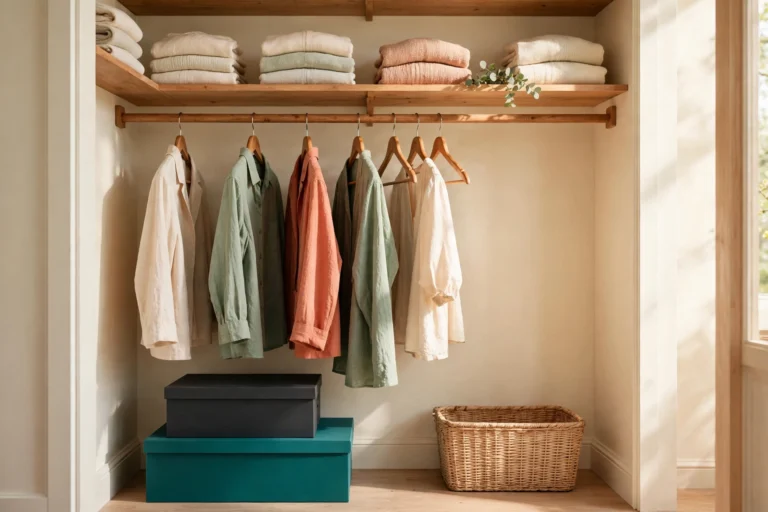
Week B — Closet and bedroom. The closet edit feeds the winter capsule system in our winter closet post: unworn, ill-fitting, stretched, single socks. One rail section or one drawer a day, never the whole closet at once.
Week C — Bathroom and paper. Expired medicines and sunscreens (check local take-back rules for medicines), half-empty bottles, dried products — then one paper stack: act, file, or shred. Paper counts item by item too: 30 old statements are 30 items.
Week D — Living, entry, and storage. Surfaces, the entryway pile, one storage box or shelf. Week D is the roaming week: whatever zone has been nagging you, plus the storage area that never makes the weekly list on its own.
Every thirteenth week — catch-up and audit. No new room. Finish any zone left short, re-count the tracker, check the running total against the pace line, and drop every outstanding bag. Four catch-up weeks a year, built in, so a bad month never needs a heroic month to fix it.
Six items a day inside one week’s zone is a small job: one shelf, one drawer, one rail section. The rotation removes the only question that kills daily challenges — “where do I even look?” — and replaces it with an answer written down in advance.
The Daily Rhythm: 15 Minutes, One Drawer, One Count
The 2027 declutter challenge asks for fifteen minutes a day, not an hour. Fifteen minutes is the unit because fifteen minutes survives real weeks: work, children, illness, guests. An hour-a-day challenge is a January challenge. A fifteen-minute challenge is a year challenge.
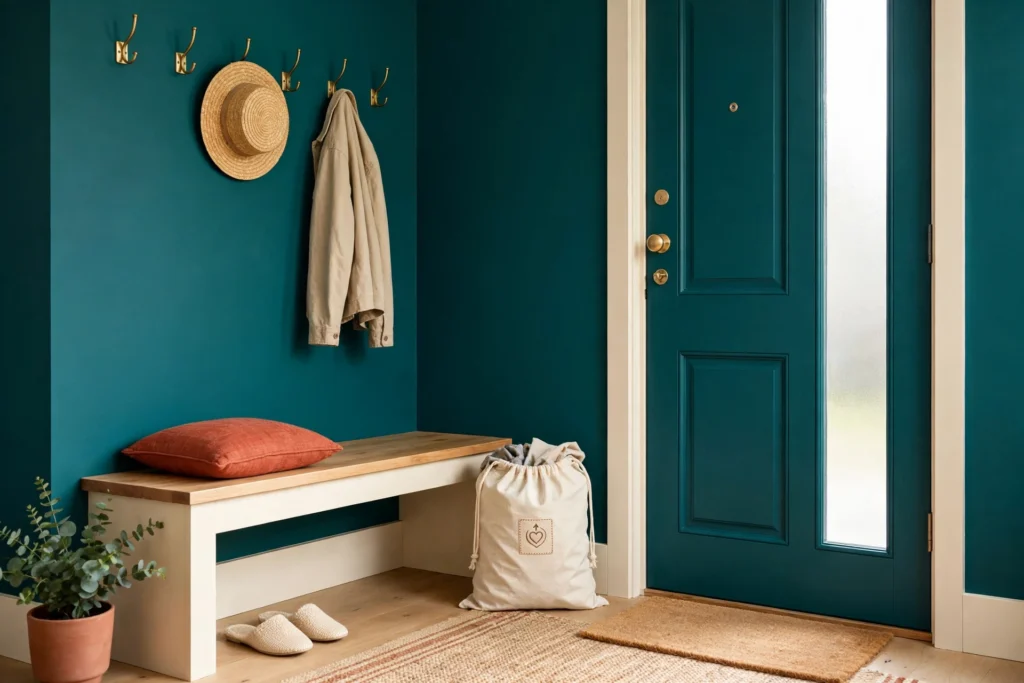
The rhythm has three parts, all this post’s system rules. Weekdays: six items, one zone, timer on. Pick the week’s zone, open one drawer or shelf, find six counted items, bag them, write the number on the tracker. Timer off at fifteen minutes whether you found six or not — if you found four, the week still has days left in it. Saturdays: the sweep. Twenty items, one bigger job: a whole shelf, a whole rail section, the top of the closet. The sweep is how the challenge banks ahead: one Saturday sweep covers more than three weekdays, and a banked week is a calm week. Sundays: the count. Two minutes, no decluttering: add the week’s total, write the running total, check it against the pace line (week number times 39), and mark rest days taken. Sunday is the only day the tracker gets touched without a bag in hand, and that separation is deliberate: counting is a ritual, not an afterthought.
If a week ends short — 31 instead of 39 — the rule is simple: add one sweep the following Saturday, never double a weekday. Doubled days burn people out. Sweeps are the pressure valve. The 2027 declutter challenge is designed to be caught up in one Saturday, at any point in the year, from any deficit short of a lost month. A lost month is what the thirteenth-week audit is for.

The Free Printable: The 52-Week Count Tracker
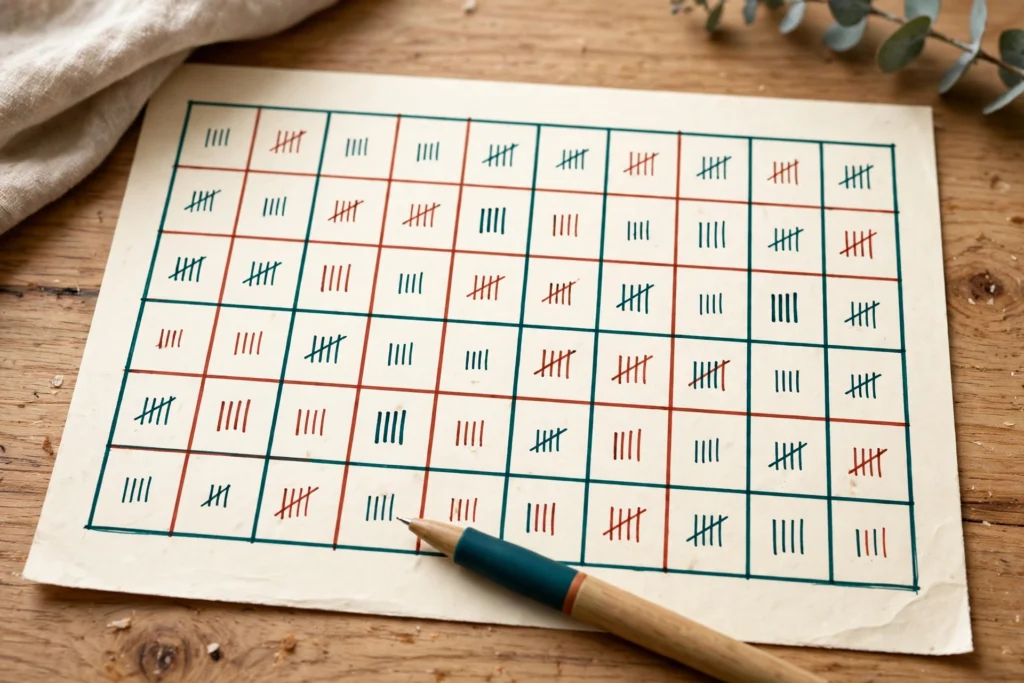
One sheet, four sections, and the only tool the 2027 declutter challenge needs. The top carries the three numbers: 2,027 total, 39 a week, six a day with 27 rest days. The middle is the 52-week grid: one row per week, with columns for the week’s zone (A, B, C, or D), the week’s count, the running total, and rest days taken. Milestone lines sit at 500, 1,000, 1,500, and 2,027, so the running total crosses a visible line four times in the year. The bottom carries the seven counting rules in one line each, and a bag-out log: date filled, date dropped, items counted — the 48-hour rule made visible. Print it, pin it where the bags live, and write on it with a pen. The tracker is the challenge. A phone note is not the same: the sheet on the wall is seen every day, and seen totals get finished.
What to Do When the Count Stalls
Every counting challenge stalls, usually twice: once in late February, when the easy duplicates are gone, and once in the summer, when the house is busy and the tracker is boring. The 2027 declutter challenge has a stall rule for each, and both are this post’s system rules.
The February stall means the easy counts are done and the remaining items need decisions. The fix is a decision shortcut, borrowed from the methods post: if you have not used it, worn it, or opened it in a year, and it has no assigned job this month, it counts out. No “maybe someday” hearings. One question, one answer, one bag. February is also the month to run a 12-12-12 round inside the week’s zone: 36 items in ten minutes, counted, and the stall breaks on arithmetic.
The summer stall means the tracker has not been touched in two weeks and the number feels accusing. The fix is a reset week, not a restart: pick the current week’s zone, do one fifteen-minute session, count whatever it yields, and write the running total as it stands — no back-filling, no guessing the missed weeks. The tracker restarts from the truth, not from zero. Restarting from zero is how challenges die twice. The 2027 declutter challenge has no restart. It has a next session.
If the stall is longer — a month gone, bags un-dropped, tracker buried — use the thirteenth-week audit early: one sweep, one bag-out run, one honest running total. Then resume the rotation where the calendar says, not where you left off. The year does not wait, and neither does the count. That sounds harsh, and it is meant kindly: the challenge that forgives a missed month and keeps going is the challenge that finishes.
Frequently Asked Questions
What is the 2027 declutter challenge?
The 2027 declutter challenge is a year-long counting system: declutter 2,027 items in 2027, the same number as the year, counted one by one, with a weekly target of 39 items, a daily pace of about six items, 27 rest days built in, a four-week room rotation, and a 48-hour rule for donate bags. An item counts only when it has left the house. The counting rules, rotation, and tracker are this post’s own system, adapting the established counting-challenge genre credited in the Sources.
How is the 2027 declutter challenge different from the 31-day January challenge and the 12-12-12 method?
The 31-day January declutter challenge is a sprint: one small mission a day for 31 days, 15 to 20 minutes each, with catch-up Sundays. The 12-12-12 method is a ten-minute round: 12 to throw away, 12 to donate, 12 to return home, repeatable per room. The 2027 declutter challenge is the year version: one number, counted daily for 52 weeks, with a room rotation and a running total. Different length, different promise — the sprint finishes in a month, the round finishes in ten minutes, the count finishes at 2,027.
What counts toward the 2,027 items?
Any physical item that leaves the house: trash, donations, recycling, and items returned to their owners. Count items one by one — 23 pens are 23 items, a pair of socks is two. Rehoming inside the house does not count, nothing counts twice, and a donate bag counts only once it has left the house within 48 hours. Broken and expired items count: the challenge is about fewer items in the house, not about donating everything.
What if I fall behind or miss a whole month?
Catch up with one Saturday sweep the following week — 20 items, one bigger job — and never double a weekday to catch up. If a whole month is lost, use a catch-up audit week early: one sweep, one bag-out run, one honest running total, then resume the rotation where the calendar says. Never restart from zero: the 2027 declutter challenge has no restart, only a next session.
Do I need to buy anything for the 2027 declutter challenge?
No. The challenge needs bags or boxes the house already has, a pen, and the free one-page 52-week tracker. Nothing in the counting rules, the rotation, or the daily rhythm requires a purchase — organizing products come after the count, only for what survives it, and only if a zone still needs them.
Related Reading
- The 31-Day January Declutter Challenge: A Fresh Start, One Day at a Time — the sprint version: one small mission a day for 31 days, 15 to 20 minutes each, with catch-up Sundays. Do the sprint in January, then keep counting all year here.
- How to Declutter Your Home: 3 Viral Methods Tested on One Closet — the methods test: which viral method wins on one closet, and the 7-day test that picks your method when a zone needs decisions, not just counting.
- The 12-12-12 Method: 36 Items Gone in ~10 Minutes — the ten-minute round: 12 to throw away, 12 to donate, 12 to return home. Run a round inside the week’s zone when the count stalls — 36 counted items, one timer.
Sources
- Batch 12 brief #88, viral-topics-batch12-2026-10-30.md — 2027 counting-challenge system angle (2,027 items, daily count, weekly room rotation, 48-hour donate-bag rule, 52-week tracker printable); counting-challenge genre evidence and January-peak timing; overlap check against #83, #60/#82, and #81. No invented statistics, percentages, or studies are claimed in this post.
- The Declutter Hub, “Start as you mean to go on — plan 2026 for decluttering success,” https://declutterhub.com/plan-2026/ — January as the recurring peak of decluttering demand (“in January is the peak of our popularity”) and the Reset Your Home challenge running in early January.
- Laura Noelle, “Declutter 2026 Items in 2026,” https://www.lauranoelle.com/declutter-2026-items-in-2026/ — the counting-challenge concept (declutter the same number of items as the year), her three-year account reported as one person’s result (2,818 in 2023, 2,024 in 2024, 2,025 in 2025, over 6,800 in three years), and the six-a-day maths with 27 days off. Credit: she notes she learned the challenge from another minimalist blogger in 2023.
- Nourishing Minimalism, “2026 in 2026 Decluttering Challenge,” https://nourishingminimalism.com/2026-in-2026/ — the annual counting challenge with a free tally chart; 2,026 items, five to six items a day or about 40 each weekend.
- The 31-day January declutter challenge (blog #33), https://clutterandcalm.com/january-declutter-challenge/ — the sprint version this post differentiates from. The 12-12-12 method (blog #9), https://clutterandcalm.com/12-12-12-method/ — the ten-minute round. How to declutter your home (blog #83), https://clutterandcalm.com/how-to-declutter-your-home/ — the methods test. The counting rules, weekly target, room rotation, daily rhythm, stall rules, and tracker described here are this post’s own system rules, labeled as such throughout.




One Comment