

The Winter Entryway Drop-Zone Reset: Four Jobs at the Door, One Bay Per Person
Winter is when the entryway stops being a hallway and starts being a pile. Coats come in wet, boots come in muddy, bags land wherever a hand lets go of them, and keys vanish into the pocket of whichever coat you are not wearing. In summer the same space forgives you — one jacket, one pair of sandals, nothing wet. In winter it does not. The entryway is the smallest room in the house and the one that has to work the hardest, and most of them fail for the same reason: they were never given a job description.
This post gives the door a system. A drop zone does four jobs and only four: sit, shoes, hang, keys. A place to sit while boots come off. A place for wet shoes to dry that is not the floor. A place for today’s coat and bag to hang. A place for keys, sunglasses, and wallet to land every single time. Everything else — the mail, the returns, the dog lead, the spare umbrella — either earns a named spot inside one of those four jobs or it does not live at the door at all. One bay per person, a boot tray for wet winter shoes, a tray or dish for keys, and one bin for mail and returns. It takes an afternoon to set up and sixty seconds a night to keep.
This is not a styling post, and the batch-9 entryway-decor signal is not claimed for it. It is an organization system for the zone where winter enters the house — and deliberately not three posts you may already know. Our January command center (https://clutterandcalm.com/new-year-reset-organization/) is the wall station inside the house, and this door zone feeds it: the mail that lands in the drop-zone bin gets sorted at the command center, not at the door. Our winter capsule (https://clutterandcalm.com/closet-organization-ideas/) decides which coats you own; this post decides which of them hang at the door — the daily ones only. And our Sunday reset routine (https://clutterandcalm.com/sunday-reset-routine/) is the weekly ten-minute reset that keeps every system in the house working, including this one.
The Four Jobs: Sit, Shoes, Hang, Keys
Before you buy a hook or move a bench, name the four jobs and give each one a spot. This is the map, and the map comes first because a drop zone built without one becomes a shelf with good intentions.
Sit. Somewhere to sit while boots come off — a bench, a sturdy stool, a low cube. If there is no room for a seat, the wall or doorframe becomes the lean-and-pull spot, with the boot tray directly below it. A person who can sit down takes their boots off at the door. A person who cannot, does not.
Shoes. Wet winter shoes need a tray, not a floor and not a rug. A boot tray with a raised edge, big enough for the household’s daily pairs, placed where the boots actually come off. Shoes live in the tray or in their bay slot, never loose on the floor beside the tray. A tray that overflows has stopped working, and the fix is fewer pairs at the door, not a bigger tray.
Hang. One hook rail for daily coats and bags. Daily means the coat you wore today and will wear tomorrow. Off-season coats, the formal coat, the coat you wear twice a year — those live in the closet, and the closet post linked above is where they get edited. Hooks hold daily coats and bags only. That rule keeps a hook rail from becoming a second closet.
Keys. A tray or dish on a shelf, a console, or the top of the bench: the landing pad for keys, sunglasses, and wallet. One spot, the same spot, every single time, at hand height on the way in. Keys that always land in the same dish are keys you never hunt for.
Draw the map before you shop: a piece of paper, four boxes, one per job, each labeled with its spot in your actual entryway. The free printable at the end of this post is exactly that map, plus the nightly-reset card. Measure the wall and the floor while you are at it. Nestorafind’s mudroom guide makes the point this post is built on — a mudroom is a system, not a room — and the same guide notes that a drop zone can work in as little as one foot of depth. A small entryway is not a reason to skip the system. It is a reason to measure first and buy second.
One Bay Per Person
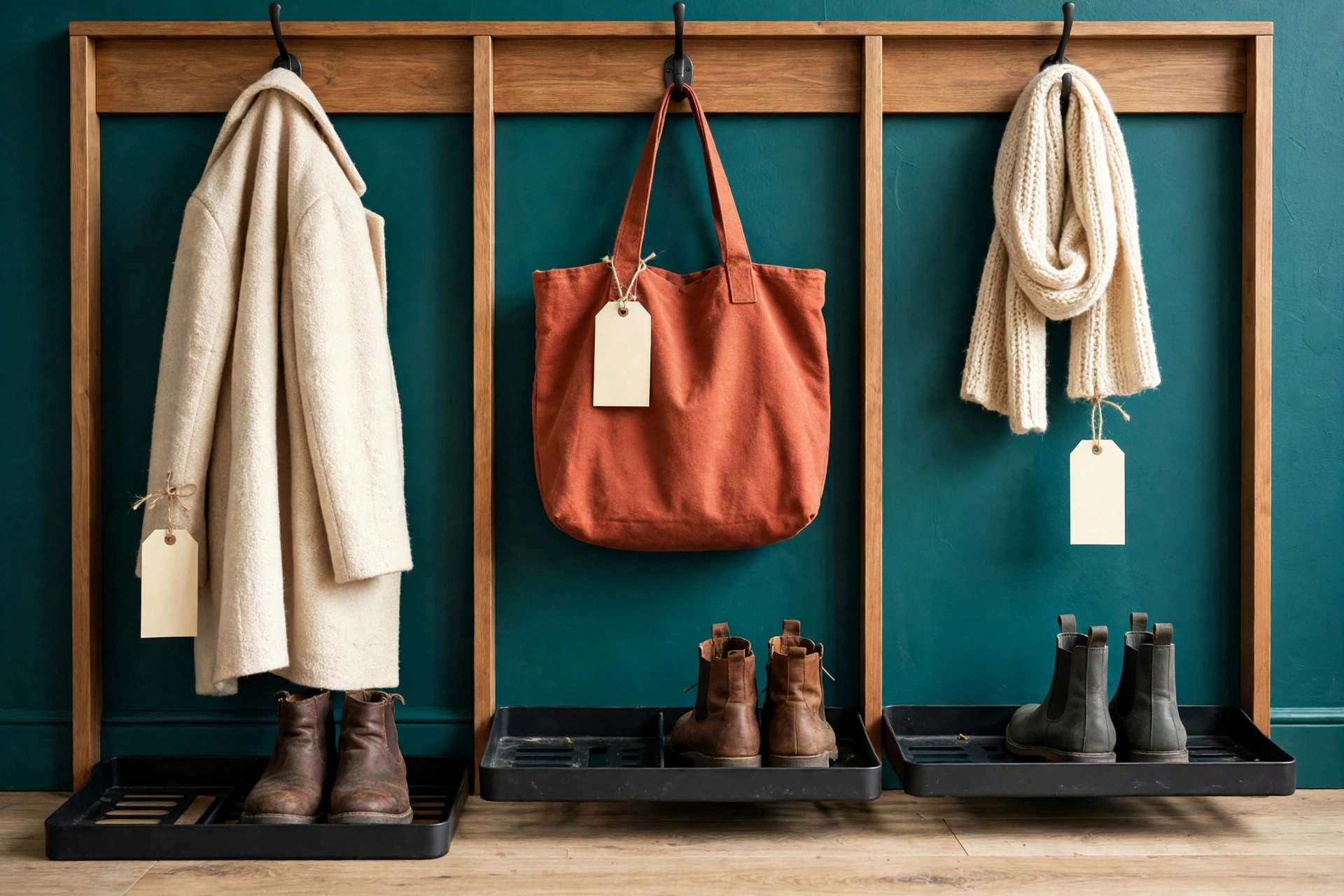
Here is the rule that makes the whole zone work: one bay per person. A bay is a hook (or two), one shoe slot, and one small bin — a named slice of the drop zone that belongs to one person and nobody else.
Count the people who use the door daily, and count the bays honestly. Two adults and two children means four bays, not two generous ones and a hope. If the wall cannot hold four bays, shrink what each bay holds: one daily coat per person, one bag, one pair of daily shoes in the tray. When only daily coats hang at the door, four bays fit on a rail that two bays of overstuffed coats would have filled.
Label the bays, at least at first — a small tag on each hook, a name, an initial, a colour per person. Children especially need a bay they can see is theirs, because a child with a named hook hangs their coat on it and a child with a shared rail drops their coat on the floor. The tag costs nothing and it is the difference between a system and a suggestion. Adults get tags too, for the first two weeks: the habit is built while the tags are on and survives after they come off.
One bay per person also settles the argument about whose mess the pile is. There is no shared pile anymore. There is your bay, my bay, and the floor — and the floor is not a bay. The 60-second nightly reset works because of this rule: resetting four named bays takes a minute, and resetting one communal pile takes a negotiation.
Shoes: The Boot Tray Rule
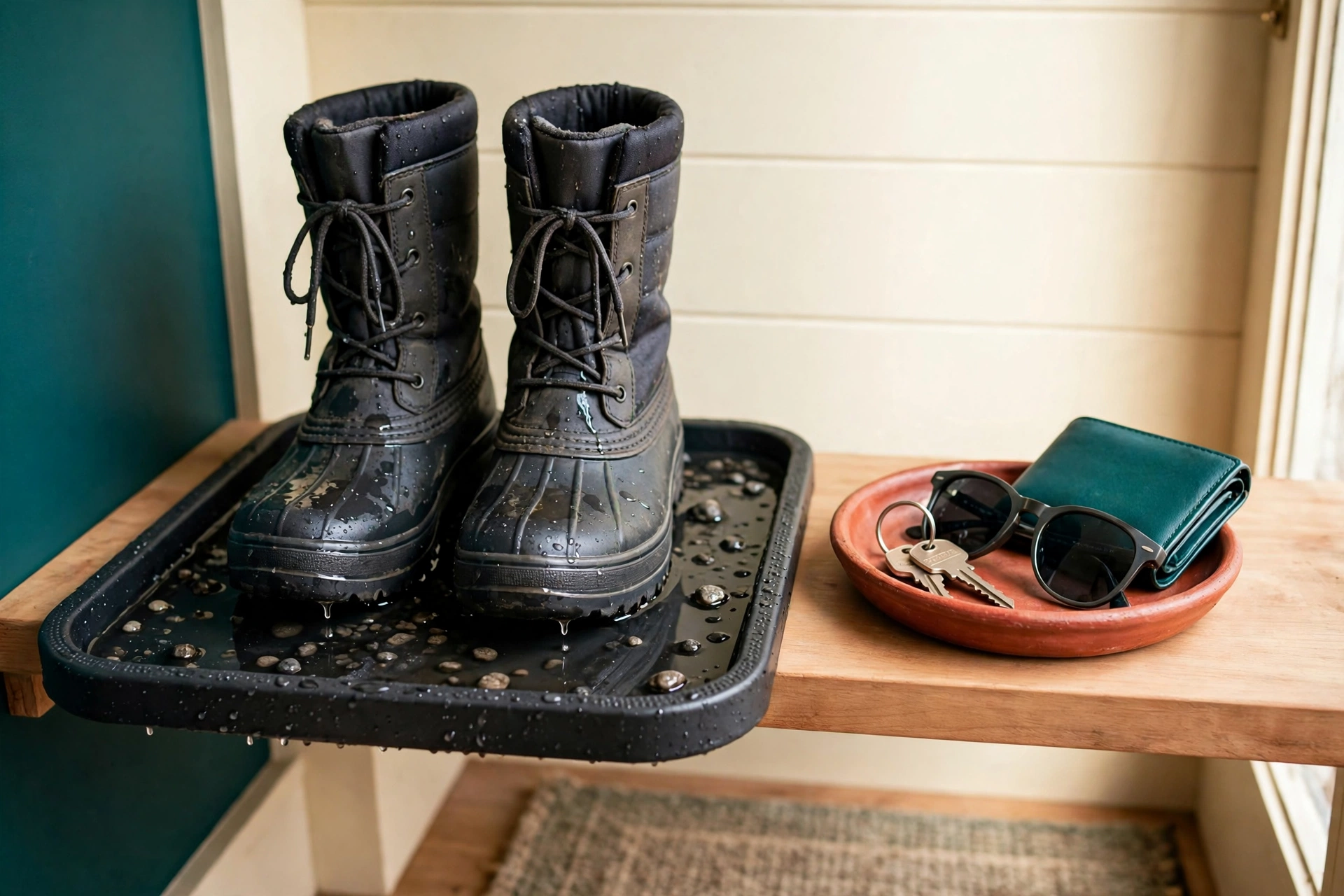
Winter shoes are the messiest job at the door, so they get the strictest rule. Wet shoes go in the boot tray. Dry shoes go in the bay slot. No third option, no “just for tonight” on the bare floor, because the bare floor is where the pile starts and the tray is where it stops.
Size the tray to the household, not to the catalogue photo. Count the daily pairs: one pair per person, plus one spare for the person whose boots are drying from the morning walk. That is the tray’s capacity, and the tray’s capacity is the household’s shoe limit at the door. When the tray is full, a pair moves to the closet. When a pair has not been worn in a week, it moves to the closet.
Put the tray where the boots come off — directly under the sitting spot, or directly inside the door if there is no seat. A tray across the room is a tray nobody uses. If the entryway is a single wall in a small apartment, the tray goes against that wall under the hooks, with the bench beside it rather than in front of it. The Tiny Nest’s small-apartment drop-zone guide, published in October 2026, is built for exactly this situation — a hook rail, a bench, and a boot tray in a small space, with renter-friendly options — and its lesson is the same as this post’s: the tray is the system, and the system fits the space you have.
One pair of daily shoes per person at the door — the second pair lives in the closet and comes out when the first pair is wet through or being cleaned. Two pairs per person at the door is how a tray for four becomes a floor for eight. If your household genuinely needs two pairs at the door, that is two bays’ worth of tray space, counted honestly. What never works is pretending the second pair does not count.
Keys: The Landing Pad
Keys are the smallest job at the door and the one that causes the most daily friction. A lost key costs ten minutes on the worst morning of the week, and the fix costs nothing: a dish, in the same spot, every single time.
The landing pad is a tray or a dish on a shelf, a console, or the top of the bench — wherever a hand naturally falls on the way in. Keys, sunglasses, wallet. That is the whole inventory, not a pocket-emptying station for receipts and coins. Anything else goes to its real home, and the mail goes to the bin in the next section. A landing pad with three items in it is a landing pad. A landing pad with eleven items in it is a junk drawer that happens to be near the door.
If your household has more than one set of keys, the dish holds all of them, side by side, not one set in the dish and one set in a coat pocket. The coat-pocket set is the set that goes missing, because pockets change with coats and the dish does not. House keys, car keys, the spare set — all in the dish, every night. A key hook works too, if it is at the door and every key has its own hook; the difference is habit, not hardware. Pick the one closest to the door handle and enforce it for two weeks. The system that survives two weeks survives the winter.
Mail and Returns: One Bin
Everything that arrives at the door and is not a coat, a shoe, or a key goes in one bin. Mail, parcels, returns, the school form, the thing that needs posting. One bin, by the door — your choice of lid or open top, but one bin only.
The bin has two rules. First, it empties every night, or at least every Sunday, at the command center — the mail gets opened and filed or actioned there, the returns get their envelope and deadline there. Our January command center (https://clutterandcalm.com/new-year-reset-organization/) is where that sorting happens, and our Sunday reset (https://clutterandcalm.com/sunday-reset-routine/) is the weekly rhythm that keeps the bin from becoming a second inbox. A bin that never empties is a pile with walls. Second, nothing else goes in the bin. Not the dog lead, not the spare umbrella, not the bag of donations waiting for the car. The bin is mail and returns only, because a bin with one job is a bin you can empty in two minutes, and a bin with five jobs is a bin you avoid opening.
The Home Channel TV drop-zone guide describes the same four-part shape this post is built on — sit, shoes, hook, and a landing pad — with one bay per person. That shape keeps appearing across the sources credited here because it is the complete list of what actually happens at a door. Sit down, take your shoes off, hang your coat, put your keys down. Everything else at the door is either mail or clutter, and the bin sorts the mail.
The Renter-Friendly Version: No Drilling Required
Renters get the same system, with different hardware. Nothing in this post requires a hole in the wall. Adhesive hooks and rails hold daily coats and bags — rated for the weight, stuck to clean, dry wall or tile, tested with one coat before the whole rail goes up. An over-door rack does the same job on the back of the entry door or a closet door, and it moves with you. A freestanding coat stand does it with no wall at all, though it needs floor space the wall version does not.
The bench becomes a stool or a cube that moves, the boot tray is a tray wherever you put it, and the key dish sits on any shelf or small console you own. The map is the same, the four jobs are the same, the one-bay-per-person rule is the same. Only the fixings change. If a landlord’s rule is the reason the entryway has never had a system, that reason is now gone: adhesive hooks, an over-door rack, and a tray are a complete drop zone, and all three leave with you when you move.
One caution, honestly stated: adhesive hooks fail when overloaded or stuck to dusty or damp surfaces. Clean the spot, let it dry, press firmly, wait the time the packet says, and respect the weight rating — a hook rated for one coat holds one coat.
The 60-Second Nightly Reset
A system that needs a weekend to maintain is a system that dies in week two. The drop zone needs sixty seconds a night, in the same order every night, by whoever comes in last.
Shoes in the tray. Every pair on the floor goes in the tray or its bay slot. Wet boots stay in the tray to dry — that is what it is for — but they sit straight, not in a heap.
Coats on the hook. Every coat on the bench, the chair, or the floor goes on its person’s hook. One coat per hook. If a hook already has a coat on it, the second coat goes to the closet, not on top of the first.
Keys in the dish. Every set, in the dish, now. Check the coat pockets — that is where the missing set is hiding.
Bin check. Anything in the mail bin that can be dealt with in under a minute gets dealt with. The rest waits for the command center.
Floor clear. One look at the floor. If it is clear, the zone is done. If it is not, the thing on it has a bay, a tray, or a home somewhere else, and it goes there now.
Sixty seconds, five moves, in that order. Do it for seven nights and it stops being a task and starts being the way you come in. That is the challenge below: seven nights, sixty seconds each, and on the seventh night the zone looks the way it looked on the day you set it up. If it does not, the failure is specific — one bay is over capacity, one rule is being broken, one item has no home — and the fix is specific too.
The weekly reset keeps the nightly one honest. Our Sunday reset routine (https://clutterandcalm.com/sunday-reset-routine/) runs ten minutes a week across the whole house, and the drop zone is one of its zones: the bin empties properly, the tray gets wiped, any coat not worn in a week goes back to the closet, and the bays get their tags checked. Nightly keeps it working. Weekly keeps it true.
The 7-Day Drop-Zone Challenge
Set the zone up on a Saturday, when you have an afternoon and the house is quiet enough to measure a wall. Then run the challenge: seven nights, sixty seconds each, starting that same evening.
Day 1 — Map and measure. Draw the map, measure the wall and the floor, count the bays. Buy nothing yet. Day 2 — Hooks and bench. Rail or hooks up, bench or stool in place, tags on the bays. Daily coats only. Day 3 — Tray and dish. Boot tray under the sitting spot, key dish at hand height. Every daily shoe in the tray or its slot; every key set in the dish. Day 4 — The bin. One bin for mail and returns, by the door. Everything else that was living at the door goes to its real home today. Day 5 — The coat edit. Any coat on a hook not worn this week goes to the closet. The hooks should have air between them tonight. Day 6 — The first full reset. Run the sixty seconds, in order, and time it. If it takes more than two minutes, something is over capacity — find it. Day 7 — The check. Floor clear, hooks holding daily coats only, tray holding today’s shoes, dish holding every key set, bin holding only mail and returns. That is the system working, and it is yours to keep.
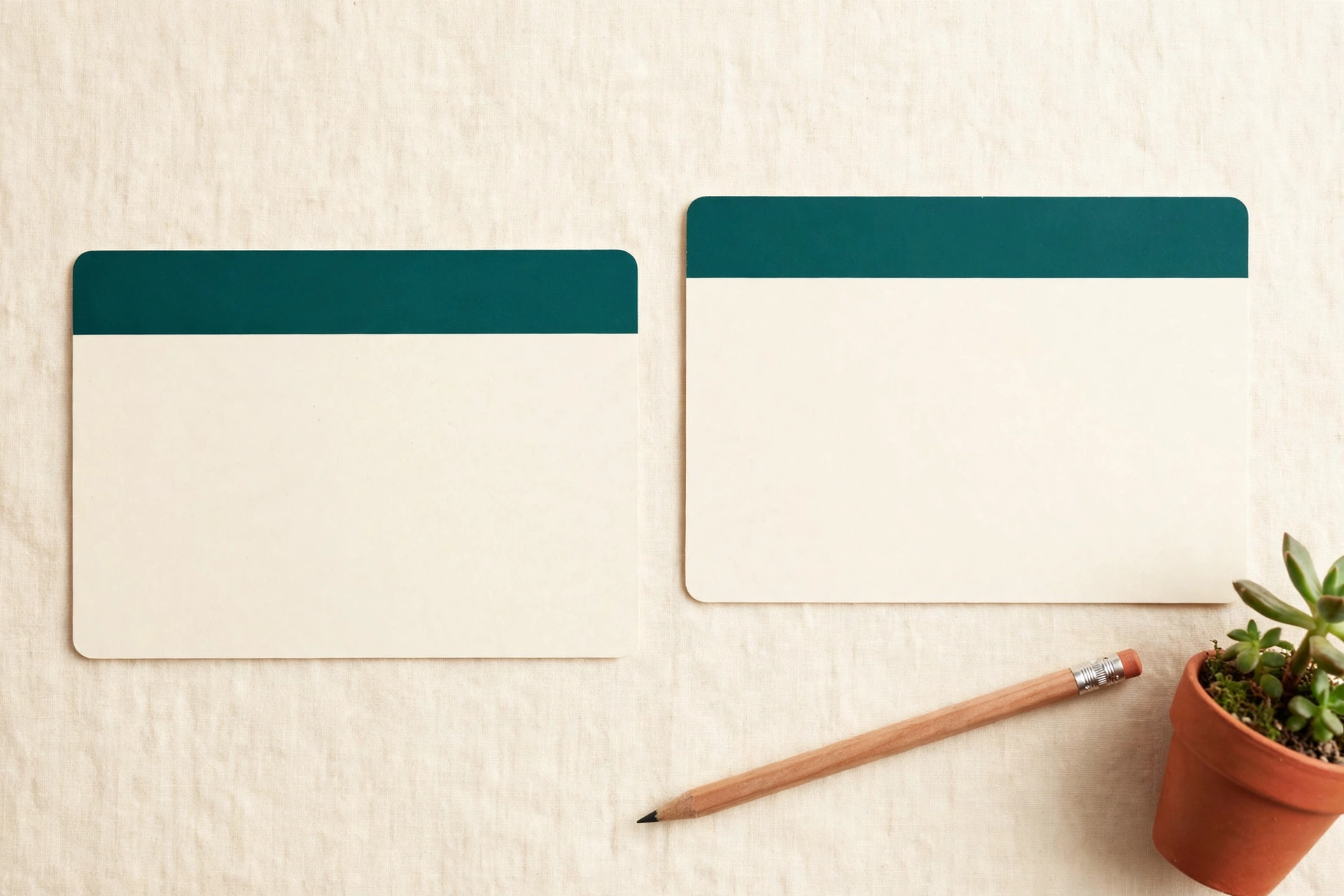
Free printable: the Drop-Zone Map + Nightly-Reset Card — the four-job map with a box for each job and its spot, the one-bay-per-person tags, and the five-move sixty-second reset in order. Print it before Day 1 and stick the reset card inside the door or on the fridge.
A winter entryway does not need more space. It needs four named jobs, one bay per person, a tray for wet shoes, a dish for keys, one bin for mail — and sixty seconds a night. Build it this weekend, and the door stops being the pile and starts being the system. That is what entryway organization ideas are for: not a prettier hallway, but a morning where the keys are in the dish, the boots are in the tray, and the coat you need is on your hook, waiting.
FAQ
What are the best entryway organization ideas for winter? Give the door four jobs — sit, shoes, hang, keys — with one bay per person, a boot tray for wet shoes, and a dish for keys, sunglasses, and wallet. Add one bin for mail and returns, and keep it to daily coats only on the hooks.
How do I organize a small entryway with no mudroom? Use one foot of depth: a hook rail or adhesive hooks on the wall, a boot tray on the floor below, and a small dish on a shelf for keys. A mudroom is a system, not a room, so the same four jobs fit a single wall.
How many coats should hang at the front door? One daily coat per person, on their own hook. Off-season coats, formal coats, and coats worn twice a year live in the closet — hooks hold daily coats and bags only.
How do I stop shoes piling up by the door? One pair of daily shoes per person in a boot tray with a raised edge, placed where the boots come off. When the tray is full, a pair moves to the closet. Wet shoes go in the tray; dry shoes go in the bay slot; nothing goes loose on the floor.
What is the 60-second nightly entryway reset? Shoes in the tray, coats on their hooks, keys in the dish, a one-minute check of the mail bin, and one look at the floor. Five moves, in that order, every night — it keeps the drop zone working between weekly resets.
Sources
- The Tiny Nest, “13 Small Apartment Mudroom Drop Zone Ideas” (October 2026) — http://thetinynesthome.blogspot.com/2026/10/13-small-apartment-mudroom-drop-zone.html
- Nestorafind, “Mudroom Ideas” — https://nestorafind.com/mudroom-ideas/
- Home Channel TV, “Mudroom Drop Zones: Entryway Storage” — https://www.homechanneltv.com/post/mudroom-drop-zones-entryway-storage


4 Comments