The Spring Wardrobe Swap: Two Boxes, One Capsule, Zero Floor Pile
Spring is the second swap point of the year — winter weight out, spring layers in — and this post is the spring half of a swap you may already know. The winter edit was the edit: cut the closet down and feed the capsule. The winter capsule was the method: 30 pieces, a 3-coat edit, a layering formula. This post is the spring swap: the same method, the spring edition, run in one sitting with two boxes. Winter goes out sealed and labeled into one box; spring comes in, one shelf per category, into the second. The capsule is rebuilt from what you already own. Everything that fits neither box goes in the donate bag by the door, out within 48 hours. That is the whole system, and it fits on one page.
Here is how this post differs from its three twins, stated plainly. Our winter closet edit is the winter half — the edit and the donate-bag rule, built for cold-weather weight. Our winter capsule is the capsule method in its winter edition — heavy layers, three coats, the layering formula for cold. Our fall wardrobe reset is the autumn switch — the October mirror job, fall-weight in. This post is the spring half: winter out, spring in, one sitting, two boxes. Same system, different season, different job. And it rides on our pre-spring cleaning countdown — the bedrooms-and-closets week — so if you are running the countdown, this swap is the closet week.
The timing is honest: this post publishes in November for a swap that happens in March, about four months early on purpose — Pinterest seasonal searches ramp 30–45 days before the event, new pins need weeks to gather rank, and a seasonal pin recurs every year once indexed. The system is built in the quiet months and executed at the peak: February to April 2027, not now. The only search figure here is a thread figure: Pinterest’s Spring Trend Report 2026 reports searches for “wardrobe reset” up 140%, a number this site already claimed for our fall wardrobe reset and our winter capsule post — cited here as the thread those posts carry, not as this post’s own evidence.
The System in One Paragraph
One sitting, two boxes, one capsule, one bag out. Box 1 — winter out: heavy knits, boots, winter coats — washed or aired first, sealed, labeled on two sides with season and category, stored in one place so next autumn is one trip, not a hunt. Box 2 — spring in: lighter layers, one shelf per category — tops, bottoms, layers, dresses, shoes. The 30-piece spring capsule is rebuilt from what is already owned, using the capsule method from our winter capsule post in its spring edition: count to 30 from the spring box before buying anything, and a slot stays empty until the count says it is needed. The donate bag sits by the door and leaves within 48 hours — the rule from our winter closet edit — and one bag goes out per swap. Anything that fits neither box goes in the bag. Anything not worn by the next swap is re-evaluated, not re-stored. The swap happens in one uninterrupted sitting, with 2–3 transition pieces kept accessible for 2–4 weeks in case spring weather flips back to cold.
The Two Boxes: Winter Out Sealed, Spring In by Category
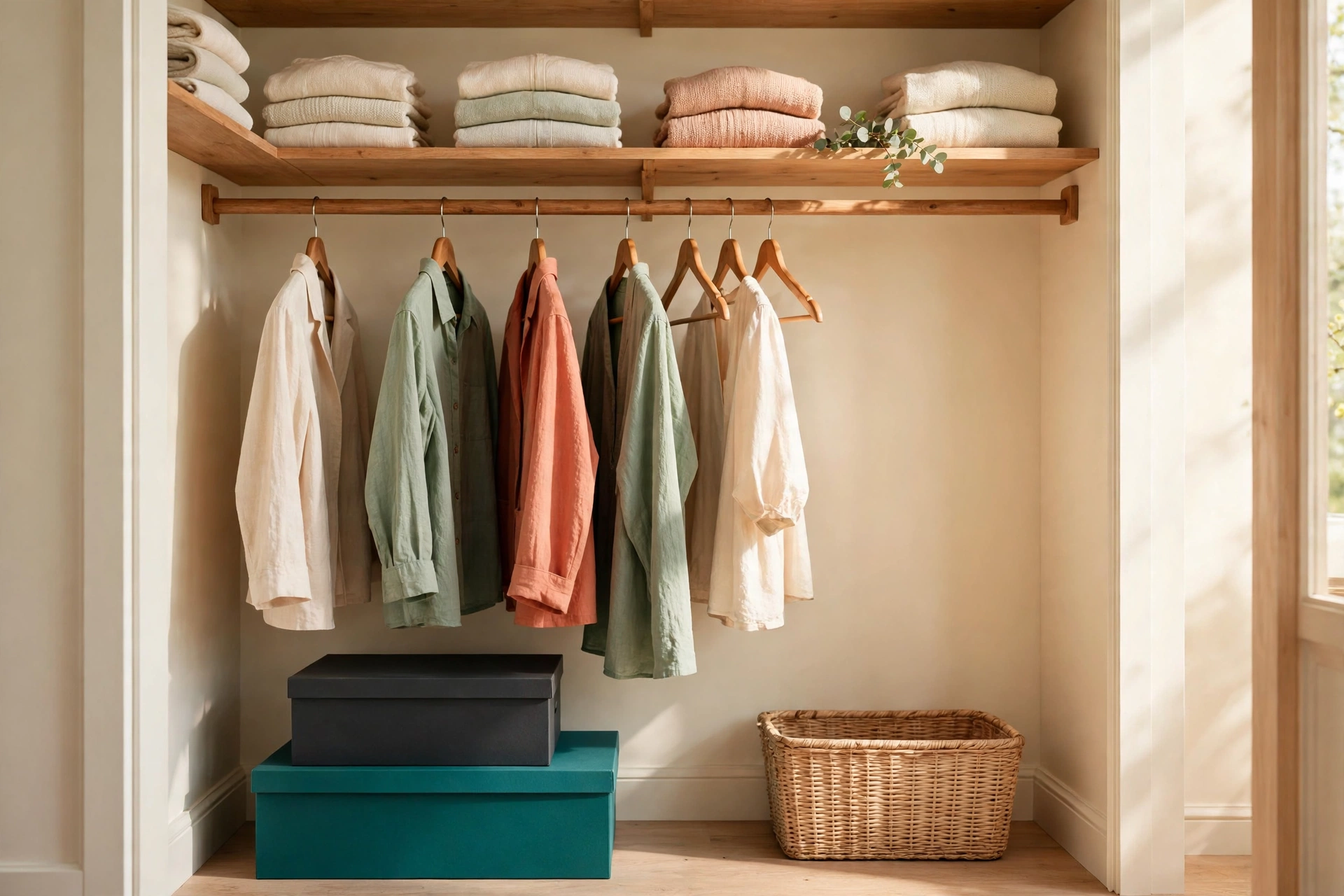
The two boxes are the system, and there are only two of them. Nothing lives outside them except what is hanging in the active closet and the donate bag — that is the rule that keeps the swap from becoming a reshuffle. Box 1 is winter out. Heavy knits, boots, winter coats: everything winter-weight comes out of the closet first, and it goes away clean — washed or aired before storage, the genre rule every seasonal guide agrees on. Then it is sealed, labeled on two sides with season and category — label both sides, because the side you can read is never the side facing out — and stored in one place, so next autumn the winter box is one trip, not a hunt. Box 2 is spring in. Lighter layers come in by category, one shelf per category: tops, bottoms, layers, dresses, shoes. Category shelves are easier to live from than mixed piles, because you dress by category, not by digging. The boxes are the boundary: winter-weight belongs in Box 1, spring layers on a Box 2 shelf, and anything that fits neither does not get a third box — it goes in the donate bag.

The 30-Piece Spring Capsule: Rebuilt From What You Already Own
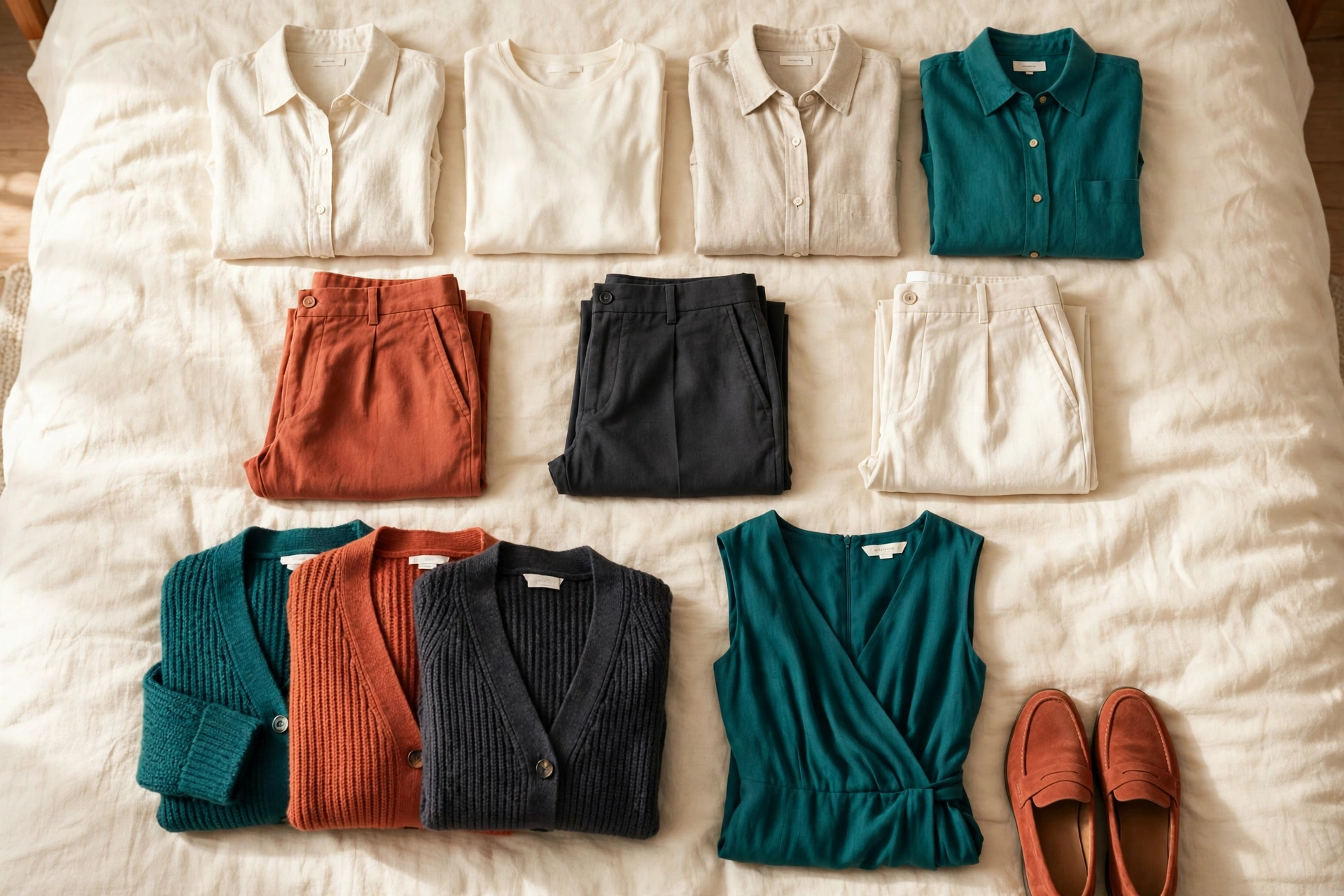
The capsule is the heart of the swap, and it is rebuilt, not bought. The method is the one from our winter capsule post — 30 pieces, counted before anything is bought — in its spring edition: lighter layers instead of heavy knits, one shelf per category instead of the winter coat wall, transition layers kept accessible. Count to 30 from the spring box: tops, bottoms, layers, dresses, shoes, and the outer layer spring actually needs. A slot stays empty until the capsule count says it is needed — an empty slot is not a shopping emergency, it is a decision waiting for the count. Nothing is bought until the count says a slot is empty, and nothing is bought because a sale exists. If the count reaches 30 before the box is empty, the extras go in the donate bag — the capsule is a ceiling, not a target to overshoot. And the spring edition has one difference from the winter one: the transition layers. Keep 2–3 transition pieces out and accessible for 2–4 weeks — a light jacket, a cardigan, one warmer layer — because spring weather rarely flips in a day. Those pieces sit outside the 30-count as the weather bridge, and when the weather settles, they either join the capsule or join the box.
The Donate Bag: One Bag Out, 48 Hours, By the Door
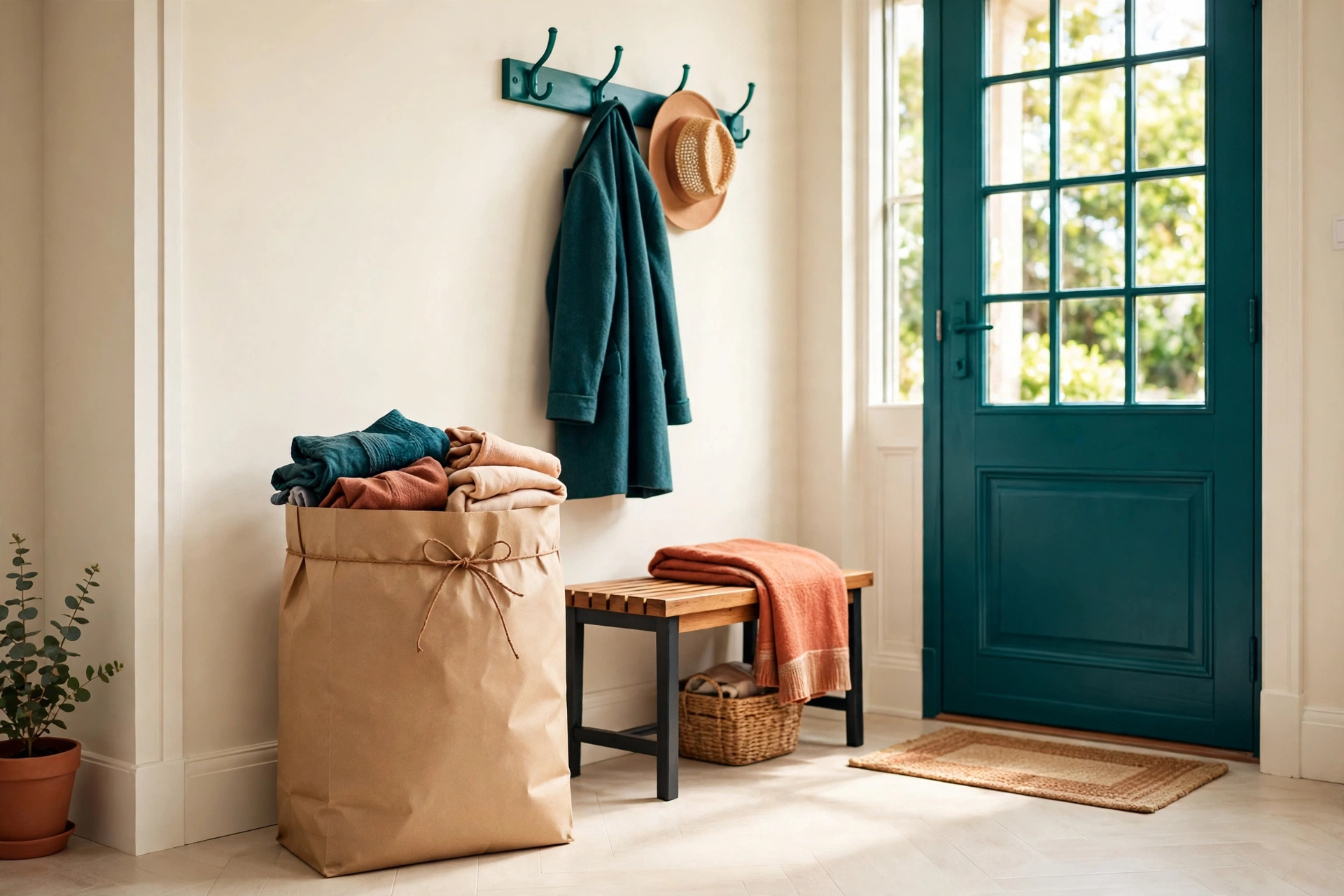
The donate bag is the exit, and the exit has a deadline. Everything that fits neither box goes in the bag: the pieces that are neither winter-weight nor spring layers, the duplicates the capsule count exposed, the pieces that survived the winter edit but never got worn. One bag goes out per swap — one, not a pile of half-filled bags waiting for a someday trip. The bag sits by the door, and it leaves within 48 hours — the rule from our winter closet edit, and the rule exists because bags left out drift back into the closet. The genre guides agree in their own words: CozyCubby puts donations by the door or in the car the same day; Flawlessly Functional puts the donation bags in the car before finishing, because they leave the house that day or come back into the closet. The bag is packed during the swap, not after it — it is open on the floor while you sort, and a piece that fits neither box goes straight in, no maybe-pile, no second look. The 48-hour clock starts the moment the swap ends, not the moment you remember the bag exists.
One Sitting, Not a Weekend Project
The swap happens in one uninterrupted sitting — that is this post’s own rule, and it is the rule that makes the swap actually happen. A swap spread across a weekend becomes three half-finished piles and a bed you cannot sleep in. One sitting means the bed is cleared and the bags are ready before it starts, the boxes are open, and the closet is emptied in one pass. The genre guides give the timing ranges, and they are the guides’ ranges, not this post’s measured result: CozyCubby times the swap at about 90 minutes in three phases — pull and sort in the first 25 minutes, clean and store in the next 35, hang the new season in the final 30 — while Flawlessly Functional, citing the experts quoted by Apartment Therapy, suggests dedicated uninterrupted sessions of roughly 3–6 hours for a thorough swap. Refresh Routine puts a systematized rotation at 1–2 hours twice a year, or 30–45 minutes per swap once the system is in place. The range is wide because closets are wide; the rule is the same either way: one block, start to finish. Order the sitting the way Flawlessly Functional orders it — empty, edit, clean, store, rehang — and sort into the four piles CozyCubby names: keep or store, donate, repair, toss or recycle. The wear test decides the hard calls: not worn all season goes in the donate bag. When to do it is set by your weather, not a fixed date — Sort and Stow puts the spring window at late March to mid-April in moderate climates, early March in the South, and mid-April to early May in the North.
The Rules That Hold the Swap Together
Eight rules, and they are this post’s own system rules, not research findings. Two boxes only — Box 1 winter out, Box 2 spring in. Nothing lives outside the two boxes except what is hanging in the active closet and the donate bag. Box 1 is sealed, labeled, stored in one place. Winter goes away clean, labeled on two sides with season and category, so next autumn is one trip, not a hunt. Box 2 is one shelf per category. Spring comes in by category — tops, bottoms, layers, dresses, shoes — one shelf each. The 30-piece spring capsule is rebuilt from what is already owned. Count to 30 from the spring box before buying anything; a slot stays empty until the capsule count says it is needed. One bag out per swap. Everything that fits neither box goes in the donate bag by the door — out within 48 hours, the rule from our winter closet edit. One sitting, not a weekend project. The swap happens in one uninterrupted sitting, with the bed cleared and the bags ready before it starts. Transition layers stay accessible. Keep 2–3 transition pieces out for 2–4 weeks — a light jacket, a cardigan, one warmer layer — because spring weather rarely flips in a day. Not worn by the next swap = re-evaluated, not re-stored. Anything unworn through spring does not earn a second storage season; it is re-evaluated at the fall swap, not automatically re-stored. The eight rules are the difference between a swap and a reshuffle, and the reshuffle is what this post exists to prevent.
The Free Printable: Two-Box Swap Checklist + Spring Capsule Tracker
The free printable for this post is the two-box swap checklist plus the spring capsule tracker, on one page. The two boxes on one page — Box 1 winter out with its seal-and-label checklist, Box 2 spring in with one shelf per category — beside the 30-piece count grid, with the donate-bag deadline at the bottom: bag by the door, out within 48 hours. Copy it onto one page and pin it to the closet door for the swap. It is the whole swap system on a single sheet — and the sheet is the system, because a system nobody can see is a system nobody follows.
The Challenge: Run the Two-Box Swap Once This Spring, Then Repeat It at the Fall Switch
Run the two-box swap once this spring, then repeat the same system at the fall switch — the seasons change, the system does not. Two boxes, one 30-piece capsule, one bag out within 48 hours, one sitting. That is the whole challenge, and it is deliberately small: one page, two boxes, one bag. After that, you have a closet that runs on a system instead of a floor pile, a winter box that is one trip next autumn, and a method that works for the next swap — because the seasons come back every year, and the system will be ready.
FAQ
When should I do the spring wardrobe swap?
When your local weather turns — late March to mid-April in moderate climates, early March in the South, mid-April to early May in the North; swap on the weather, not a fixed date.
What are the two boxes in the spring wardrobe swap?
Box 1 is winter out (heavy knits, boots, coats — sealed, labeled, stored in one place); Box 2 is spring in (lighter layers, one shelf per category).
How many pieces are in the spring capsule?
30 pieces, rebuilt from what you already own using the #644 capsule method in its spring edition — count to 30 before buying anything.
What happens to clothes that fit neither box?
They go in the donate bag by the door, out within 48 hours — the #92 rule. One bag out per swap.
How long does the swap take?
One sitting, not a weekend project — the genre range is 90 minutes timed to 3–6 hours thorough; this system is one uninterrupted sitting with the bed cleared and bags ready first.
What if spring weather flips back to cold?
Keep 2–3 transition pieces accessible for 2–4 weeks (a light jacket, a cardigan, one warmer layer) — they handle a cold snap without reversing the swap.
Sources
- Pinterest — “Spring Trend Report 2026”: “wardrobe reset” +140% — THREAD FIGURE ONLY for #107, already claimed on this site for #24 (post 221) and #644 (post 644); cited here as the thread, not as this post’s own evidence (read directly 2026-11-11, per batch-15 brief): https://newsroom.pinterest.com/news/spring-trend-report-2026/
- Sort and Stow — “How to Rotate Seasonal Wardrobes Without Rebuilding”: spring swap windows by climate (late March–mid-April moderate, early March South, mid-April–early May North); 2–3 transition pieces accessible for 2–4 weeks; declutter-before-you-store (read via search 2026-11-12, per blog107 fact pack): https://sortandstow.com/seasonal-closet-swap/
- Refresh Routine — “Seasonal Clothing Rotation”: late March spring swap; 1–2 hours twice a year, 30–45 minutes per swap with a system; two full rotations unworn = out (read via search 2026-11-12, per blog107 fact pack): https://refreshroutine.com/closet/seasonal-rotation/
- CozyCubby — “Seasonal Closet Swap Checklist: Done in 90 Minutes”: 90-minute three-phase swap; four piles (keep/store, donate, repair, toss/recycle); wear test; label bins on two sides; donations by the door or in the car the same day (read via search 2026-11-12, per blog107 fact pack): https://www.cozycubby.top/seasonal-closet-swap-checklist/
- Flawlessly Functional — “Seasonal Closet Switch”: one uninterrupted block, empty → edit → clean → store → rehang; experts quoted by Apartment Therapy suggest dedicated uninterrupted sessions of roughly 3–6 hours for a thorough swap; donations leave the house that day (read via search 2026-11-12, per blog107 fact pack): https://blog.flawlesslyfunctional.com/blog/seasonal-closet-switch
Related reading: our winter closet edit on the winter half of the swap and the 48-hour donate-bag rule, our winter capsule post on the 30-piece capsule method rebuilt here in its spring edition, our fall wardrobe reset on the autumn switch, the mirror job, and our pre-spring cleaning countdown on the four-week countdown this swap rides on.