

Thanksgiving Appetizer Recipes: The 3-Zone Spread System
Every Thanksgiving the same thing happens: the appetizer table becomes twelve competing dishes, half of them still in the oven when guests arrive, and the host spends the first hour of the holiday running between the kitchen and the living room instead of being with anyone. By dinner the spread is a mess of half-empty bowls, and Friday morning the leftovers go straight into the bin.
Thanksgiving appetizer recipes are not a recipe list. A Thanksgiving appetizer spread is a system: three zones that hold, a count that decides, a timeline that paces, and a flip that saves the leftovers. Three zones, one tray each. A 3-2-1 count per eight guests. A make-ahead timeline that starts two days out. And a leftover flip that turns the board into Friday lunch. That is the whole system — and it is the reason this post exists now: thanksgiving appetizer recipes are up 200% on Pinterest (PBC Weekly Trends Report, 13 November 2026), and last November thanksgiving appetizers rose 900% month over month, with Thanksgiving demand projected up 379% into the holiday and peaking around 28 November (Market with Miranda, Pinterest Trends tool). Thanksgiving falls on Thursday 26 November this year, so this post lands ten days before the peak — it catches the tail of the wave by design, and the make-ahead and leftover angles keep it useful past the day itself. No recipes live here: the dishes are named once, as what fills each zone, and the system is the post.
The system at a glance
Four steps, in order. Then a printable, and a challenge.
- Step 1 — Three zones: the board (cold), the hot bites, and the dips — each zone gets exactly one tray.
- Step 2 — The 3-2-1 count: per 8 guests, 3 cold, 2 hot, 1 dip. Six items total per table.
- Step 3 — The make-ahead timeline: 2 days out (shop + freeze the hot bites), day-before (build the board, chill the dips), day-of (heat, plate, serve).
- Step 4 — The leftover flip: the board’s remainders become the next-day lunch box, packed the same night.
Four rules govern the whole spread: three zones, one tray each; six items per eight guests; nothing new cooked on Thanksgiving morning; nothing from the spread wasted. A seventh dish is not generosity. It is a second spread arguing with the first.
Step 1 — Three zones, one tray each
Three zones: the board, the hot bites, and the dips. Each zone gets exactly one tray, so the table never becomes twelve competing dishes.
- The board (cold): one board, and everything cold lives on it — aged cheddar, cured meats, grapes, crackers, a handful of nuts. The board is built the day before and chilled overnight, so it is finished before Thanksgiving morning even starts.
- The hot bites: one tray, and everything hot lives on it — mini meatballs and stuffed mushrooms, bought or made two days out and frozen, then heated on the day. Hot food gets one tray because hot food is the tray that needs the oven, and the oven belongs to the turkey.
- The dips: one bowl, and the dip lives in it — a warm spinach-and-artichoke dip or a cranberry brie dip, chilled the day before and warmed on the day. One dip, not three: a second dip is a second zone pretending to be part of the first.
One tray per zone keeps each zone readable and the table calm. Guests can see the whole spread in one look, and the host can see at a glance what needs refilling. A fourth tray is not “more generous” — it is a second spread arguing with the first, and the table loses. The Thanksgiving tablescape system sets the table the spread sits on: the table is styled in zones too, and the spread’s three trays slot into the tablescape instead of fighting it.

Step 2 — The 3-2-1 count: 3 cold, 2 hot, 1 dip per 8 guests
Per 8 guests: 3 cold, 2 hot, 1 dip. Six items total per table of eight. That is the whole spread for one table.
The count scales by table, not by panic. Sixteen guests is two tables of 3-2-1, not twelve appetizers on one table. Two tables means two boards, two hot trays, two dip bowls — the system repeated, never stretched. A seventh dish added to one table is not a bigger spread; it is a table that has stopped being a system.
The count also decides the shopping list, which is the point of it. Three cold items, two hot, one dip — write the six on the spread map before shopping, and the shop is a single trip with a finished list instead of three trips with a growing one. The count decides. You just follow the timeline.
Thanksgiving appetizer recipes fail most often at the count, not the cooking: too many dishes, too little of each, and a host who cooked all day for a table nobody could read. Six items, one tray each, and the spread is done. The Thanksgiving drinks station is the spread’s partner station — drinks run on their own system, on their own table, so the food table stays a food table and the drinks never crowd the board.

Step 3 — The make-ahead timeline: 2 days out, day-before, day-of
Two days out is shop + freeze. Day-before is build + chill. Day-of is heat + plate + serve. Nothing new is cooked on Thanksgiving morning — the morning belongs to the turkey.
- Two days out (Tuesday): shop with the six-item list, and freeze the hot bites. The mini meatballs and stuffed mushrooms go into the freezer the same day they are bought or made, so the hot zone is already decided before the week gets busy.
- Day-before (Wednesday): build the board and chill the dips. The cheddar, cured meats, grapes, crackers and nuts go onto the board, the board goes into the fridge covered, and the dip is made and chilled. Wednesday is the last cooking day of the spread — after Wednesday, nothing is built from scratch.
- Day-of (Thursday): heat, plate, serve. The hot bites go into the oven while the turkey rests, the board comes out of the fridge, the dip is warmed, and the three trays go onto the table. The host is in the living room when guests arrive, not in the kitchen.
The timeline slots into the bigger plan: the Thanksgiving week countdown is the day-by-day plan for the whole holiday, and the spread’s three days — Tuesday, Wednesday, Thursday — sit inside it. And the baking runs on its own clock next door: the holiday baking station is the spread’s kitchen neighbour, with its own prep days, so the baking and the spread never compete for the same oven or the same afternoon. The same four-zone hosting structure runs the year’s other parties too — the Super Bowl party reset uses it for game day, and the Easter brunch reset uses it for brunch — but this spread is Thanksgiving’s, with Thanksgiving’s count and Thanksgiving’s timeline.
Step 4 — The leftover flip: board → next-day lunch box
Whatever survives the spread is packed as Friday lunch the same night. A spread with no flip is a spread that wastes food.
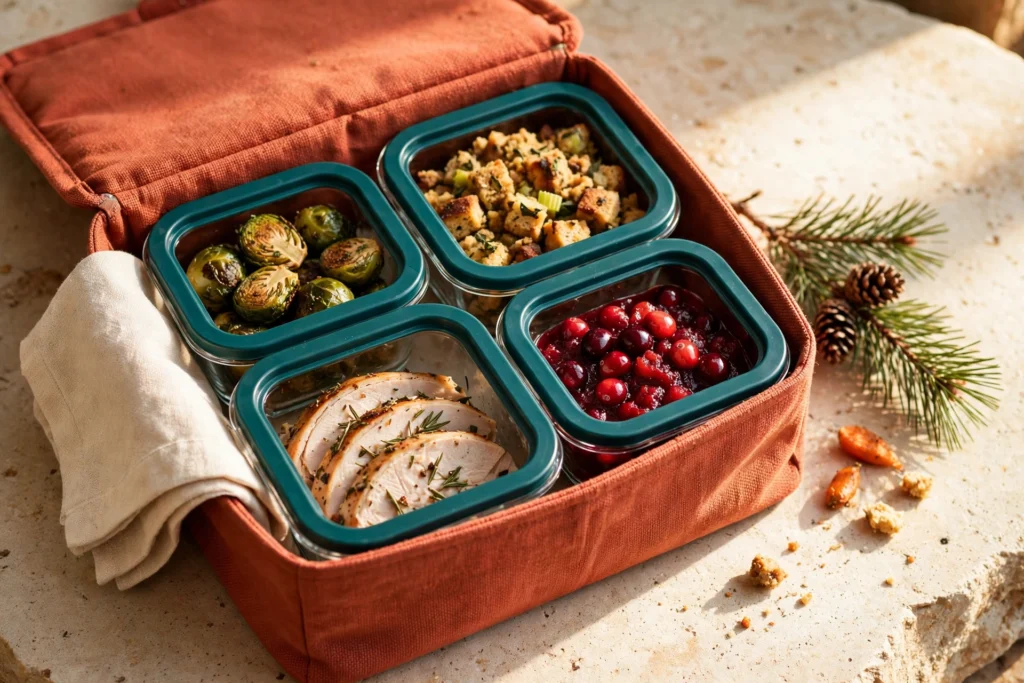
The flip happens Thursday night, before the kitchen is closed: the board’s remainders — the cheddar, the cured meats, the grapes, the crackers that survived — go into a lunch box with a lid, and the dip goes into its own small container. Friday lunch is already decided before Friday starts, and nothing from the spread is wasted.
The flip is also why the count matters. A spread built on the 3-2-1 count leaves a lunch box, not a fridge full of half-bowls. Twelve appetizers leave waste; six items leave lunch. The system ends where it started — with a decision already made, instead of a mess to sort out.
Before you start: map the spread tonight
Map the spread tonight, not on Thanksgiving morning. Draw the three zones on the printable — board, hot bites, dips — write the six items into the 3-2-1 slots, and check them against each other before any of them is bought. Do they sit together as a spread, or is one of them from a different meal arguing with the rest? A dish that does not fit the zone goes off the map, and the spread stays coherent.
The challenge is simple: map the spread tonight, shop two days out — the count decides, you just follow the timeline. Thanksgiving appetizer recipes work best as a system, and the system is already written. The only decision left is which six dishes fill the six slots.
The free printable: spread map + make-ahead timeline
The printable for this post is a spread map and a make-ahead timeline: three zones with one tray each and the 3-2-1 slots to fill in, plus a three-day timeline — two days out (shop + freeze), day-before (build + chill), day-of (heat + plate + serve) — with a row for the leftover flip at the bottom.
Print it, write the six dishes into the slots, and work the timeline day by day. The challenge is simple: map the spread tonight, shop two days out — the count decides, you just follow the timeline.
Frequently asked questions
What is the Thanksgiving appetizer spread system?
Three zones (board, hot bites, dips), one tray per zone, a 3-2-1 count per 8 guests, a make-ahead timeline (2 days out, day-before, day-of), and a leftover flip into Friday lunch.
How many appetizers do I need for 8 guests?
Six — 3 cold, 2 hot, 1 dip. That is the whole spread for one table; 16 guests is two tables of 3-2-1, not twelve dishes.
Why one tray per zone?
One tray keeps each zone readable and the table calm. A second tray in a zone is a second spread competing for the same guests.
What can I make ahead?
Almost all of it: shop and freeze the hot bites 2 days out, build the board and chill the dips the day before — day-of is only heat, plate, serve.
What do I do with leftover appetizers?
Flip them: pack the board’s remainders as the next-day lunch box the same night, so nothing is wasted and Friday lunch is decided.
Is this a recipe post?
No — dishes are named only as what fills each zone. The system (zones, count, timeline, flip) is the post; it is not a recipe list.




One Comment