
Pantry Organization: The January Eat-Down System
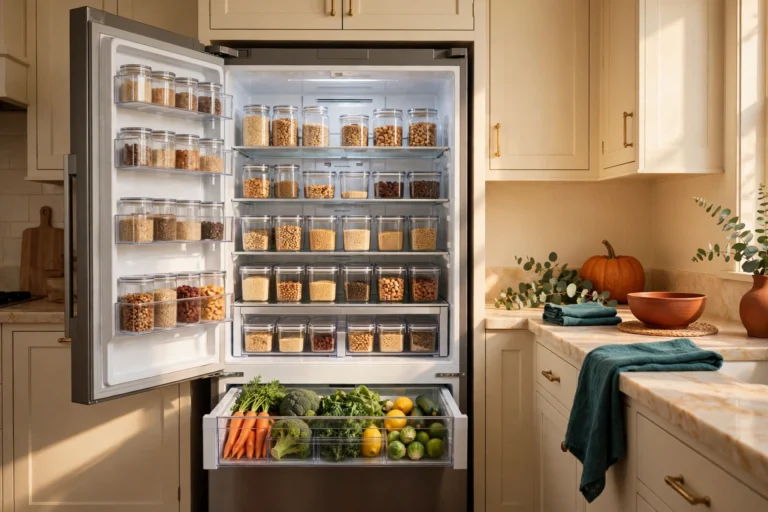
January opens the pantry and finds the holidays still in there. The half-bag of flour from the baking station. Three open boxes of crackers. The canned pumpkin nobody touched. The freezer is worse: labeled trays from the holiday vault sitting next to unlabeled bags nobody can identify without defrosting them. The instinct is to buy a fresh start — a big grocery run, new containers, a clean slate. The pantry organization move that actually works is the opposite: eat what you already own before you buy another thing.
This is not our January pantry reset — that is the post-holiday audit, the clear-out, group, and zones system that gives every shelf a permanent home. It is not our holiday freezer reset — that is the November vault, the stock-up that filled the freezer for December. And it is not our post-Thanksgiving reset — that is the one-hour flip that packed the leftovers away. The January eat-down is the consumption plan those three systems were building toward: the order in which the stored food gets eaten, the week nothing new comes in, and the basket that makes sure the open and near-date food goes first. Audit, stock-up, flip — then eat-down. This post is the last step, and it is the one that turns storage into savings.
Pantry organization is not a container purchase. It is a decision order. When everything in the pantry and freezer has a turn to be eaten, nothing hides until it expires, nothing gets bought twice, and the shelves empty in the right order instead of all at once. The eat-down runs on one rule: freezer first, then pantry baking supplies, then canned goods. Everything else in this post — the no-buy week, the use-first basket, the tracker — exists to enforce that order.
The Eat-Down Order
The order matters because food spoils at different speeds once the holidays end. Frozen food keeps longest, but it is also the easiest to forget: out of sight, behind a freezer door, it quietly becomes next year’s mystery. So it goes first, deliberately, while the motivation of January is still fresh. Baking supplies go second: open bags of flour, sugar, and spices lose quality fast once opened, and every open bag is a small leak in the pantry budget. Canned goods go last: they keep, they wait, and they are the safety net that makes the first two stages possible without a panic shop.
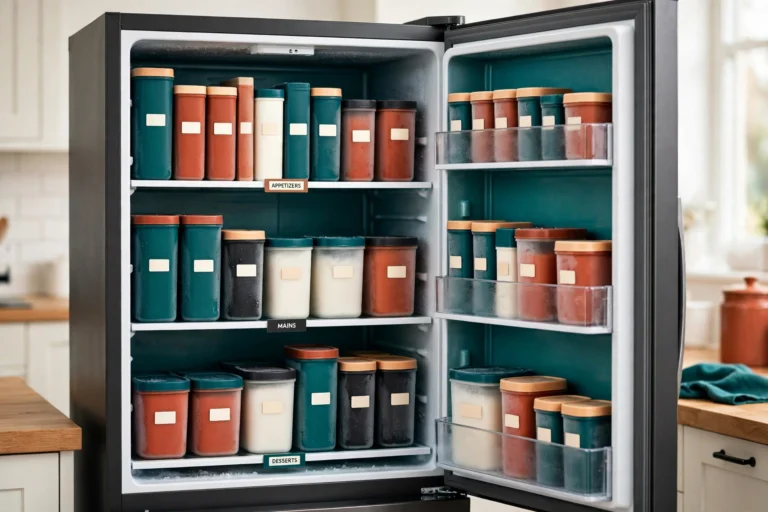
Stage 1: Eat the freezer first. Work through the vault in label order, oldest date first. Every tray that leaves the freezer frees a shelf and removes one decision from a January evening. The vault’s own rule still applies: nothing leaves without a plan, and the thaw moves to the fridge the day before it is needed, never the morning of.
Stage 2: Eat the baking supplies. Open bags, half-used boxes, the spice jars that were opened for one holiday bake. Use them in the order they were opened, oldest first. This is where the baking station earns its keep: the station’s inventory sheet tells you exactly what is open, so the eat-down never starts with a guess.
Stage 3: Eat the cans and jars last. Canned goods, jars, and sealed staples are the reserve. They fill the gaps in weeks two and three, and whatever is left at the end of the eat-down is the true backstock — the pantry’s honest baseline, not its holiday aftermath.
The order is the system. Skip it — eat the cans first because they are easy — and the freezer stays full, the flour goes stale, and February opens with the same pantry January found. Follow it, and by the end of the month the shelves tell the truth about what the household actually uses.

The Use-First Basket
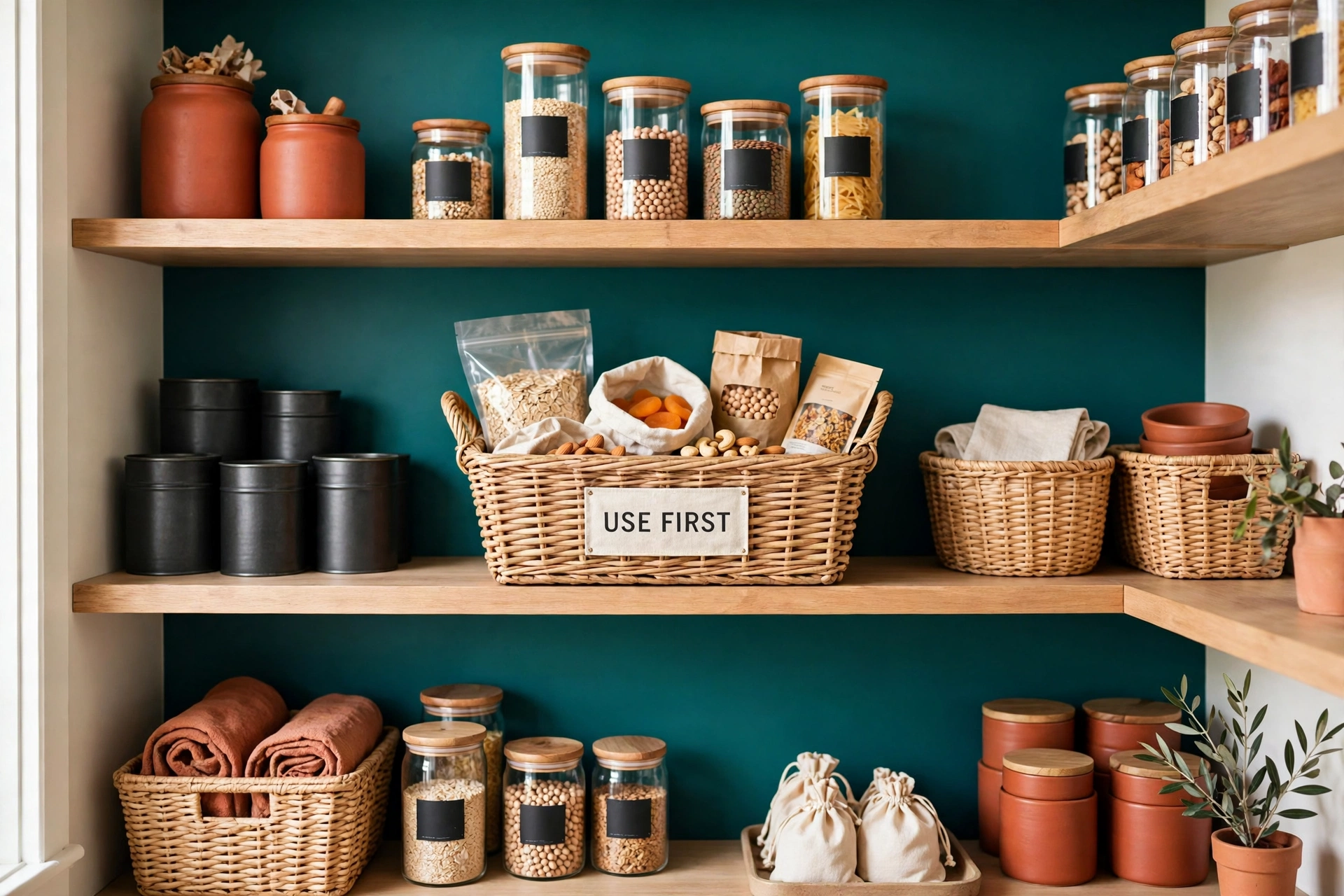
The use-first basket is the single most effective pantry organization habit in this whole system, and it is borrowed with credit: the “eat me first” bin is the signature move of Sabrina’s Organizing’s pantry system, which our January pantry reset already uses. One clear bin, front and center at eye level, holding every open and near-date item in the pantry. When anyone in the house wants a snack or starts a meal, they shop the basket first.
The basket has three rules. First, everything open goes in it — no open bag stays on a shelf where it can hide behind a sealed one. Second, everything in it gets eaten before anything behind it: the basket is the front of the queue, always. Third, new additions go to the back of the basket, so the oldest open item is always the next one out — the same first-in, first-out rule the pantry reset runs on its shelves.
The basket is refilled once a week, on the same day as the tracker check. Anything in it that has gone too far is tossed without guilt: the basket’s job is to surface food while it can still be eaten, and a toss from the basket is a small, honest loss instead of a forgotten one discovered months later. A household that shops the basket first wastes less without anyone needing a lecture, because the decision is made by placement, not willpower.
The 7-Day No-Buy Week
The eat-down needs one hard boundary to work: a week in which no groceries come in. Seven days, no grocery run, no top-up shop, no “just popping in for one thing” — because one thing is never one thing, and a top-up shop in week one kills the eat-down before it starts. The no-buy week is the first full week of the eat-down, and it is the week the freezer-first stage does its heaviest work.
The no-buy week has one exception, and it is a narrow one: fresh perishables only — milk, bread, fresh fruit and vegetables — bought once, in one trip, at the start of the week. Everything else comes from the freezer, the basket, and the shelves. No pantry staples, no snacks, no “bargains.” The exception exists because the eat-down is a consumption plan, not a fast; fresh food keeps the household fed while the stored food gets eaten.
Plan the week’s meals before the week starts, from the tracker, not from appetite. Five freezer meals, two baking-supply meals, and one can-and-jar meal make a workable week — and the plan is written down, on the tracker, before day one. A no-buy week without a written plan fails by Wednesday, when the household opens the freezer, sees work instead of dinner, and orders in. A written plan turns the freezer into a menu.
If the week feels hard, that is the system working. The hardness is information: it shows exactly which stored foods the household actually wants to eat, and which ones were bought for an imaginary version of the holidays. Write that down too. Next November’s stock-up list should be built from this week’s evidence, not from this year’s optimism.
The Eat-Down Tracker
The tracker is one sheet, kept where the food decisions happen — on the fridge door or inside the pantry door — and it carries the whole eat-down. Three columns: what it is, where it lives, and when it gets eaten. Every item in the freezer vault, every open bag in the basket, and every can in the reserve gets a line. Nothing is tracked from memory; memory is how the unlabeled bag happened.
The tracker runs in three passes. Pass one, the count: on day one, count the freezer items, the basket items, and the cans, and write the totals at the top of the sheet. The count is the starting line — it is also the number the household beats. Pass two, the week: each evening, tick off what was eaten and move tomorrow’s thaw from freezer to fridge. One tick a day, thirty seconds, no spreadsheet. Pass three, the close: at the end of the month, count what is left. What remains is the true backstock, and it becomes the baseline for the pantry’s zones — not a guess, a count.
The tracker has one more job: it records what was tossed. Every toss gets a line, with a reason — stale, freezer-burned, past date. The toss list is the most valuable page in the whole system, because it is the shopping list for next year written in reverse: everything on it is something to buy less of, or not at all. A household that reads its toss list shops differently without trying.

The 15-Item Count
The eat-down inherits its number from the vault: fifteen items across three shelves was the vault’s stock-up target, five per shelf, and fifteen is the number the eat-down counts down from. Fifteen freezer items, eaten oldest first, is a month of hosting leftovers turned into a month of weeknight dinners — and it is small enough to track on one sheet without a spreadsheet.
Count the freezer on day one. If the count is fifteen, the eat-down is a four-week plan: roughly four items a week, freezer-first, with the basket and the cans filling the gaps. If the count is higher — twenty, twenty-five — the eat-down runs longer, or the week gets a second freezer meal. If the count is lower, the no-buy week still runs its seven days, and the pantry stages start sooner. The number sets the pace; the order never changes.
The count is also the honesty check for the vault. A freezer that holds thirty items in January was over-stocked in November, and the tracker proves it without an argument. Next November, the stock-up list gets shorter. Pantry organization compounds: every January’s count makes every November smarter.
The One-In, One-Out Rule
During the eat-down, and after it, one rule guards the pantry: one new thing in, one old thing out. A new bag of flour enters only when an old one finishes. A new can joins the reserve only when a can leaves it. The rule is the eat-down’s permanent form — it is what keeps January’s empty shelves from refilling into February’s chaos by default.
The rule has a partner, carried over from the post-Thanksgiving flip: nothing new lands on a surface without a home. A grocery bag that comes home during the eat-down — the week’s fresh perishables — is unpacked into its zone immediately, not parked on the counter. The counter is not storage, and a bag left on the counter becomes a shelf that nobody chose.
Together, the two rules do the maintenance the audit cannot: the audit empties and zones the pantry once, and the rules keep it that way. A pantry that runs one-in, one-out never needs another January rescue, because it never accumulates one.

What the Eat-Down Is Not
The eat-down is not a pantry purge. Nothing is thrown away to make the shelves look empty; everything is eaten, in order, or tossed only when it is genuinely past saving. A purge feels productive and wastes food. An eat-down feels slower and wastes nothing.
It is not a diet, and it is not a budget plan. The eat-down does not restrict what the household eats — it restricts what the household buys while stored food waits. No calorie counting, no spending targets, no finance advice: the system is a consumption order, and its only promise is that stored food gets eaten before new food replaces it.
And it is not a recipe collection. The eat-down never tells the household what to cook — it tells them what to cook from, and in what order. The meals themselves are the household’s own. A system that prescribes recipes becomes a food blog; a system that prescribes order stays pantry organization.
Week by Week: The Four Weeks of the Eat-Down
Week one is the no-buy week, and it is freezer-heavy: four freezer meals, planned from the tracker before the week starts, with the basket covering snacks and breakfasts. The thaw moves each evening for the next day. By Sunday, four items have left the freezer, the basket has turned over once, and the tracker shows the first real progress — a count that moved, not a shelf that was rearranged.
Week two opens the baking supplies. The freezer meals drop to three, and two meals are built from what is open: the flour that needs using, the half-box of pasta, the spice jar opened for one bake. This is the week the household discovers what it actually likes cooking from, as opposed to what it liked buying. Write down the meals that worked; they are the keepers for next year’s stock-up list.
Week three is the mixed week: two freezer meals, one baking-supply meal, and the first can-and-jar meal. The cans stop being the safety net and start being dinner. The basket, refilled weekly, should be visibly smaller now — open items eaten, not replaced, because the one-in, one-out rule is already running and nothing new has entered to refill it.
Week four is the close. Whatever freezer items remain get eaten, the basket is emptied to its last honest items, and the cans that are left become the true backstock. Count what remains, write the totals on the tracker, and compare them with day one. The difference is the eat-down, measured in items, not intentions. The shelves that remain are the pantry’s real baseline — and the zones from the January pantry reset finally hold only what the household uses.
The 7 Eat-Down Rules
- Freezer first, always. The oldest labeled freezer item is the next meal’s starting point, and the thaw moves to the fridge the day before.
- The basket decides. Open and near-date food lives in the use-first basket at eye level, and the household shops the basket before any shelf.
- Seven days, no grocery run. One no-buy week, one fresh-perishables trip at the start, nothing else. The boundary is the system.
- Plan from the tracker, not from appetite. The week’s meals are written down before the week starts, from the count, not invented at 6 p.m.
- Tick it off daily. One tick an evening on the tracker. Thirty seconds keeps the eat-down honest; a week without ticks is a week without a system.
- Record every toss. The toss list is next year’s shopping list in reverse. A toss without a reason teaches nothing.
- One in, one out. Nothing new enters the pantry without something old leaving it. The rule outlives the eat-down.
Free Printable: Eat-Down Tracker
The free printable for this post is the eat-down tracker on one sheet: the 15-item freezer count, the use-first basket list, the three-stage order, the no-buy week meal plan, and the toss list. Print it, stick it on the fridge door, and the eat-down runs itself — one tick an evening, one thaw a day, one honest count at the end of the month.
FAQs
How long does the January eat-down take?
About four weeks for a fifteen-item freezer, counting from the first no-buy week. A larger freezer runs longer; a smaller one hands over to the pantry stages sooner. The order never changes, whatever the count.
What is the use-first basket?
One clear bin, front and center at eye level, holding every open and near-date item in the pantry — the “eat me first” bin from Sabrina’s Organizing’s pantry system, which our January pantry reset uses. The household shops the basket before any shelf, and new additions go to the back so the oldest open item goes first.
Can I buy anything during the no-buy week?
Fresh perishables only — milk, bread, fresh fruit and vegetables — in one trip at the start of the week. No pantry staples, no snacks, no top-up shops. The exception keeps the household fed while the stored food gets eaten.
What if the freezer holds more than fifteen items?
The eat-down runs longer, or the week gains a second freezer meal. Count on day one, set the pace from the count, and keep the order: freezer first, baking supplies second, cans last. A high count is information for next November’s stock-up, not a failure.
How is the eat-down different from the January pantry reset?
The pantry reset is the audit: clear out, group, and zone the pantry, with the eat-me-first bin and the FIFO rule. The eat-down is the consumption plan that follows it — the order in which the audited food gets eaten, the no-buy week, and the tracker. Run the reset first, then eat down what it found.
Related Reading
- The Holiday Freezer Reset — the vault the eat-down empties: the November stock-up, vertical filing, and the thaw calendar.
- The January Pantry Reset — the audit that zones the pantry and installs the eat-me-first bin the basket borrows.
- The Post-Thanksgiving Reset — the one-hour flip that packed the leftovers away, labeled, so the eat-down starts clean.



2 Comments