

The Holiday Baking Station Reset: One Zone, Every Tool, Zero Counter Chaos
Baking season does not fail for lack of recipes. It fails for lack of a station. The flour lives in three different places. The mixer lives in a cupboard that takes five minutes to empty. The cooling racks are behind the roasting tins. The trays are in the oven, because that is where trays live when they have no home. So every bake starts with a twenty-minute hunt and ends with a counter that looks like a flour bomb went off — and the next bake starts from scratch, because nothing was ever put back in a system.
This post fixes one zone only: the baking station. It is deliberately different from the whole Thanksgiving kitchen, which our fridge-and-kitchen reset already covers, and from the gift-wrap station, which is the other holiday station in the house. This is the baking zone only: flour, sugar, and spice decanting; one baking tray and one mixer zone; the “bake, cool, pack” flow; and the pre-shop inventory so nothing is bought twice.
The rule that runs the whole station is simple. The station has four zones. After every bake, it resets to empty.

The 4-Zone System
The station is one stretch of counter — the stretch nearest the oven — divided into four zones. Four zones, each with one job, each with a home for everything in it. Nothing in the station lives anywhere else, and nothing from anywhere else lives in the station.
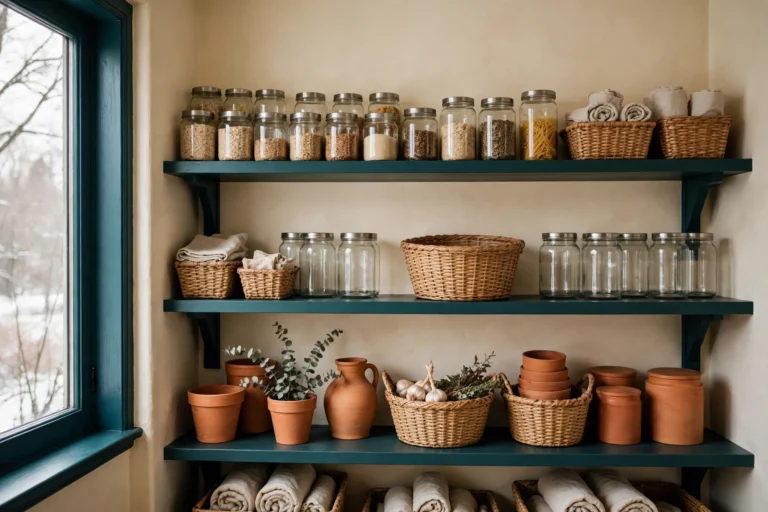
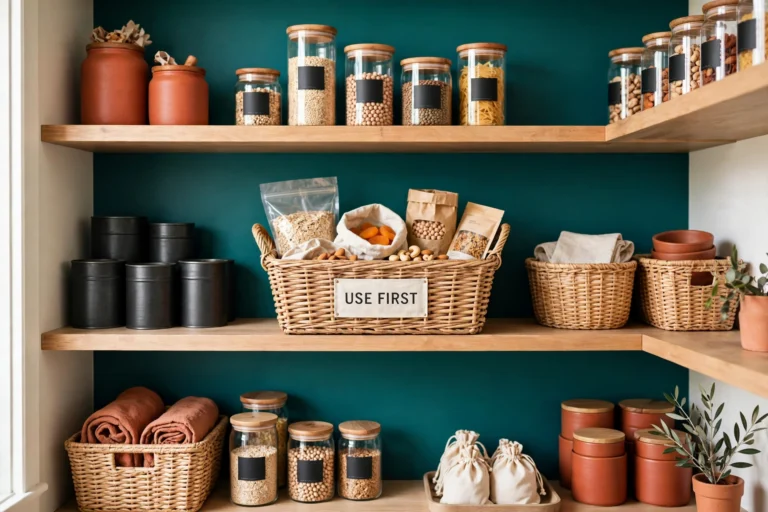
Zone 1: the dry zone. Flour, sugar, and spices, decanted into clear, labelled jars in one row. Not in bags. Bags tear, bags spill, bags hide the last cup of flour at the bottom where you cannot see it. Clear jars show exactly what you have, and the labels mean nobody has to open three jars to find the cinnamon. Keep only what the season uses: plain flour, self-raising flour, caster sugar, brown sugar, baking powder, bicarbonate of soda, vanilla, cinnamon, mixed spice, cocoa. Anything you have not used in two baking seasons leaves the zone. The dry zone is a working row, not a museum.
Zone 2: the tools zone. One mixer, on the counter, plugged in, ready. Not in a cupboard. A mixer that lives in a cupboard is a mixer that does not get used on a weeknight — the five-minute excavation kills the impulse. Beside it: the measuring cups and spoons in one jar, the spatulas in a second jar, the rolling pin in its slot. Baking trays stacked vertically in a rack, not piled flat — vertical trays come out one at a time without an avalanche. Everything else — the piping bags, the novelty cutters, the three sets of cookie cutters — lives in one labelled box on a shelf above, and comes out only for the bakes that need it.
Zone 3: the cooling zone. Two cooling racks, on a tray, in a fixed spot beside the oven. Hot trays come out of the oven and go straight here — never on the work surface, never balanced on the hob, never on top of the dry zone. The cooling zone is empty until a bake is in it, and it empties again when the bake is packed. A cooling zone with yesterday’s biscuits still on it is not a cooling zone. It is a display shelf.
Zone 4: the packing zone. Boxes, bags, labels, and ribbon, in one container. The “bake, cool, pack” flow ends here: bakes cool in zone 3, move to zone 4, get boxed, labelled, and put in their home — the tin, the freezer, the gift pile. The packing zone is where baking becomes giving, storing, or freezing, and it is the zone most kitchens do not have at all. Without it, cooled bakes sit on the counter in a pile until someone eats them standing up or they go stale. With it, every bake has a destination before it cools.
Four zones, one stretch of counter, everything in its home. That is the whole station.
The Pre-Shop Inventory
The station resets to empty after every bake — but it also starts from an inventory, not a shopping trip. Before the baking season starts, and before every big baking week, run the inventory sheet (see the printable below) over the four zones:
Dry zone: open every jar. Weigh or measure what is left. Write it on the sheet. Flour below a quarter jar means buy. Sugar you have not touched since last Christmas means do not buy — use it first, or let it go.
Tools zone: check the mixer works, the measuring cups are complete, the trays are clean and not warped. A warped tray is a tray that burns one side of every batch. Replace it now, not mid-bake.
Cooling zone: racks clean, tray clean, space clear. If the cooling zone has become a dumping ground for mail or keys, clear it before the season. A zone that is not empty is not ready.
Packing zone: count the boxes and bags. If you are baking for gifts, count the labels too. Running out of boxes mid-bake is how cooled bakes end up wrapped in foil on the counter, which is how they end up stale.
Then shop from the sheet, not from memory. Memory buys flour you already have and forgets the baking powder you do not. The sheet buys exactly what is missing, and nothing twice. The rule is written on the sheet itself: nothing is bought twice. If it is on the sheet as “have,” it is not on the shopping list.

The Bake, Cool, Pack Flow
Every bake follows the same flow, in the same order, through the same zones. The flow is the system — and the flow is what keeps the counter calm.
Bake (zones 1 and 2). Take ingredients from the dry zone, measure at the tools zone, mix, and get the tray in the oven. As you use each jar, put it straight back in the dry zone. As you use each tool, rinse it or put it in the sink — not back on the counter “for later.” Later is how counters get covered. The work surface stays clear because everything returns to its zone the moment it is used.
Cool (zone 3). Tray out of the oven, straight onto the cooling racks. Nothing else goes on the cooling zone while a bake is cooling. The bake cools undisturbed, the counter stays clear, and nobody burns themselves moving a hot tray to make room for a shopping bag.
Pack (zone 4). When the bake is cool, it moves to the packing zone. Box it, label it with the bake name and the date, and put it in its home: the tin for this week, the freezer for later, the gift pile for giving. Then — and this is the rule that makes the system last — the station resets to empty. Jars back in the dry zone. Tools washed and back in the tools zone. Racks wiped and back on their tray. Packing box closed and back on its shelf. The counter is empty. The next bake starts from zero, not from the wreckage of the last one.
The reset-to-empty rule is the whole difference between a station and a mess. A station that resets to empty is ready every time. A station that accumulates is a counter that slowly disappears under jars, tools, and yesterday’s baking. Reset to empty, every bake, without exception. It takes five minutes. It saves twenty on the next bake.
The November Bake-Ahead Timeline
The station earns its keep in November, when the make-ahead wave hits. The advice from the season’s baking content is consistent: do the work in November, coast through December. The station makes that possible, because a station that resets to empty can run bake after bake without a single deep clean.
Early November: set up the station and run the first inventory. Buy from the sheet. Bake the first batch — the freezable base: plain biscuits, cake layers, pastry. Cool, pack, label, freeze. Reset to empty.
Mid-November: the second wave. Bake the gift bakes — the ones that travel well and keep. Pack them in the packing zone, label them, store them. Reset to empty.
Late November: the Thanksgiving week. The station runs alongside the Thanksgiving kitchen, not inside it — the baking zone is separate from the dinner prep, so the two do not collide on the same counter. Bake the pies and the puddings that the season demands. Cool, pack, reset.
December: the station is now a habit, not a project. Bakes happen when they happen, the counter resets every time, and the kitchen never looks like baking season exploded in it. That is the payoff: not one heroic bake, but a month of calm ones.
What This Post Is Not
This is not a recipe list. There are no recipes here, on purpose. Recipes are everywhere, and a list of them would make this a food blog, not an organization system. What the station needs is not another recipe. It needs a place to happen, a flow to follow, and a reset that holds. If you want recipes, your recipe books and your saved pins already have them. What they do not have is a station — and that is what this post builds.
It is also not the whole kitchen. The Thanksgiving kitchen reset covers the fridge, the counters, the whole cooking operation for the biggest meal of the year. This post is one zone inside that kitchen, with its own rules, its own inventory, and its own reset. A zone that works on its own is a zone that never fights the rest of the kitchen for space.
The Baking Station Inventory (Free Printable)
The free printable for this post is a one-page baking station inventory sheet: the four zones with a line for every jar, tool, rack, and box; a “have / need” column for the pre-shop check; the “nothing bought twice” rule at the top; and the reset-to-empty checklist at the bottom. Print one copy, keep it in the packing zone container, and run it before every big baking week. When every line is checked, the station is ready — and the shopping list writes itself.

Frequently Asked Questions
I have a small kitchen with no spare counter. Where does the station go?
The station is one stretch of counter, not a whole kitchen. One section, roughly the width of the mixer plus the jars — about 60 to 90 centimetres. If even that is too much, the station becomes a trolley: a kitchen cart with the four zones stacked vertically (dry on top, tools in the middle, cooling on a tray, packing underneath) that wheels to the counter for a bake and wheels away after the reset. A station that moves is still a station, as long as the zones stay separate and the reset still happens.
Do I really need to decant everything into jars?
Decant the things you use every bake: flour, sugar, and the two or three spices you reach for most. The rest can stay in their bags inside one labelled box in the dry zone — but the box must be a box, not a shelf of loose bags. The point is visibility and containment, not a matching jar collection. Do not buy jars for the system. Use the jars you already own, and spend the money on better flour.
What about the mixer — mine lives in a cupboard and I like it there?
If the cupboard is next to the station and the mixer comes out in under a minute, it can stay. The rule is not “mixer on the counter.” The rule is “mixer ready in under a minute.” A mixer that takes five minutes to excavate is a mixer that quietly stops being used. Time your own cupboard honestly. If it is fast, keep it. If it is not, the mixer moves to the counter, and the cupboard holds something you use less.
How is this different from the pantry reset?
The pantry reset is the whole pantry — every shelf, every category, the full stock system. The baking station is one zone that borrows from the pantry. The pantry holds the bulk bags and the backstock; the station holds the working jars and the tools. When a jar runs low, it gets refilled from the pantry — which is exactly why the inventory sheet exists. The two systems connect, and neither replaces the other.
Can children use the station?
Yes — and the zones make it safer, not riskier. Children get one job per zone: weighing in the dry zone, mixing in the tools zone, watching the cooling zone (hands off), labelling in the packing zone. A child with one job and one zone is a child who is not wandering a chaotic kitchen. The reset-to-empty rule applies to them too, and children who reset a station learn the system faster than adults do.



One Comment