
The Holiday Dessert Table Reset: Display the Baking Without the Mess
The baking is done. That is the good news. The bad news is on every surface in the house: a pie on the sideboard, cookies on the coffee table, a cake on the kitchen worktop, a tray of brownies balanced on a chair, and a gingerbread house slowly shedding crumbs onto the dining table that is supposed to be set for dinner. The desserts have taken over the house, and dinner has not even been served.
The dessert table fixes it with one rule: desserts live on one table, and nowhere else. This post is only the dessert display — not the baking prep zone in our baking station reset, not the dinner table in our Thanksgiving tablescape reset. The dessert table is the display system: tiers and stands, the one-table rule, labels for dietary needs, one serving tool per dish, and the pack-away system that clears it all after the evening.

The One-Table Rule
Desserts never spread to every surface. They live on one table — a side table, a console, a cleared end of the sideboard, or a dedicated dessert table if the room allows it. One table, with edges, that contains every dessert. The table is the boundary: if it is on the dessert table, it is dessert. If it is not on the dessert table, it does not come out yet.
The rule is enforced at the moment desserts leave the kitchen, not after they have spread. As each dish is finished, it goes to the dessert table — covered, labeled, and placed — not to “a spot for now” on the nearest surface. “A spot for now” is how desserts colonize a house. The dessert table is the only spot, decided in advance, and everything goes there first time.
If the dessert table fills up, the answer is not a second table. The answer is fewer desserts out at once, or a second wave (see the timing rule below). One table, one wave at a time, everything contained.
The Tier System: Tallest at Back, Labeled, One Tool Each
A flat table of desserts is a mess waiting to happen: plates at the same height, dishes crowded together, guests reaching across each other, and nobody able to see what is at the back. The tier system fixes it with height, order, and tools.
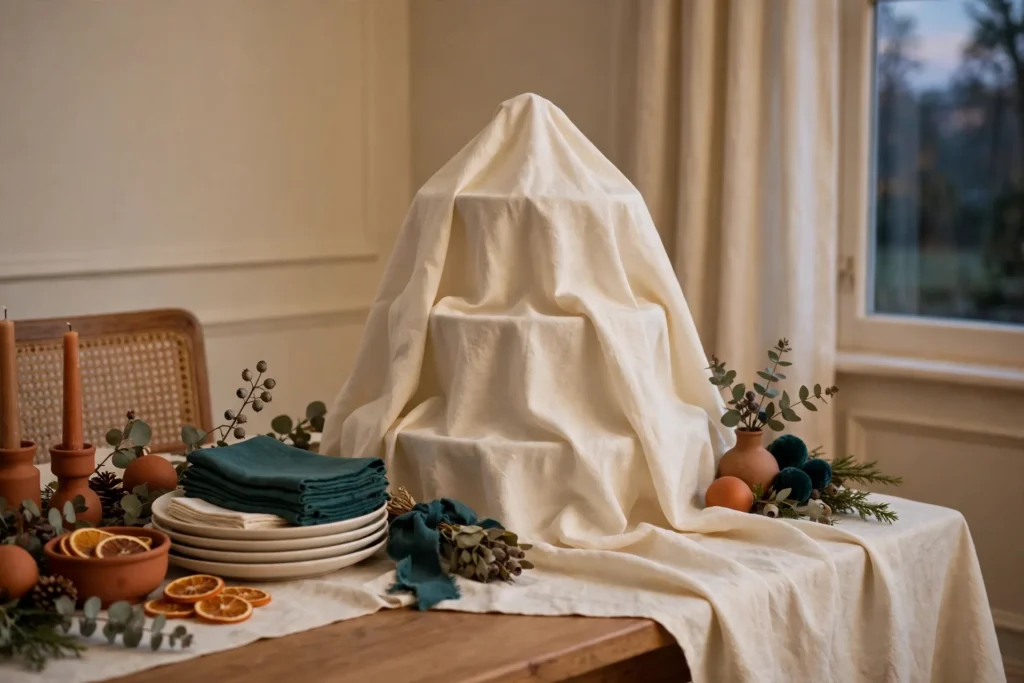
Height: tallest at the back, lowest at the front. Cake stands, tiered trays, and sturdy boxes under tablecloths create three levels: tall at the back (cakes, gingerbread house, trifle), medium in the middle (pies, tarts), low at the front (cookies, brownies, bars). Height is what makes the table readable — a guest standing in front can see every dish without moving one. Build the tiers before the desserts arrive, not while holding a hot pie.
Order: one row per kind. Pies together, cookies together, cakes together. Grouping by kind stops the table looking like a jumble and lets guests find what they want without a search. Within each group, the best-looking dish goes at the front of the group — the table photographs well and serves well at the same time.
Labels: every dish labeled. A small card in front of every dish: the dish name, and any dietary note that matters — “contains nuts,” “gluten-free,” “no dairy,” “vegetarian.” Labels are what make a dessert table self-serve. A guest who can read the card does not have to ask the host, does not have to guess, and does not have to risk an allergen. Labels are written before the table is set, not during the party.
One serving tool per dish. Every dish gets its own server, knife, or spoon — laid beside it, not shared between dishes. Shared tools mix flavors, spread crumbs, and create a queue at the one knife. One tool per dish, laid out with the dish, and the table serves itself without a bottleneck.
The Timing Rule: Dessert Goes Out AFTER Dinner, Not Before
Desserts come out after dinner, not before. This is a timing rule, not a serving preference — and it is the rule that stops the dessert table from competing with the dinner table.
Before dinner, the dessert table is set, covered, and left alone — in a room guests are not yet using, or covered with a clean cloth if it must share the room. Nothing is tasted early, nothing is moved, nothing migrates. The covered table is a promise, not a buffet.
After dinner, the cloth comes off, the table is revealed, and dessert becomes the event. The reveal matters: it gives the evening a second act, it keeps the dinner table clear for dinner, and it stops children (and adults) from filling up on cookies before the main meal. One reveal, once, after the plates are cleared.
The rule also protects the baking. Desserts sitting out for hours — uncovered, at room temperature, in a warm room — dry out, melt, and attract attention they do not need. Desserts that come out after dinner are at their best when they are eaten. Timing is presentation.
The Display: What Goes Where
Set the table in this order, and the display builds itself:
- The cloth and the tiers. A clean cloth, then the stands and boxes that make the three levels. Tiers first, desserts second — never the other way round.
- The tall back row. Cakes, the gingerbread house, the trifle. Tall, stable, at the back, where nobody reaches across them.
- The middle row. Pies and tarts, on plates, with their servers. One pie per plate, one server per pie.
- The front row. Cookies, brownies, and bars, on flat plates or in shallow trays. Low, reachable, easy to take one of without disturbing the rest.
- Labels and tools. A card in front of every dish, a tool beside every dish. Then step back and look: can you read every label from the front? Can you reach every dish without moving another? If not, adjust now — not mid-party.
- The small extras, contained. Napkins in a stack at one end, small plates in a stack at the other, a small pot for used napkins. Extras live at the ends of the table, not scattered across it. A dessert table without a waste spot spreads its rubbish; a dessert table with one stays clean by itself.
Leave one empty spot on the table — a gap the width of one plate. The gap is the landing zone: somewhere to set a dish down, somewhere to rest a plate while serving, somewhere for the dish a guest brings that you did not expect. A table with no gap has nowhere to put anything down, and everything ends up balanced on top of something else. One gap, kept empty on purpose.
The Pack-Away System: Leftovers Without the Mountain
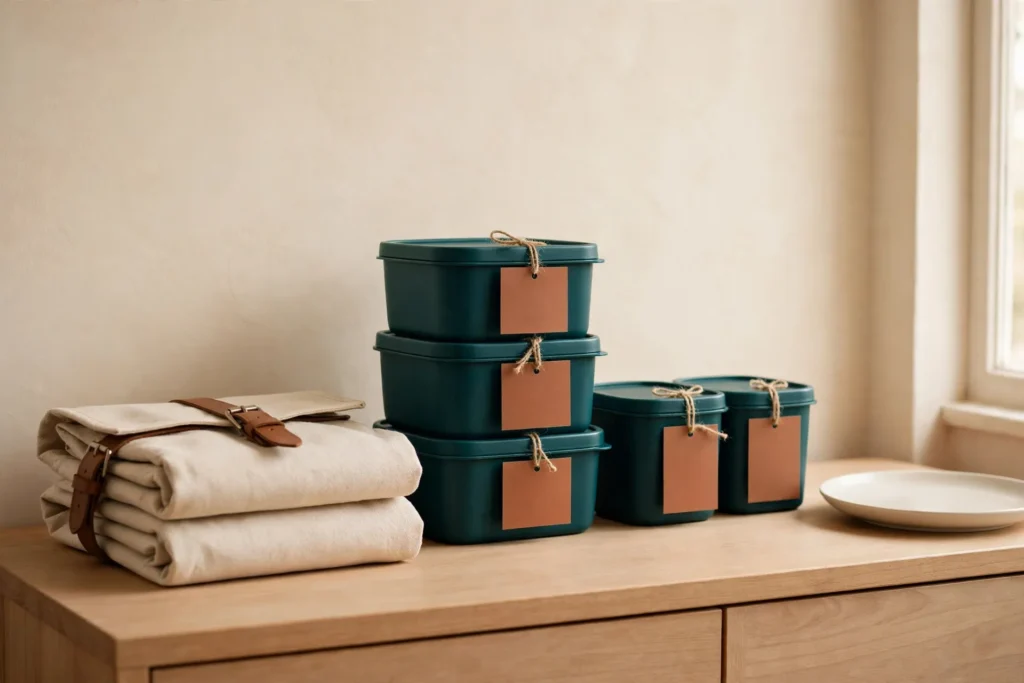
The pack-away starts before the party, not after it. Before the table is set, put out the pack-away kit: a stack of labeled containers and bags, lids beside them, on a cleared surface near — not on — the dessert table. The kit is the system that stops the leftover mountain.
When the evening winds down, the pack-away runs in one pass:
- One dish at a time. Each dish is packed into its own labeled container — dish name and date on the label, the same label discipline as the freezer vault. No mixed containers, no mystery boxes.
- The table clears in order. Back row first, then middle, then front. As each dish is packed, its stand or plate leaves the table too. The table empties visibly, which tells the evening it is ending — and tells the host the job is nearly done.
- The distribution rule, announced once. “Take a box home” — said once, warmly, when the pack-away starts. Guests taking leftovers home is the fastest way to clear the table, and it is also the kindest: the baking was made to be eaten, not to sit in the host’s fridge for a week. Our post-Thanksgiving reset covers the leftover pack-away system that this one feeds into.
- The table wiped and the cloth off. The table is wiped, the cloth is shaken and put away, and the surface is clear. The room is reset, not just tidied — and the reset takes fifteen minutes, because everything had a place and a container from the start.
Leftovers that go home go in labeled containers. Leftovers that stay go into labeled containers in the fridge or freezer, with dates, on the same day — never “in the morning,” because morning leftovers are forgotten leftovers.
What the Dessert Table Is Not
The dessert table is not the dinner table, and it is not the baking zone. The dinner table — our Thanksgiving tablescape reset — is set for the meal, cleared for dessert, and never shared with the dessert display. The baking zone — our baking station reset — is where desserts are made, and it stays a work zone until the baking is done. Three zones, three jobs: make, eat, display. The dessert table is the display, and it does not borrow the dinner table’s space or the baking zone’s mess.
Free Printable: The Dessert Table Layout
The free printable for this post is the dessert table layout: the three tiers, the placement order, the label template, and the pack-away checklist, on one page. Print it, stick it where the dessert table will be set, and the display builds itself.
FAQs
What if I do not own cake stands?
You do not need to buy them. Sturdy boxes under a tablecloth, an upturned bowl under a plate, a stack of books under a cloth — all make tiers. The tier is a height difference, not a purchase. What matters is tallest at the back, lowest at the front, and stable.
How many desserts should be on the table?
One table’s worth — which means as many as fit in three tiers with a gap left empty. For most gatherings, that is five to eight dishes: one tall centerpiece, two or three middles, three or four low dishes. More than that, and the table is crowded; run a second wave instead of a bigger table.
What about the gingerbread house — does it count as a dessert?
It counts as the centerpiece, not a serving dish. It sits tall at the back, labeled, admired — and it is not expected to be eaten on the night. Centerpieces are display; serving dishes are food. The table holds both, and the label says which is which.
Can children serve themselves from the table?
Yes — that is the point of labels, low front rows, and one tool per dish. The front row is at child height on purpose, and the low dishes are the sturdy ones: cookies and brownies, not the trifle. The tall back row is for adults to serve, and children know the difference because the tiers show it.
What if a guest brings a dessert I did not plan for?
That is what the empty gap is for. The unexpected dish goes in the gap, gets a label written on the spot, and gets a serving tool from the pack-away kit. The table absorbs one surprise gracefully. Two surprises, and the second wave starts early — which is also fine, because the system is built for waves.
Related Reading
- The Thanksgiving Tablescape Reset — the dinner table the dessert table must never spread onto, and the surface it is revealed beside.
- The Post-Thanksgiving Reset — the leftover pack-away system this table feeds into, and the one-hour reset that follows the feast.
- The Thanksgiving Kitchen & Fridge Reset — the kitchen where the baking happens, and the fridge space the leftovers need.