

Holiday Games Night, Minus the Mess: Set Up, Play, and Pack Away in One Evening
Games night is supposed to be the easy kind of hosting. No formal dinner, no seating plan, no table that has to look like a magazine. And yet, by nine o’clock, the living room tells a different story: board game boxes stacked on the floor, cards under the sofa, snack bowls on every surface, phones glowing in every hand, and a cookie mountain nobody quite knows what to do with.
The problem is not the games. The problem is that everything came out at once, with no system for putting it back. This post fixes only one shelf and one evening — the games and media shelf — and it is deliberately different from the whole party in our Friendsmas reset and from the whole room in our living room reset. This is the games-night ritual only: the one-box game kit, the phone-free rule, the cookie-exchange station, and the ten-minute pack-away that leaves the living room calm again by bedtime.
The rule that runs the whole evening is simple. One box comes out. Nothing else does. When the box goes back, the evening is over — and the room is already reset.
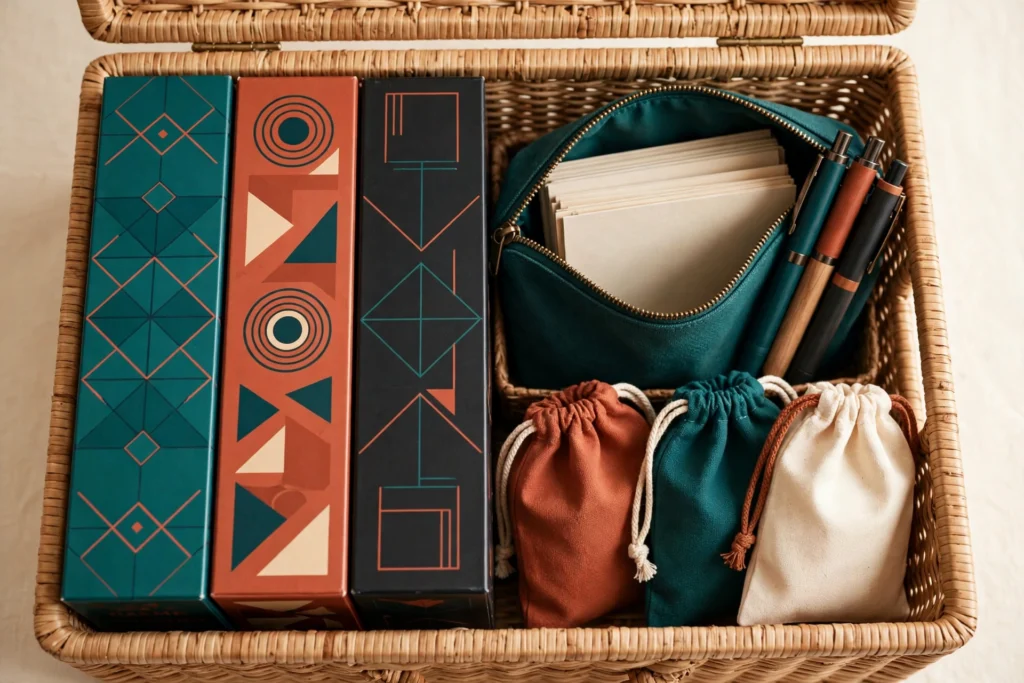
The One-Box Rule
Before games night, walk to the games shelf and be honest about what lives there. Most shelves hold three kinds of things: games you actually play, games nobody has touched in two years, and pieces of games that are no longer complete. The one-box system only works if the box holds the first kind. Everything else is not part of games night; it is part of the toy purge conversation, and it leaves the shelf before the guests arrive.
Choose one sturdy box — a lidded storage box, a large basket, or the biggest game box you own with room to spare. This box is now the whole of games night. It holds the games, the scorecards, the pens, and the snack tray. If something does not fit in the box, it does not come out for the evening. That single constraint does more for the living room than any amount of tidying after the fact, because it caps the mess before it starts.
Put the box where the evening will happen — beside the sofa, at the end of the coffee table, on the sideboard. Not in the hall, not in a cupboard upstairs. The box lives in the room, in reach, so nobody has to go hunting for a missing piece mid-game and leave a trail of open boxes behind them.
What Goes in the Box: The Games-Night Kit
The kit is small on purpose. A box stuffed to the lid is a box nobody wants to unpack, and a box nobody unpacks is a box nobody repacks either. Keep it to this:
Three games, maximum. One quick warm-up game that takes five minutes to explain. One main game that everyone can join, whatever their age. One quiet backup for the end of the evening, when energy drops and half the room wants something gentle. Three games is a choice, not a library — and choosing in advance is what stops the mid-evening shelf raid.
Scorecards and pens, in a zipped pouch. Loose scorecards are how paper ends up under cushions. One pouch, one set of cards, two pens. When the game ends, the pouch goes straight back in the box.
One snack tray. Not five bowls. One tray, with sections or small bowls that sit on it, that carries the snacks for the whole evening and contains every crumb. The tray is the boundary: snacks stay on the tray, the tray stays on the coffee table, and the coffee table stays clear of everything else.
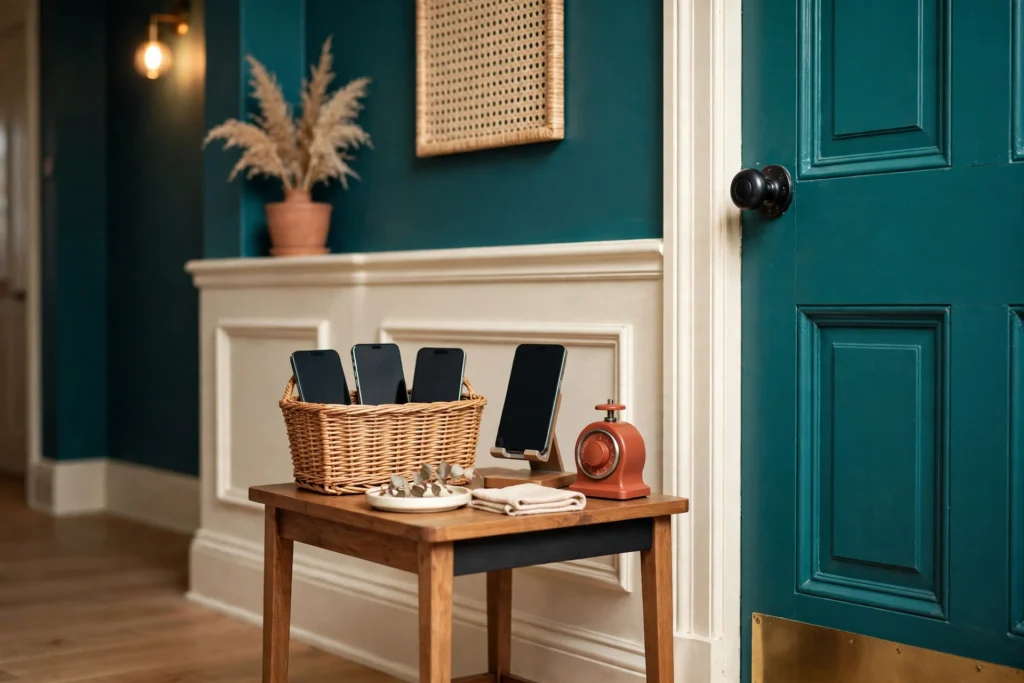
One timer or phone stand — for the host only. The host’s phone, on a stand, running the timer and the playlist. Everyone else’s phone goes in the phone basket (see below). One screen, doing a job, is a tool. Six screens, glowing in six laps, is the evening quietly leaving the room.
The cookie-exchange envelopes. If you are running a cookie exchange (see below), the labelled bags or envelopes for the swap live in the box too, ready before anyone arrives. No last-minute hunt for bags while cookies cool on every surface.
That is the whole kit. If your box already holds more than this, take the extra games out now and put them back on the shelf — or better, into the donate box. The box should close easily, with room for the lid. A box that closes easily gets closed. A box that overflows gets abandoned open on the floor.
Games That Work for Mixed Ages
The hardest part of games night is not the mess. It is picking a game that a seven-year-old, a teenager, a grandparent, and a guest who has never played anything can all enjoy at the same table. The shortlist below is built on one test: can everyone play in the first five minutes, with no reading of a rulebook at the table?
Trivia, in teams. Teams fix trivia. A child teams with an adult, the questions are read aloud, and nobody is put on the spot alone. Keep the rounds short — ten questions, then a break — and let the youngest team member read the scorecard.
Charades and drawing games. No equipment, no setup, no age barrier. One person acts or draws, everyone else shouts. These games work because the silliness is the point, and silliness does not need instructions.
Bingo, holiday edition. Make or print simple holiday bingo cards — tree, star, snowman, candy cane — and call them from a hat. Young children can play without reading, adults can play without thinking too hard, and a full card is a satisfying end to a round.
A simple card game. One deck, one set of rules everyone learns in a minute. Card games scale to any table size, pack away in seconds, and survive a spill better than a board with a hundred pieces.
A guessing game. Twenty questions, “who am I” with names on foreheads, or a holiday version of either. Guessing games need nothing at all — no box, no pieces, no setup — which makes them the perfect backup when the main game runs long.
A cooperative game. One where the table wins or loses together. Cooperative games remove the sting of losing for younger players, and they keep the evening friendly instead of competitive — which matters when the same people have to share a house for the rest of the holidays.
Pick your three from this list before the evening, and write them on the kit list (see the printable below). Deciding at the table, with everyone shouting suggestions, is how six boxes end up open at once. Deciding in advance is how one box stays enough.
The Phone-Free Game Rule
Games night fails quietly when every phone stays in every lap. Nobody announces that they have stopped playing; they just drift — one message, one scroll, one photo — until half the table is watching the game and half is watching a screen. The phone-free rule stops the drift before it starts, and it works because it is simple, visible, and the same for everyone.
One basket, by the door. A small basket or bowl, placed where guests arrive. Phones go in as people come in — not confiscated, just parked. The host goes first. The rule only works if it is visibly the same for the host as for everyone else.
One exception, announced in advance. The host’s phone stays out, on its stand, running the timer and the music. Say so when people arrive: “Mine stays out for the timer. Yours get the evening off.” One announced exception is a system. A quiet exception is a double standard, and guests notice it instantly.
A photo moment, built in. The reason most people reach for a phone is the photo they want to take. So build it in: one photo moment, after the first game, when everyone poses with the cookie exchange or the winning team. Take the photo on the host’s phone, share it later, and put the basket back where it belongs. One photo moment satisfies the urge; an open phone policy never does.
No phones at the table, phones welcome at the break. Between games, the basket is open. Anyone can check a message, answer a call, post the photo. Then the basket closes again and the next game starts. Breaks are the release valve that makes the rule feel fair instead of strict — and fair rules are the ones people actually follow.
If a guest genuinely needs their phone — a babysitter on call, a shift to cover — say so and mean it. The rule is about attention, not punishment. The guest who keeps their phone for a real reason, and still plays, is following the spirit of the evening. The guest scrolling through the main game is not, and the basket is the gentle way of saying so without a speech.
The Cookie-Exchange Station
The cookie exchange is the part of games night that creates the most clutter for the least reason. A dozen people arrive with trays, boxes, and bags; the kitchen counter disappears under cookies; everyone takes some of everything; and the host is left with a mountain of mixed cookies, half of them stale by morning, and a counter that takes an hour to clear.
The station fixes it with one rule, announced before the evening: bring two dozen, take two dozen, no leftovers mountain.
One table, one station. A side table, a cleared counter end, or the dining table if the games are in the living room. The exchange lives in one place, and one place only. Cookies do not migrate to the coffee table, the sofa arm, or the kitchen worktop. One station, contained.
Labelled bags, ready before anyone arrives. The bags or envelopes from the kit box, labelled in advance with each guest’s name — or blank, with a pen beside them, so guests label their own. A labelled bag is a decision made once. An unlabelled pile of cookies is a decision remade a dozen times, with crumbs.
Two dozen in, two dozen out. Each guest brings two dozen cookies of one kind, and leaves with two dozen cookies of mixed kinds — one dozen in each bag, or two bags of one dozen. The numbers are the system: nobody brings four dozen “just in case,” nobody leaves with a carrier bag of random cookies, and the host is not left holding the surplus. If someone brings extra, the extra goes home with them. Say so kindly, in advance, and it is a rule instead of a rejection.
The swap happens once, at a set time. After the first game, or at the break — one swap moment, when everyone fills their bags from the station at the same time. A single swap is a moment, and a moment is memorable. An all-evening free-for-all is a mess that never quite ends.
Leftovers leave with their baker. Whatever is left on the station at the end of the swap goes home with the person who brought it. Not into the host’s cupboards, not into a tin on the counter. The station is empty when the swap ends, and the host’s kitchen stays the host’s kitchen.
Done this way, the cookie exchange is the highlight of the evening instead of its aftermath: a table full of variety, a bag full of cookies to take home, and a station that is clear again in ten minutes.
Set Up in 20 Minutes, Pack Away in 10
The evening has a shape, and the shape is what keeps it calm. Work to this timeline and the room resets itself.
Twenty minutes before guests arrive. Box beside the sofa. Snack tray on the coffee table, empty for now. Phone basket by the door. Cookie-exchange station set, bags labelled. Coffee table clear of everything except the tray and the box. That is the whole setup — if the setup takes longer than twenty minutes, something that is not in the box has crept into the plan.
Guests arrive. Phones in the basket, host goes first. Snacks on the tray. First game explained in five minutes, played straight away. No committee meeting about which game to play — the three games were chosen in advance, and the first one is already on the table.
The break. Phones out, photo moment, cookie swap at the station. Bags filled, station cleared, phones back in the basket. The break is fifteen minutes, timed on the host’s phone, and then the second game starts.
The last game. The quiet backup game, or the last round of the main game. Energy drops, the room softens, and the evening winds down on its own instead of needing to be ended.
Ten minutes to pack away. This is the part most hosting advice skips, and it is the whole point of the one-box system. Scorecards into the pouch, pouch into the box. Games into the box, lid on. Snack tray to the kitchen, crumbs in the bin. Cookie station: leftovers with their bakers, table wiped, bags gone. Cushions straightened, throws folded over the sofa arm, coffee table clear. Ten minutes, because there was only ever one box to put back — and because the pack-away starts the moment the last game ends, not the morning after.
By bedtime, the living room is calm again. Not “tidy enough,” not “we will deal with it tomorrow” — calm. The box is back on its shelf, the tray is washed, the station table is bare. Tomorrow morning, there is nothing to face except the memory of a good evening. That is what the system buys: not a tidier shelf, but a morning with nothing to undo.
The Games-Night Kit List (Free Printable)
The system lasts if you can run it without thinking. A one-page games-night kit list holds the whole post:
- One box only: games, scorecards, pens, snack tray, cookie-exchange bags. Nothing else comes out.
- Three games, chosen in advance: one quick warm-up, one main game for all ages, one quiet backup.
- Mixed-age test: everyone playing in the first five minutes, no rulebook at the table.
- Scorecards and pens in one zipped pouch — no loose paper under cushions.
- One snack tray — snacks stay on the tray, the tray stays on the coffee table.
- Phone basket by the door — host goes first, one announced exception for the timer, one photo moment built in.
- Cookie exchange: bring two dozen, take two dozen, labelled bags, one swap moment, leftovers leave with their baker.
- One station only for the exchange — cookies do not migrate around the house.
- Set up in 20 minutes — box, tray, basket, station, clear coffee table.
- Pack away in 10 minutes — box closed, tray washed, station clear, cushions straight, room calm by bedtime.
Print it, keep it with your holiday printables, and check the box against it before guests arrive. Next time someone suggests games night, the answer is easy — because the system is already packed, waiting on its shelf.
The 10-Point Games-Night Checklist
Run this list before the first guest arrives:
- The box closes easily, with room for the lid — nothing is stuffed in on top.
- Three games only, chosen in advance, and everyone at the table can play the first one in five minutes.
- Scorecards and pens are in the zipped pouch, in the box — not loose on a shelf.
- The snack tray is on the coffee table, and the coffee table holds nothing else.
- The phone basket is by the door, and the host’s phone is on its stand for the timer.
- The cookie-exchange station is set, bags are labelled, and the two-dozen rule was shared in advance.
- The shelf games that are not in the box are back on the shelf — or in the donate box.
- The break is planned: photo moment, cookie swap, phones out, then back in the basket.
- The pack-away is planned too: who carries the tray, who wipes the station, who folds the throws.
- The room is calm before anyone arrives — because the calmest games nights start calm, and stay that way.
Ten checks, and the evening runs itself — one box, one tray, one basket, and a living room that is calm again by bedtime.

FAQs
What is the one-box game kit?
One box that holds everything games night needs: three games, scorecards and pens in a pouch, one snack tray, and the cookie-exchange bags. If it does not fit in the box, it does not come out for the evening — and packing away means closing one box.
How do you keep games night from trashing the living room?
Cap what comes out before it starts: one box, one snack tray, one cookie-exchange station. Set up in twenty minutes, play, then pack away in ten minutes while the last game is still fresh in everyone’s mind.
What games work for mixed ages at a holiday gathering?
Trivia in teams, charades and drawing games, holiday bingo, one simple card game, a guessing game, and a cooperative game. The test is always the same: everyone playing in the first five minutes, with no rulebook at the table.
How does a cookie exchange work without leftovers?
Bring two dozen cookies of one kind, take two dozen of mixed kinds, in labelled bags, at one set swap moment. Whatever is left on the station goes home with the person who brought it — no leftovers mountain for the host.
What is the phone-free rule for games night?
Phones go in a basket by the door as guests arrive, the host goes first, and the host’s phone stays out only for the timer. Phones come out at the break for messages and one photo moment, then go back in the basket for the next game.





2 Comments