

Kids Room Ideas: The 4-Zone Reset System for a Tidy Kids Room
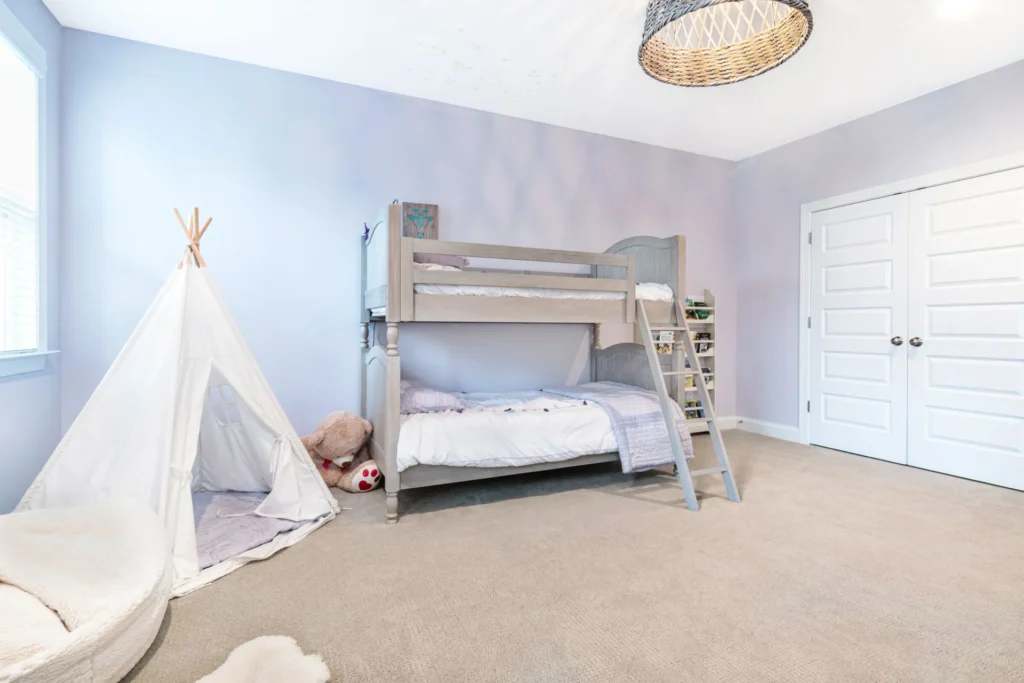
Photo by Curtis Adams on Pexels — https://www.pexels.com/photo/children-bedroom-with-bunk-beds-5008397/
Most kids rooms do not look messy because the child owns too many toys. They look messy because the room has no map: no zone for sleep, no zone for play, no rule for which toys are out, and no clock for when the room resets. A new bin, a new shelf, a new toy box, and the room still looks the same by Thursday: toys on the floor, books on the bed, homework on the play mat, and a parent tidying a room the child cannot tidy alone. A list of kids room ideas does not fix that, because a list has no zones, no rotation and no reset. The room gains storage faster than it gains order.
Kids room ideas are not a shopping list. They are a system: a map that decides where everything lives, a rotation that decides which toys are out, rules that decide what never lands on the floor, and a timeline that decides which evening resets which zone. Four zones in order — sleep, play, study, storage — so the bed is made before the toys come out. Three toy groups — play now, rest, rotate — one group out at a time, swapped every Sunday. And a 10-minute nightly reset, timed, before bed — so the room returns to its map every night instead of once a season. That is the whole system — and it is the reason this post exists now: kids room ideas are up 131% on Pinterest (PinPinterest, Rising on Pinterest, November 2026 edition, saves 29 Sep–29 Oct 2026), so a system built now is ready while the search is climbing, not after it has passed. No rule here is presented as research: the zones, the toy-rotation rule, the child-height rule, the one-home rule, the 10-minute reset and the one-in-one-out rule are this post’s own system rules, labeled as such.
The system at a glance
Five steps, in order. Then a printable, and a challenge.
- Step 1 — The four zones: sleep, play, study, storage — one zone at a time, in that order, so the bed is made before the toys come out.
- Step 2 — The toy-rotation station: three toy groups (play now, rest, rotate), one group out at a time, swapped every Sunday in 5 minutes.
- Step 3 — The rules that keep the room one system: everything at child height, one labelled home per toy, a 10-minute nightly reset, one toy in means one toy out.
- Step 4 — The four-evening timeline: Monday sleep, Tuesday play, Wednesday study, Thursday storage — four evenings, 20 minutes each, and the room is fully reset.
- Step 5 — The room map + rotation checklist: every zone mapped before it is reset, every toy group listed before it rotates.
Six rules govern the whole system: sleep runs first, because a made bed sets the room; one toy group out at a time, because three groups out is a floor, not a playroom; everything at child height, because a shelf the child cannot reach is a shelf the parent tidies; every toy has one labelled home, because a toy with no home lives on the floor; the room resets in 10 minutes every night, because a reset with no clock spreads to 30 minutes and then never happens; and one toy in means one toy out, because a toy count that only grows is a rotation that stops working. A room that follows the kids room ideas rules resets itself in 10 minutes a night; a room that ignores them gets tidied once a season, in a weekend-long purge, and is messy again by Tuesday — and this system exists so that never happens.
Step 1 — The four zones, in order
Four zones. Sleep, play, study, storage — in that order, and never starting with storage.
- Zone 1 — Sleep: the bed, made every morning before breakfast; one blanket, one pillow each, nothing stored on the bed. The bed is the first zone because a made bed sets the room — everything else resets around it, and a room with an unmade bed looks unfinished no matter how tidy the toys are.
- Zone 2 — Play: the play mat and the toy group that is out this week — one group only, on the mat, never spread past the mat’s edge. Play stays in its zone so the rest of the room stays a room: the mat is the boundary, and a toy past the mat’s edge is a toy that goes home.
- Zone 3 — Study: the desk and chair by the window, homework supplies in one caddy, books on one shelf — the desk is for schoolwork and drawing only, never for toy storage. The study zone borrows its discipline from the Homework Station Ideas post — #103 runs four school zones for one break week, and this post’s study zone runs all year, in the same spot, with the same caddy.
- Zone 4 — Storage: the cube unit and labelled bins at child height — the two resting toy groups, out-of-season clothes, and the donate bag live here, behind closed bins, not on display. Storage runs last because it is where everything returns: a zone that is set up first becomes a cupboard, and a cupboard is where toys go to be forgotten.
The zones decide the room before the room decides the day. In kids room ideas, a room that starts at Zone 1 has a made bed before it has a toy on the mat — the sleep zone is set, the play zone has its boundary, and the room already feels calm before a single book is shelved. A room that starts at storage has organised the cupboard and left the bed unmade. The zones run in order for a reason: sleep first, play second, study third, storage last — and a zone that is skipped is a zone that shows up later as a floor full of toys and a desk full of homework that never got done.
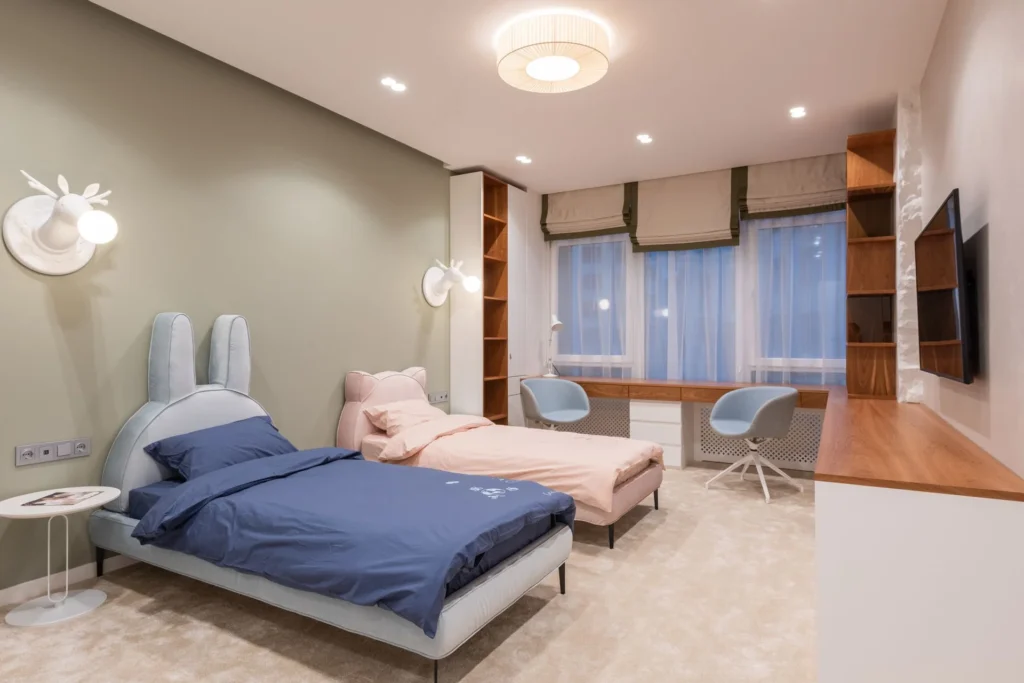
Photo by Max Vakhtbovych on Pexels — https://www.pexels.com/photo/empty-modern-bedroom-for-children-6758769/
Step 2 — The toy-rotation station: three groups, one out, Sunday swap
Three toy groups, roughly equal in size — PLAY NOW (out this week), REST (on the shelf this week), ROTATE (in the cupboard this week). One group out at a time, swapped every Sunday.
- One group out at a time: roughly a third of the toys. The other two groups rest on the shelf and in the cupboard — out of sight, out of the floor, and missed just enough to feel new when they return.
- Swap every Sunday, 5 minutes: play-now goes to rest, rest goes to rotate, rotate comes out as the new play-now. One swap, once a week, on the same day every week — a rotation with no fixed day is a rotation that never happens.
- Full cycle is three weeks: every toy is out one week in three, and no toy is ever out two weeks running. A toy that stays out all month stops being played with; a toy that returns after two weeks away plays like new.
- The rotation checklist records each group first: the checklist on the printable lists all three groups before the first swap — no group rotates without being written down first. A group that is not written down is a group that gets lost in the cupboard.
- New toys enter the ROTATE group, never straight into play-now: so the one-in-one-out rule has somewhere to send the toy that leaves — the new toy waits its turn, and the old toy leaves through the donate bag.
The rotation is the reason kids room ideas work as a system instead of a buying habit. Without rotation, every toy is out all the time — the floor is the storage, the child plays with nothing because everything is available, and the only fix is buying more storage. With rotation, a third of the toys are out, the child actually plays with them, and the room resets in 10 minutes because there is only one group to put away. The seasonal version of this discipline is the Purge Before the Presents post — #188 clears toys in one 45-minute session before Christmas, and this post’s rotation is the everyday system that keeps that purge small.

Photo by Tatiana Syrikova on Pexels — https://www.pexels.com/photo/interior-of-children-bedroom-with-wooden-furniture-and-toys-and-globe-placed-on-shelves-in-room-3932930/
Step 3 — The rules: child height, one home, 10 minutes, one in one out
Four rules, one job between them: keep the room a system the child can run, not a system the parent runs alone.
- The child-height rule: everything the child uses lives at the child’s height — shelves, bins and hooks the child can reach without climbing. A shelf the child cannot reach is a shelf the parent tidies — and a room the parent tidies is a room that never stays tidy. If the child cannot reach it, it does not live there.
- The one-home rule: every toy has one labelled home — a bin, a shelf, a hook — and the label is a picture, not a word, for children who cannot read yet. A toy with no home lives on the floor, and a toy with two homes lives in neither. The label is the rule: if the child can see where it goes, the child can put it away.
- The 10-minute nightly reset: the room returns to its map in 10 minutes every night, before bed — timed, not finished-when-finished. The reset is the same four moves every night: toys to their homes, books to their shelf, desk cleared, bed ready. A reset that has no clock spreads to 30 minutes and then never happens.
- The one-in-one-out rule: a new toy in means one toy out — to the donate bag, the hand-down box, or the bin. The rule keeps the toy count flat, so the rotation never grows past three groups and the storage never overflows. A birthday or holiday is the test of this rule: the new toys arrive, and the same number leaves the same day.
The rules are where kids room ideas stay a system instead of a tidy-up lecture. A room that breaks the child-height rule has beautiful high shelves and a floor full of toys; a room that breaks the one-home rule has bins without labels and toys without homes; a room that breaks the 10-minute rule has a nightly tidy that nobody starts; and a room that breaks one-in-one-out has a rotation of four groups, then five, then a cupboard that will not close. And the same budget discipline already runs elsewhere in this house: the Budget Home Decor System caps a room at $100, and a kids-room reset fits inside that budget — bins, labels and a map cost less than one new toy box, and they work longer.
Step 4 — The four-evening timeline: Monday to Thursday, 20 minutes a night
Four evenings, 20 minutes each. Monday sleep, Tuesday play, Wednesday study, Thursday storage — and the room is fully reset.
- Monday evening (20 minutes): Zone 1 — sleep: beds made, bedding straight, nothing stored on the bed. The sleep zone runs on Monday so the week starts with a made bed: a room with its bed made is a room that already feels reset before the week begins.
- Tuesday (20 minutes): Zone 2 — play: the week’s toy group on the mat, everything else back to its home. One group only, on the mat, never past the mat’s edge — the play zone is the loudest evening of the four, and the one that proves the rotation works.
- Wednesday (20 minutes): Zone 3 — study: desk cleared, caddy stocked, books back on their shelf. The quietest evening of the four, and the one that finishes the school side of the room. The closest cousin to this evening is the school launch in the Back-to-School Organization post — #115 launches the school year, and this post’s study zone is the room that launch lands in, every week.
- Thursday (20 minutes): Zone 4 — storage: bins labelled, resting groups in place, donate bag checked. The room is fully reset in four evenings, 20 minutes each — then the 10-minute nightly reset keeps it that way, and Friday is free.
The timeline is what keeps kids room ideas to four evenings. A reset without a timeline spreads across the month — a bed made on the 5th, a desk cleared on the 12th, a storage zone that never quite gets labelled — and a room that spreads its reset across the month is a room that is never actually reset. A room with a timeline is finished on Thursday, and the rest of the week is for playing in it. Before any zone starts, one job runs first: the family thread that opens this room. The Elf on the Shelf Ideas post is the elf that visits the room for 24 days — #123’s elf needs a room with zones to hide in, and this post is the room it hides in.
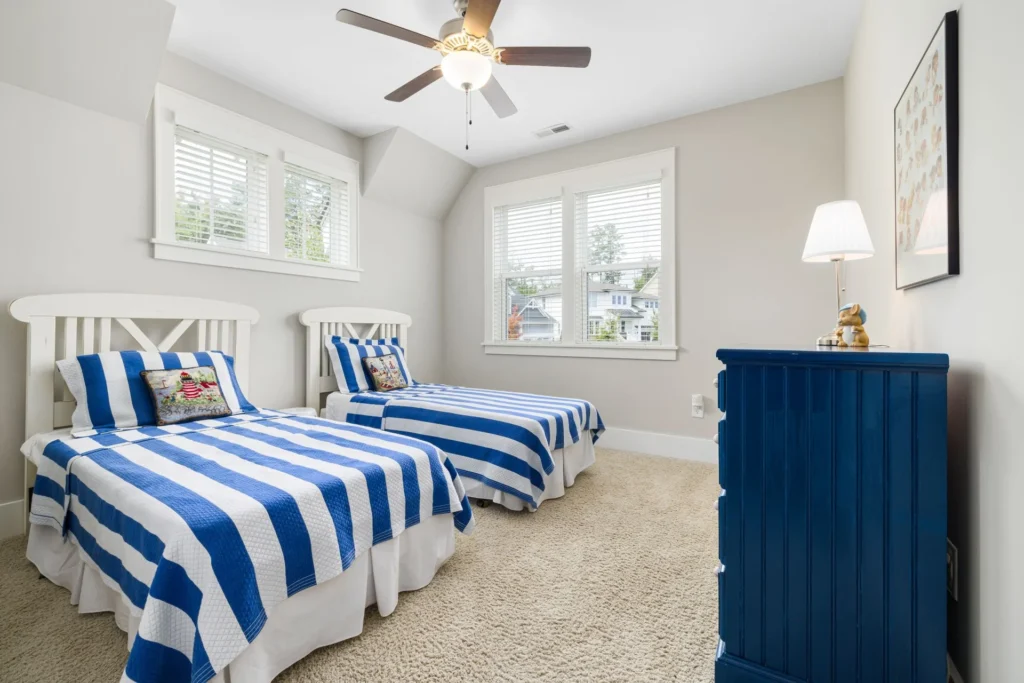
Photo by Curtis Adams on Pexels — https://www.pexels.com/photo/view-of-a-kids-bedroom-10099276/
Step 5 — The room map + rotation checklist
The checklist is the kids room ideas system in two pages: the zones, the toy groups, and every toy’s home mapped before it is reset.
The checklist has one line per zone — sleep, play, study, storage — and one checkbox per zone, checked only when the zone is reset and its toys are home, not when it is started. A zone checked off before it is reset is a zone that gets forgotten by bedtime. The rotation checklist has one line per toy group — play now, rest, rotate — with the swap date written in advance, so no group rotates without being listed first. Every zone is mapped before it is reset, every toy group is listed before it rotates, and the donate-bag check — one toy out for every toy in — is written on the checklist the day it is printed, so the toy count stays flat from the start.
The checklist is also the record that makes the system repeatable. After one month, the checklist shows the pattern: which toy group got played with most, which toy never left its bin, which zone took the full 20 minutes, and which zone finished in 10. A system that is not written down is a system that is re-invented next month; a system on two pages is a system that runs next month in four evenings, again.
Before you start: print the checklist tonight
Print the room map and rotation checklist tonight, not on Monday, so your kids room ideas week starts organised. Map the four zones — sleep, play, study, storage — sort the toys into three groups, label one home per toy with a picture, and set out the bins before the week starts: bins, labels, map, in one spot. The challenge is simple: reset one zone tonight, in 20 minutes — the map decides, you just follow the card. Four evenings, 20 minutes each, and by Thursday the room is fully reset, the toys rotate on their own, and the 10-minute nightly reset keeps it that way.
The free printable: room map + toy-rotation checklist
The printable for this post is a room map and a toy-rotation checklist: the map has one line per zone with a checkbox that is ticked only when the zone is reset and its toys are home, and the checklist has one line per toy group with the Sunday swap date written in advance — so the whole system fits on two pages.
Print it, map your four zones, sort your three toy groups, and start your kids room ideas week — the checklist is the only plan you need. The challenge is simple: reset one zone tonight, in 20 minutes — the map decides, you just follow the card.
Frequently asked questions
What is the Kids Room Reset System?
Four zones in order (sleep, play, study, storage), a three-group toy rotation swapped every Sunday, and a 10-minute nightly reset — four evenings, 20 minutes each.
How many toys should stay out at once?
One group only — roughly a third of the toys. The other two groups rest on the shelf and in the cupboard.
How often do I rotate the toys?
Every Sunday, one 5-minute swap — play-now goes to rest, rest goes to rotate, rotate comes out. Full cycle: three weeks.
How long is the nightly reset?
10 minutes, timed, before bed — the room returns to its map, not to perfect.
What if my child won’t tidy up?
Make the home obvious: bins at child height with picture labels, one group out at a time — tidy-up becomes a 2-minute put-away game, and the parent does the 10-minute reset first until the child copies it.
What ages is this system for?
Roughly ages 3–10 — the zones stay the same as the child grows; only the bin labels and the toy groups change (picture labels before reading, word labels after).