
The Purge Before the Presents: Declutter Toys Before Christmas in One 45-Minute Session
Picture Christmas morning at your house. The wrapping paper is everywhere — and that’s the fun part. The not-fun part? The mountain of toys that already lived in your house before the gifts arrived, now buried under a second mountain of new ones. By December 26th, the playroom looks like a toy store exploded, and your brain is already doing the math on where it will all go.
Here’s the thing every organized mom learned the hard way: the answer is not a bigger toy box. The answer is that you declutter toys before Christmas, not after.
Mid-October is exactly the right moment. You’re inside the sweet spot where planning now pays off in December: one focused 45-minute session today, plus one clever November habit, and Christmas morning brings joy instead of a storage crisis. Think of it as the toy-box version of our heritage Christmas declutter — that guide handles the decor; this one handles the stuff the presents will compete with.
This method has four parts, built from parent-tested sources: a fast Keep/Donate/Toss purge, a boundary rule that runs itself, a one-in-one-out agreement made before the holidays, and the famous November toy rotation trick. None of it requires a full weekend. All of it prevents January regret.
Why Now: The Timing Math Nobody Tells You
Homes & Gardens treats the pre-Christmas toy purge as an annual editorial staple — it shows up every single year because the problem shows up every single year. Their rule of thumb is beautifully simple: every toy needs a designated spot, and when the shelves and bins overflow, it’s time for an edit. Gifts are coming whether the shelf has room or not — so you make the room first.
There’s a second timing layer, and it’s the clever one: part four of this method — toy rotation — is explicitly a November move. Starting mid-October means you’re not rushing it the week of Thanksgiving. You purge now, rotate in November, and glide into December with physical space already waiting under the tree.
So block out 45 minutes this week. Put on your favorite playlist, grab three bags (Keep, Donate, Toss), and let’s do this.
Part 1: The Toy Purge — Keep, Donate, Toss in 45 Minutes
The purge that From Overwhelmed to Organized recommends is ruthlessly simple: work one category at a time, not the whole playroom at once. Stuffed animals. Then action figures. Then art supplies. Small batches keep your decision muscles fresh and keep the floor from becoming an impassable minefield.
Set a timer for 45 minutes and sort each category into three piles with these purge targets:
- Outgrown toys — the baby toys the toddler has clearly outgrown, the puzzle for a younger age
- Long-unplayed-with toys — if it hasn’t been touched in months, it’s decoration, not a toy
- Broken toys and missing-piece toys — be honest about the game with 11 pieces and the truck with no wheels
- Corroded-battery toys — the electronic toy with the battery door you never open because you know what’s inside
- Space-hogging big toys — the ride-on, the play tent, the giant dinosaur; if it eats a quarter of the room and gets used twice a month, it goes
- Forgotten small toys — the party-bag fillers, the happy-meal relics, the bottom-of-the-bin mysteries
Two rules from Tampa Bay Moms’ “Big Purge Before the Presents” guide make this painless: do the first pass while the kids are out or napping — you’ll quietly clear the obviously-dead items (broken, corroded, forgotten) without anyone noticing, because no one was playing with them anyway. Then involve the older kids for the rest. They decide about their “favorites” shelf; you already handled the dead inventory solo.
One more Tampa Bay Moms gem: sell the outgrown-but-good toys and let the proceeds fund presents. It’s not just decluttering — it’s a money-sense lesson for the kids, and it turns “we’re getting rid of stuff” into “we’re trading up.” If you’ve ever wondered whether this could double as a teaching moment, KinderCare’s take (via NewsUSA) says yes — and we’ll get to that in a moment.
This purge pairs beautifully with the 12-12-12 method if you want to gamify it: 12 toss, 12 donate, 12 rehome, ten minutes a pop. And if decision fatigue hits mid-purge, borrow the ruthlessness from our reverse-decluttering post — pull everything out of one bin, and only put back what earns its spot.

Part 2: The Boundary Rule — One Container Per Category
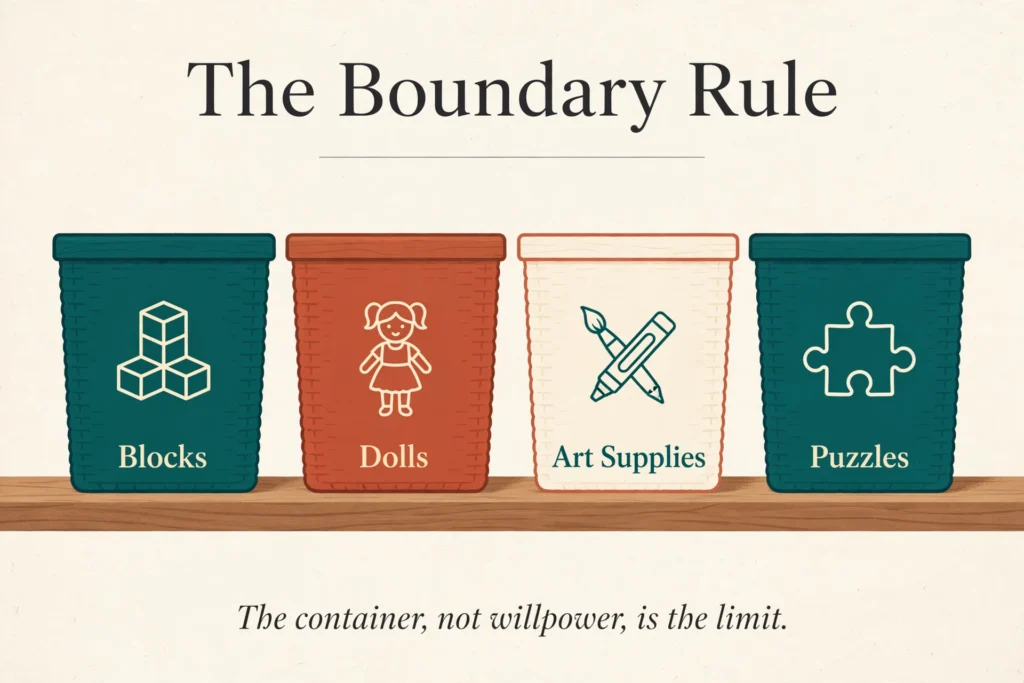
Here’s where the system replaces willpower. Once the purge is done, give every toy category exactly one physical container: one cubby for building sets, one shelf for dolls, one bin for art supplies. The rule, in the Homes & Gardens framing: the container is the limit, not your resolve. When the container is full, something has to go before anything new comes in.
Physical boundaries teach kids the limit better than any lecture. A child can see that the bin is full. There’s no abstract “too many toys” argument — there’s a bin, and it’s full, and that’s the whole conversation. This is the same logic that makes our fall declutter checklist work: external limits beat internal guilt every time.
Practical tips for setting up your boundaries:
- Match the container to the child. Little kids need shallow, wide bins they can actually reach into and tidy (tall deep bins become black holes). Older kids can handle cubbies and shelves.
- Label with pictures, not words, for pre-readers. A photo of the category taped to the bin works wonders.
- Leave 20% breathing room in every container. A bin packed to the rim is a bin that explodes onto the floor daily. The boundary works best when there’s slack in the system.
- Make the container beautiful. The boundary rule only sticks if the container is something you like looking at. This is one area where a pretty basket from a thrift flip run beats a plastic tub every time.
When Christmas morning arrives, the boundary rule does its quiet magic: new gift goes into the building-set cubby, so an old set gets chosen for donation. Which brings us to part three.
Part 3: One-In-One-Out, Starting Today
Homes & Gardens’ companion advice for the holidays is the one-in-one-out rule: as new gifts arrive, one older toy gets chosen to donate. But here’s the critical detail — make this agreement with your kids before Christmas morning, not on it.
Pick a calm moment — a car ride, a Saturday breakfast — and frame it positively: “For every gift that comes in this Christmas, we get to pick one toy that’s ready to make a new friend.” The kids are part of the plan, so it feels like a tradition, not a punishment. KinderCare’s guidance (via NewsUSA) backs this up: when kids help decide what stays and what finds a new home, they learn responsibility and generosity.
Frame donations as toys “making new friends” — that single phrase, borrowed from KinderCare’s framing, transforms the conversation. Your child isn’t losing a toy; they’re sending it on an adventure to a kid who will love it. And there’s a developmental bonus worth knowing: fewer toys leads to deeper, more imaginative play. The kids don’t just tolerate a smaller collection — they often play better with it.
Part 4: The November Toy Rotation Trick
Now the maintenance move — and the one that makes this whole method feel almost unfair in its effectiveness.
In early November, pack away roughly one-third of the kept toys. Not into the trash, not into donation bags — into storage bins in the garage, the attic, or the top of a closet. Leave a smaller, curated selection on the shelves. Then swap the selection every two to three weeks.
Homes & Gardens calls this the November toy rotation, and the quote from Pocket Storage co-founder Max Wilson says it all: “The secret to a stress-free Christmas morning is making space now.” Old toys, rediscovered after a few weeks in storage, feel brand new again — the kids get a “fresh toy” experience for free, several times over.
And the rotation has two bonus effects worth the effort alone:
- It curbs impulse buying. When the shelves hold a curated selection instead of an overwhelming pile, you stop feeling the urge to buy “just one more thing” — the playroom already looks intentional and calm.
- It boosts independent play. A curated shelf invites engagement; an avalanche shelf invites dumping. Less visual noise means kids actually see what they have and dive in.
Logistics, simplified: use three labeled bins (“Set A,” “Set B,” “Set C”). November starts with Set A on the shelves. Mid-November, swap to Set B. Early December, swap to Set C — and suddenly Christmas morning has physical space waiting for new gifts, because a third of the collection is tucked away. January’s traditional “where does it all go” panic simply never arrives.
Keep the rotation on autopilot with the weekly reset ritual — a Sunday swap takes five minutes once the bins are labeled. And if you’re hosting family over the holidays, a rotation-curated playroom is half the battle for the guest-ready home you’re building.

The Generosity Angle: Why This Is a Gift to Your Kids, Too
It’s worth saying plainly: this isn’t about taking things away from children. KinderCare’s holiday guidance puts it perfectly — involving kids in the decision teaches responsibility and generosity at exactly the age when those lessons land hardest. A toy your child has outgrown becomes, in another child’s hands, a treasure. Letting them experience that — choosing the toy, wrapping it for donation, hearing where it goes — is a Christmas memory in its own right.
And the play research backs the smaller collection: fewer toys, deeper play. Your kids aren’t losing abundance. They’re gaining focus.
Your Free Pre-Christmas Toy Purge Checklist
To make the 45-minute session foolproof, we’ve turned this whole method into a one-page printable: the Pre-Christmas Toy Purge Checklist — the seven purge categories, a boundary-rule worksheet for mapping one container per category, and the November rotation calendar, all on a single page you can stick on the fridge.
It’s a free email freebie — use the signup form on this page (it’s in the footer) and it’s yours. Then work through it with a coffee in hand and Christmas handled before it starts.
And if you want the full holiday system — the Christmas-decor version of this method, the guest-ready room plan, the January-reset guide — the Holiday Home Reset Pack is coming soon. It’s the natural “what’s next” after this purge, and we’ll announce it right here the moment it launches.
Frequently Asked Questions
When should I declutter toys before Christmas?
November is the sweet spot — early enough to run the purge calmly, and perfectly timed for the November toy rotation method. Starting in mid-October is even better, since it gives you a relaxed runway. Never wait until January: by then you’re managing a pile-up instead of preventing one.
How do I get my kids to let go of toys?
Involve them in the decision rather than deciding for them. Do the first pass solo while they’re out or napping — clear the broken, corroded, and long-forgotten items no one will miss. Then let older kids choose for their “favorites” shelf, and frame every donation as a toy “making a new friend.” Kids who help decide what stays and what goes learn responsibility and generosity in the process.
What is toy rotation, and does it work?
Toy rotation means packing away about a third of your child’s toys in storage, leaving a smaller curated selection on the shelves, and swapping the selection every two to three weeks. It works because rediscovered toys feel brand new — the rotation curbs impulse buying, boosts independent play, and guarantees physical space is waiting when Christmas gifts arrive.
What should I do with broken or missing-piece toys?
Toss or recycle them — don’t donate junk. Broken toys and games with missing pieces are “toss” pile, full stop: donating them just transfers your clutter to a charity’s sorting room. Clear them during your solo pre-clear so kids never have to agonize over a truck with no wheels.
How many toys should my child have?
Let the boundary rule decide: one physical container per toy category. When the container is full, something goes before anything new comes in. There’s no magic number — the container is the limit, not a count, and it teaches kids the concept of “enough” better than any rule you could recite.





7 Comments