

Winter Closet Organization: The 30-Piece Capsule System
Winter mornings are unforgiving. The room is cold, the light is late, and the closet is full — full of jumpers that pill, coats that no longer close over a thick layer, and three almost-identical black tops that never make an outfit. So you stand there shivering and leave in the same safe combination as yesterday. A full closet and nothing to wear is not a shopping problem. It is a counting problem. Real closet organization ideas do not start with buying storage. They start with deciding how many pieces earn a place, which pieces they are, and how they work together when you have six minutes to get dressed.
This post builds the winter closet. It is deliberately not a re-run of our fall post, and the difference matters, so here it is in plain words. Our Fall Wardrobe Reset was the fall switch — transition plus toss. You swapped the fabrics, packed the summer pieces away, cleaned the empty closet, and made a keep, toss, or donate decision on every item you touched. This post is the winter build. It takes the closet the fall reset left behind and turns it into a working system: a 30-piece capsule you can count, a coat edit of three coats, a layering formula, and a morning rule that ends the standing-and-staring. Our one-in-ten-out rule is the year-round maintenance rule that keeps the capsule at 30 — for every one piece that comes in, ten go out. And our after-Black-Friday purge is the sales-aftermath discipline that stops winter sale buys breaking the capsule: every sale item must pass the one-in-one-out test before it earns a hanger. Fall switched it. Winter builds it. The maintenance rule keeps it. The purge discipline protects it.
The evidence for building it now is labeled honestly — no invented percentages, no promise that any post will rank. Pinterest’s own Spring 2026 Trend Report records searches for “wardrobe reset” up 140% (Pinterest Spring 2026 Trend Report, via https://newsroom.pinterest.com/news/spring-trend-report-2026/). That is a signal, not a guarantee: when the season changes, people search for a reset they can follow. The fall 2026 viral trend called “closetmaxxing” says the same from the styling side. Stylist Jaime Diehl describes it as “shopping your own closet, rediscovering pieces you’ve forgotten about, and finding new ways to style them rather than assuming the answer to every wardrobe problem is something new” (Yahoo Shopping, August 2026, via https://y.gogonow.de/shopping.yahoo.com/style/clothing/article/closetmaxxing-is-the-fall-trend-that-could-save-you-from-buying-expensive-new-clothes-144825771.html). Personal stylist Elizabeth Cardinal Tamkin makes the same point as closet-first dressing: use what you already have as the prompt. The winter capsule here is closetmaxxing with a count attached — shop your own closet first, and only fill a genuine gap once the count shows one.
Two more pieces of evidence, both labeled as third-party estimates, never as exact fact. The keyword brief records “closet” at roughly 2,000,000 Pinterest searches a month, as estimated by Pinsearch in October 2026, and “closet organizers” as holding the highest sustained Google Trends interest among organizer queries, as estimated by Accio in October 2026. Treat both as estimates, not measurements we verified, and take no ranking promise from them. January adds timing evidence only: the January “less but better” wave is genre and timing evidence for building a capsule in winter. No percentage is claimed for it.
The rewear colors help you choose when two pieces are nearly identical. Fall 2026 rewear signals, via Jena Green in August 2026, name chocolate brown as the season’s biggest color, with burgundy, forest green, and camel alongside it, and suede as the fabric of the season (https://jenagreen.com/2026/08/06/fall-wardrobe-refresh-the-2026-trends-worth-adding-to-your-closet/). Use that as a tie-breaker, not a shopping list: if a chocolate-brown knit you wear and a grey one you never reach for compete for one place, the brown one wins. Color never adds a piece; it only settles which piece wins an existing place.
Why a Winter Closet Fails Differently
A summer closet fails by overflow. A winter closet fails by weight. Coats swallow the rail, knits slide off shelves, and boots crowd the floor. Layers hide fit problems until the morning you need the piece and discover it does not work over anything else you own. Because winter clothes are bulky, forty winter pieces look fuller than sixty summer pieces — so you assume you have plenty, when you have five outfits buried under thirty-five almost-pieces.
The capsule fixes this by making the closet countable. Thirty pieces, every one wear-tested, every one able to combine with at least three others. When you can count your closet, you can dress from it without thinking. That is why closet organization ideas that start with a count outlast closet organization ideas that start with containers. A container holds whatever you put in it. A count forces a decision about every piece. Thirty is a working number: small enough to see at a glance, large enough for a real winter week plus a smart occasion and a weather emergency.
The 30-Piece Count: The Breakdown That Sums to 30
Here is the count, with its arithmetic shown. Adjust the categories to your life, but keep the total at 30 and the arithmetic visible on your planner.
- Tops: 8
- Bottoms: 5
- Knits and layers: 5
- Dresses: 2
- Coats and jackets: 3
- Shoes: 4
- Accessories: 3
8 + 5 + 5 + 2 + 3 + 4 + 3 = 30. That is the whole capsule.
Eight tops cover a working week with one spare: plain tees for layering, two smarter blouses or shirts, and the tops you actually reach for. Five bottoms cover the week: two pairs of trousers that fit over winter layers, one pair of jeans, one skirt or smart trouser, and one comfortable pair for home days. Five knits and layers are the warmth engine, counted separately because the layering formula depends on them. Two dresses are enough: one smart, one comfortable enough to layer over leggings or a thin top. Three coats are the coat edit below: three is the maximum. Four pairs of shoes cover everyday, smart, weather-proof, and comfortable — boots count inside the four. Three accessories finish outfits: a scarf, a hat or gloves set counted as one set, and one belt or piece of jewelry. Underwear, sleepwear, gym clothes, and single-event occasion wear sit outside the count.
Count what you already own before you count what you need. Lay candidates out by category, wear-test each one, and write the numbers down. Most women find they already own twenty-two to twenty-six capsule-worthy pieces and three to five gaps — a warm layer that fits under a coat, trousers that work with boots, a weather-proof shoe that is not also the smart shoe. Gaps are the only shopping list this post produces, shopped only after the count is done, one gap at a time.

Build the Capsule in Order: Empty, Wear-Test, Count, Bin
Build in this order. Each step makes the next one honest, and skipping a step is how a capsule fills with pieces that were never tested.
Step 1: Empty and clean. Take everything winter out of the closet — every coat, knit, top, bottom, dress, shoe, and accessory. Vacuum, wipe the shelves and rail, and check the light. An empty closet tells the truth about space. Fix the small things that make dressing harder — a sagging rail, a wobbling shelf — and buy no storage at this stage.
Step 2: Wear-test every piece. Try on every candidate with the layers it would actually be worn over. A knit that fits over a thin top but not over a shirt is not a layering knit. A coat that closes over a tee but not over a jumper is not a winter coat. Stand, sit, reach up, and bend down. Check for pilling, loose buttons, broken zips, and stains that only show in daylight. A piece that fails leaves today, even if it was expensive. If it needs a five-minute repair — a button, a hem — do it this week and re-test it. Anything needing more is not a capsule piece this winter.
Step 3: Count to 30. Sort the pieces that passed into the seven categories and count. If a category is over its number, choose the strongest pieces and move the rest to the bin — do not raise the number to fit what you own. If a category is under, leave the gap empty and note it as a gap to fill later. Write the count down as you go: tops 8 of 8, bottoms 4 of 5 with one gap. The written count stops the capsule drifting in week three, when a sale email arrives. Hang only the 30.
Step 4: The off-capsule bin, labeled and stored. Everything that did not make the 30 goes into one labeled bin — “Off-capsule, winter,” with the date on the label — stored in one place: the top of the closet or the spare-room shelf. Not scattered on a chair, the spare bed, or a bag by the door. A labeled bin in one place is a decision you can revisit. Scattered pieces are a second closet that undoes the first. At the end of winter, open the bin once: anything you did not miss goes to donate, and anything you retrieved twice earns a place next winter by displacing something else.
Hang the finished capsule by category, in the order you get dressed: tops, knits and layers, bottoms, dresses, then coats nearest the door. Shoes go on the floor in their four pairs, accessories in one small box or on one hook each. Good closet organization ideas end with air between the hangers. That air is the system working.
The Coat Edit: 3 Coats Max, One per Purpose
Coats break winter capsules more than any other category, because they are expensive, bulky, and emotional. Most closets hold five or six. The coat edit cuts them to three and gives each one a purpose, so no coat has to do every job badly.
Coat 1: Everyday. The coat you wear most days, over most outfits. It must close over your thickest layer, have pockets you can use with gloves on, and survive four or five days a week without looking tired.
Coat 2: Smart. The coat for occasions and smarter days — the one that makes a plain outfit look finished. It can be lighter and less weather-proof than the everyday coat. It must still fit over a layer, or it is not a winter coat.
Coat 3: Weather-proof. The coat for rain, snow, wind, and the coldest days — waterproof or genuinely weather-resistant, with a hood or a hat that works with it. Kept ready by the door, it ends more bad winter mornings than any other single piece.
The wear-test rule applies hardest here. Try each coat over your thickest knit, with the scarf and gloves you will wear with it, and check it closes without pulling across the shoulders. A coat that only works over a thin top is an autumn coat: it lives in the off-capsule bin until spring, or in the donate bag if autumn is over. Three coats, one per purpose, each wear-tested over real layers. Good closet organization ideas treat coats as a team with jobs, not as coats kept because they were once loved.

The Layering Formula: Base + Mid + Shell + One Accessory
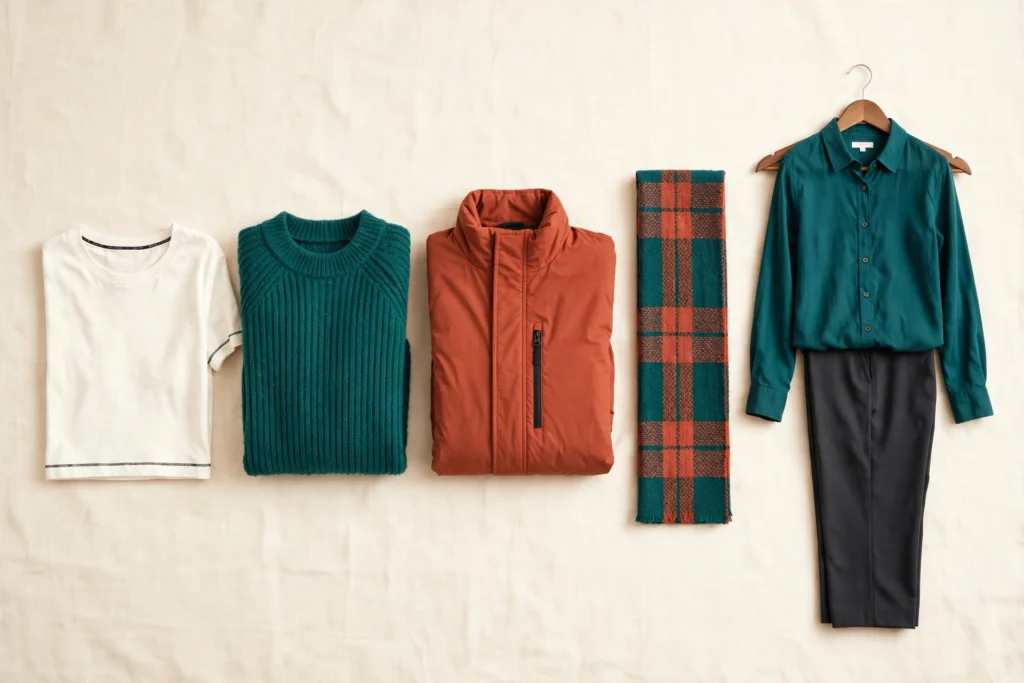
Winter warmth comes from layers, not from bulk. One thick, stiff jumper under a coat that will not close is colder than three thin layers that trap warm air and let you move. The formula for every cold-day outfit is the same, using only pieces already in the count:
Base + Mid + Shell + One Accessory.
The base is the thin layer against your skin: a fitted tee, a thin long-sleeved top, or a thermal layer on the coldest days. The mid is the warmth layer: a knit, fleece, or thin quilted layer that insulates without adding width. The shell faces the weather: a coat or jacket outdoors, or a structured cardigan indoors. The accessory is one finishing piece: a scarf, a hat, or gloves. Each layer is thin enough to move in, and you adjust by adding or removing one layer, not by swapping the whole outfit.
Test the formula before you trust it. Dress in base, mid, and shell, and check three things: can you raise both arms without the layers riding up, can the shell close without pulling, and can you sit comfortably for ten minutes? If any answer is no, change one layer — usually the mid — and test again. Most closets already contain the layers; they are just never combined in this order. A thin top under a knit under a coat is warmer than a thick jumper under the same coat, because the air between the layers insulates. This is where closet organization ideas earn their keep on a real morning: four parts, all from the capsule, adjusted by removing one layer indoors. The count holds, and you stay warm.
The Morning Outfit Rule: Pick Tonight, Photograph Five
A capsule you must think about every morning is one you will abandon by February. The morning rule removes the thinking: pick tonight, in five minutes, and plan five outfits on Sunday.
Pick the night before. Every evening, choose tomorrow’s outfit — base, mid, shell, accessory, shoes — and hang it together, ready to put on. Check the weather once, choose the coat and accessory to match, and stop deciding. A night-before outfit takes five minutes when you are warm and unhurried. A morning outfit takes twenty when you are cold and late.
Five outfits, planned on Sunday. Plan five outfits for the working week on the planner, and photograph each one — on the hanger, laid flat, or worn — keeping the five photos in one album on your phone, labeled Monday to Friday. On a tired morning you do not choose from thirty pieces; you copy a photo. If an outfit fails when you put it on, swap one piece, not the whole outfit. Over a month, the photos become a library of combinations that work, and they show which pieces never appear in any plan. A piece in no weekly plan for three weeks is a piece to review at the next count, not a piece to defend.
One In, One Out: Winter Sale Buys and the Capsule at 30
Winter sales arrive just as the capsule is built, and they are designed to break it. The rule is stated once and applied without exceptions: one in, one out, and the capsule stays at 30.
Before a sale piece crosses the threshold, it must pass three tests. First, does it fill a gap on the planner? Second, does it pass the wear test over real layers, before the tags come off? Third, which counted piece leaves to make room? If you cannot name the piece that leaves, the sale piece waits twenty-four hours in its bag while you decide. Most sale urgency fades in twenty-four hours. The capsule does not.
This is where closet organization ideas are tested by sales: the sales-aftermath discipline from our after-Black-Friday post — open the box, decide on the spot, and the old version leaves the same day. A sale coat arrives; the weakest counted coat is tried against it over the same layers, and one of the two leaves that day. No sale piece joins as a thirty-first piece “just for now.” Thirty-first pieces are how thirty becomes forty, and forty is how the morning stare comes back. Behind the sale rule sits the year-round one-in-ten-out rule: over a season, one piece in means ten out, so the capsule never grows by stealth.
The 7 Capsule Rules
Seven rules, all of them load-bearing. Print them with the planner:
1. Thirty pieces, counted, no exceptions. If it is worn in winter and it is not underwear, sleepwear, gym wear, or single-event occasion wear, it is inside the 30 or in the bin. A count with exceptions is not a count.
2. Every piece passes the wear test. Tried on, over real layers, moving, sitting, reaching. A piece that fails leaves today, however much it cost.
3. Three coats, one per purpose. Everyday, smart, weather-proof. A fourth coat displaces one of the three on the day it arrives, or it does not arrive at all.
4. Layers over bulk, always in formula order. Base, mid, shell, one accessory. If the shell will not close, change the mid, not the coat. Warmth comes from the air between thin layers.
5. Pick the night before, five outfits on Sunday. The morning is for putting clothes on, not for choosing them. A photo library of working outfits beats a full rail every time.
6. One in, one out, on the day. Every new piece names the piece that leaves, and the leaver leaves the same day. Sale pieces wait twenty-four hours if no leaver can be named.
7. Review the bin at the end of winter. Open the bin once, at season’s end. Unmissed pieces go to donate. Retrieved-twice pieces earn a place next winter by displacing something else. Nothing stays in the bin for a second winter unreviewed.
What Goes Wrong (And the Fix for Each)
The capsule fills with “just in case” pieces. A coat for a trip you might take, a dress for an event that might happen. Fix: the wear test, applied today. “Might” is not a winter need. Just-in-case pieces live in the bin, where they can be retrieved if the case actually arrives.
One category quietly grows. Usually knits, or shoes. Fix: the written count, checked once a month. Boots count inside the four shoes; sale knits count inside the five. Move any overage to the bin that week.
The layering formula gets skipped on busy mornings. You grab the thickest jumper and spend the day too hot indoors and too cold outside. Fix: lay the layers out the night before. Base, mid, and shell hung together cannot be skipped without starting again.
The night-before pick stops happening. Fix: shrink the habit, do not abandon it. On a late night, pick only the base and the coat — two pieces, thirty seconds — and choose the rest in the morning.
A sale buy breaks the count and stays. The thirty-first piece hangs at the end of the rail, “temporarily,” and is still there in March. Fix: today, name the piece that leaves, or return the sale piece while it can still be returned.
The off-capsule bin becomes a second closet. Fix: one bin, labeled, stored in one place, reviewed once at the end of winter. If the bin overflows, the overflow goes to donate this week, not to a second bin.
Cold-climate and mild-winter adjustment. This capsule does not claim to suit every climate. In a genuinely cold climate, add a thermal base layer and let the weather-proof coat do more work — the count stays at 30, but the mid gets thicker and the shell longer. In a mild winter, let the smart and everyday coats share the work, keep the weather-proof coat ready but unworn, and use a lighter mid. The count, coat purposes, and formula do not change; only the weight of the layers changes.
Free Printable: The Winter Capsule Planner
The free printable for this post is a one-page Winter Capsule Planner. Print one copy and keep it in the closet while you build. It holds:
- The 30-piece count sheet: all seven categories with their numbers — tops 8, bottoms 5, knits and layers 5, dresses 2, coats and jackets 3, shoes 4, accessories 3 — with space to write each piece and tick it wear-tested, and the total 8 + 5 + 5 + 2 + 3 + 4 + 3 = 30 shown at the bottom
- The coat edit: everyday, smart, and weather-proof, with a wear-test tick box for each coat over its thickest layer
- The layering formula: base + mid + shell + one accessory, with space to write your own working combination
- The night-before checklist: tomorrow’s outfit, coat, accessory, and shoes chosen, plus five boxes for the week’s photographed outfits
Thirty pieces, three coats, four layers, five minutes the night before. If a piece does not fit the count, it belongs in the labeled bin, not on the rail. Get the printable via the newsletter form on the site, the same way as our other printables: sign up, check your inbox, print one copy, and build from the planner, not from memory.
Frequently Asked Questions
What is winter closet organization?
Winter closet organization is building a countable winter capsule instead of tidying a full closet: 30 wear-tested pieces in seven categories, a coat edit of three coats with one purpose each, a layering formula of base plus mid plus shell plus one accessory, and a night-before outfit rule. It is the winter build that follows the fall switch — counted, tested, and kept at 30 — rather than another round of tossing without a system to replace what was tossed.
How many pieces should a winter capsule have?
Thirty pieces, in this system: 8 tops, 5 bottoms, 5 knits and layers, 2 dresses, 3 coats and jackets, 4 pairs of shoes, and 3 accessories, which sums to exactly 30. Underwear, sleepwear, gym clothes, and single-event occasion wear sit outside the count. Adjust the categories to your life if you must, but keep the total at 30 and keep the arithmetic written down, so the capsule stays countable and the morning decision stays small.
What is the 3-coat edit?
Three coats maximum, one per purpose: an everyday coat that closes over your thickest layer, a smart coat for occasions and smarter days, and a weather-proof coat for rain, snow, and the coldest days. Each coat must pass the wear test over real layers, with the scarf and gloves you will wear with it. A fourth coat displaces one of the three on the day it arrives, under the one-in-one-out rule, or it does not enter the capsule.
How do you layer clothes without bulk in winter?
Use the formula base plus mid plus shell plus one accessory, with thin layers instead of one thick, stiff layer. The base sits against the skin, the mid insulates, the shell faces the weather, and one accessory finishes the outfit. The air between thin layers does the insulating, and you adjust by adding or removing one layer instead of swapping the whole outfit. Test each combination by raising your arms, sitting down, and checking the shell still closes.
How do you stop winter sale buys breaking a capsule wardrobe?
Apply one in, one out on the day, with no thirty-first piece, even temporarily. A sale piece must fill a gap on the planner, pass the wear test over real layers, and name the counted piece that leaves the same day. If no leaver can be named, the sale piece waits twenty-four hours while you decide. The year-round one-in-ten-out rule then keeps the count honest across the season, so accumulation is always matched by release.
Sources
- Pinterest Spring 2026 Trend Report (“wardrobe reset” up 140%): https://newsroom.pinterest.com/news/spring-trend-report-2026/
- “Closetmaxxing” fall 2026 viral trend, stylist Jaime Diehl and personal stylist Elizabeth Cardinal Tamkin, via Yahoo Shopping, August 2026: https://y.gogonow.de/shopping.yahoo.com/style/clothing/article/closetmaxxing-is-the-fall-trend-that-could-save-you-from-buying-expensive-new-clothes-144825771.html
- Fall 2026 rewear colors and suede fabric, via Jena Green, August 2026: https://jenagreen.com/2026/08/06/fall-wardrobe-refresh-the-2026-trends-worth-adding-to-your-closet/
- Third-party estimates, labeled as estimates in the body (no ranking promised): “closet” Pinterest searches per month (Pinsearch, October 2026) and “closet organizers” Google Trends interest (Accio, October 2026).




3 Comments