
The Small-Space Christmas Tree Reset: Pencil, Tabletop & Wall Trees That Still Feel Big
A small home does not have to skip the tree. It has to skip the wrong tree. The full-size fir that swallows the only corner, blocks the walkway, and sheds needles into the sofa is not festive — it is furniture that happens to be green. The small Christmas tree ideas in this post are a decision system, not a shopping list: measure the corner first, pick one of three tree forms, edit the ornaments to a number the tree can actually carry, and store the whole thing — tree, ornaments, lights — in one box when January comes. No room for a tree is almost never true. No room for a seven-foot tree in a studio flat is true, and that is a different problem with a better answer.
This post is honest about its evidence. The tree forms below — pencil, tabletop, and wall — are the forms October 2026 decor publishers independently named as the small-space solutions, and those publishers are credited by name with their sources at the end of this post. The numbers that are theirs stay theirs: a six-foot slim tree’s footprint, a two-to-three-foot tabletop tree, a mirror behind a corner tree. The rules that are ours are labeled as ours: the 12-ornament edit for a pencil tree, the one-tree-one-corner rule, and the one-box storage rule. Other guides suggest far more ornaments per foot than twelve in total — one October 2026 guide suggests 10 to 20 ornaments per foot of tree height — and that is exactly why small trees end up looking crowded. This post’s 12-max is a stricter edit rule for a narrow tree, not a universal count, and it is the rule that keeps a pencil tree looking elegant instead of lumpy. If your tree is fuller and wider, it can carry more. A pencil tree cannot, and pretending otherwise is how the corner ends up cluttered.
This is not our small-space Christmas decor post — that is the room: lights, scent, and the little touches across the whole flat. It is not our Christmas decoration storage post — that is the one-box system this post’s storage rule comes from. And it is not our declutter Christmas decorations post — that is the pre-season bin audit to run before you buy or keep anything, ornaments included. This post is the tree only: which form, how many ornaments, where it lives, and how it goes away in one box.
Rule Zero: Measure the Corner Before You Shop
Every small Christmas tree idea that fails fails at this step. The tree arrives, the corner is two inches narrower than the stand, the topper touches the ceiling, and the tree spends December leaning like it is apologizing. Measure first. It takes five minutes and a tape measure, and it decides everything below.
Measure four things. The width of the corner at floor level, where the stand actually sits. The depth from the wall to the edge of the walkway — the tree must not eat the path people walk every day. The ceiling height, minus about a foot for the topper, which is the sizing rule one October 2026 styling guide states plainly: measure the ceiling, subtract a foot, and that is your tree height. And the walkway: stand where people pass and check that the tree’s widest branches leave a clear path. A tree that forces everyone to sidestep it for a month is not a decoration, it is an obstacle with lights on it.
Write the numbers down. Height limit, width limit, depth limit — three numbers on the printable at the end of this post, carried to the shop or kept open on the phone while you browse. Small Christmas tree ideas work when the numbers choose the tree. They fail when the tree in the photograph chooses and the corner has to cope. If the numbers say no form with a floor footprint fits, that is not a defeat — that is the wall tree’s cue, in the section below.
The one-tree, one-corner rule. One tree, one corner, one focal point. A pencil tree in the corner plus a tabletop tree on the sideboard plus a mini tree in the bedroom is not “Christmas in every room” — it is three trees competing for the same small flat, each one making the others look like clutter. Pick the one corner people actually see — beside the sofa, not the formal corner nobody visits — and let that tree be the tree. The rest of the flat gets lights and the small touches from our small-space decor post, not more trees. One tree, done properly, feels bigger than three trees done thinly.
The Decision: Pencil vs Tabletop vs Wall
Three forms, three different homes. Read the table, match your numbers to a row, and read that form’s section in full before you buy anything.
| Form | Footprint | Best for | Ornament scale | Storage |
|---|---|---|---|---|
| Pencil tree | One corner, about a floor lamp’s footprint | Full height in a narrow corner | Small, 12 max (our edit rule) | One tall box or bag |
| Tabletop tree | Zero floor space | No free corner at all; renters, desks, sideboards | Mini, about 1 inch | One small box, on a shelf |
| Wall tree | Zero floor space, flat to the wall | A studio, a hallway, a wall with no corner | Flat, light, pinned or hung | One flat box or bag |
The table is the shortcut. The rest of this post is the system: how each form is styled, how the ornaments are edited, and how the whole thing goes away in January in one box.

Pencil Trees: Full Height, Quarter of the Footprint
The pencil tree is the small-space Christmas miracle, in the words of one October 2026 small-space guide: full height, a quarter of the footprint. A six-foot slim tree takes up about as much floor as a floor lamp, which means even a studio flat has a corner for one. Retailers say the same thing from the product side: slim trees are ideal for smaller spaces and easier to put up, take down, and store than their full-sized counterparts. That last point matters as much as the footprint — a tree that is easy to store is a tree that actually gets stored properly, in one box, instead of shedding in a cupboard until next November.
Pick the height from the ceiling, not the photograph. A slim tree around six feet usually fits a small room well, per one October 2026 styling guide — but your ceiling minus a foot is the rule, not six feet. If the ceiling is low, a five-foot pencil tree that fits is better than a six-foot one that leans. Buy the pre-lit version if you can: it removes the most annoying step, and the lights are evenly spaced in a way hand-stringing never achieves. That is the small-space guide’s advice, and it is doubly true on a narrow tree, where every gap in the lights shows.
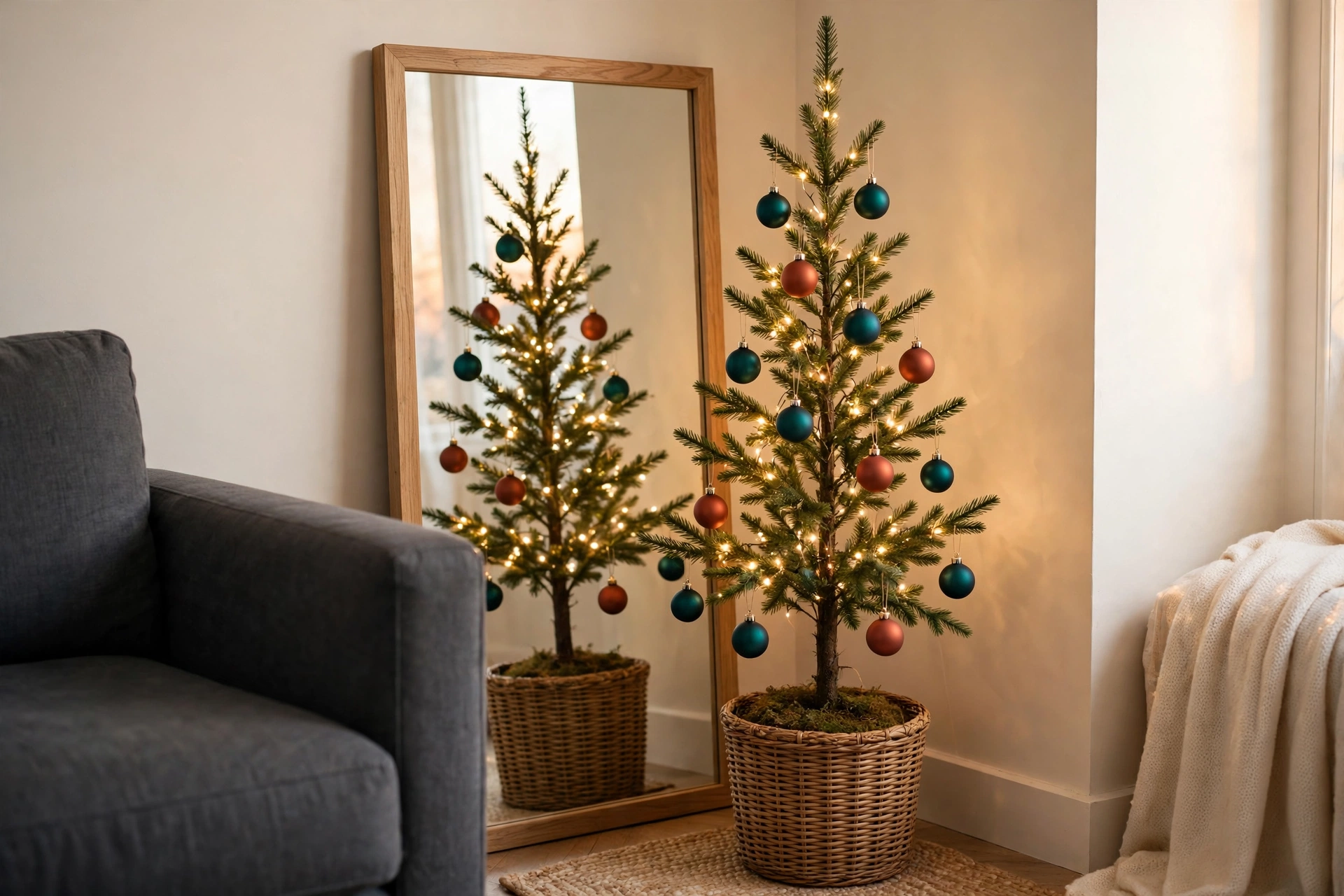
Style it vertical. Big ornaments make a pencil tree look lumpy — that warning comes from a 2026 decorating guide, and it is the single most useful styling sentence in this whole post. Go small and go vertical: smaller ornaments, and one ribbon spiraling from top to bottom, which leads the eye up and makes the tree look taller. Keep ornaments small to medium so the tree does not look crowded, add a simple topper and a ribbon, and stop. A second October 2026 guide adds the mirror trick: place a mirror behind a slim corner tree to double its visual fullness. It works, and it costs nothing if a mirror already lives in the room — but it only works if the tree behind the mirror is tidy. A crowded tree reflected is a crowded room, twice.
The 12-ornament edit. Here is the rule that makes a pencil tree feel big instead of busy: twelve ornaments, maximum, on a pencil tree. That is our edit rule, stated plainly as ours. Other guides count far more — one suggests 10 to 20 ornaments per foot — and on a full, wide tree that count is fine. On a narrow pencil tree, with fewer branches, every ornament has to earn its place, as a third October 2026 guide puts it: with fewer branches, edit ruthlessly. Twelve is the number that leaves breathing room between ornaments, which is what makes a small tree read as elegant rather than apologetic. Pick twelve: the heirlooms first, then the prettiest, then stop. The rest go into the ornament box, labeled, to rotate next year — not onto the tree “just for now,” because “just for now” is how a 12-ornament tree becomes a 40-ornament tree by the second weekend of December.
Tabletop Trees: Zero Floor Space, Full Christmas Feeling
If even a pencil tree is too much, go tabletop. A two- or three-foot mini tree on a side table, bookshelf, or kitchen counter delivers the full Christmas feeling — lights, ornaments, star on top — with literally zero floor space. That is the small-space guide’s framing, and it holds: a tabletop tree is the answer when the corner is taken by the sofa, the hallway is a corridor, and the floor belongs to living, not to a tree.
The tray rule. A tabletop tree without a tray sheds needles, glitter, and dropped ornaments across the surface it sits on, and the surface underneath becomes the clutter. Put the tree on a tray, a basket, or a wooden crate — something with an edge, something that contains the tree’s footprint and catches what falls. The tray is also the style: a basket or tree collar instead of a wide skirt is the 2026 decorating guide’s recommendation for small trees, and on a tabletop tree it reads as intentional, not improvised. Mini ornaments, about one inch, are the scale for a tree you see up close. Full-size baubles overwhelm a small tree; smaller ones look properly proportioned. That scale rule is the same one the pencil tree follows, one size down.
Cluster, don’t scatter. One tabletop tree alone on a long sideboard looks lost. A cluster of mini trees in varying heights — on a mantel, a sideboard, or a dining table — brings Christmas to the surface without taking the floor. That clustering advice comes from an October 2026 decorating guide, and it is the tabletop version of the one-corner rule: one surface, one cluster, done. Do not put a mini tree on every surface. One cluster, in the room people gather in, is the tree. The other surfaces get a candle, a sprig of greenery, or nothing at all. Restraint is what makes a small flat feel calm at Christmas, and a cluster is restraint with a focal point.
Storage is the tabletop tree’s superpower. A two-foot tree, its mini ornaments, and its lights fit in one small box, on a shelf, labeled. No tall box, no cupboard Tetris, no stand in three sections. That is the reason to choose a tabletop tree even when a pencil tree would fit: the January takedown takes ten minutes, and the box is small enough to live where you can actually reach it next November. Small Christmas tree ideas are judged in January as much as in December, and the tabletop tree wins January.
Wall Trees: When Even a Corner Is Unavailable
The wall tree is the form for the flat where the corner does not exist: a studio with no spare floor, a hallway that is a walkway, a wall with no corner to tuck a tree into. A wall-mounted half tree — flat against the wall — is a genuine solution for studio flats, per one 2026 decorating guide. A wall-mounted garland tree is the best option when even a corner is unavailable, per the small-space guide. Both are the same idea: the tree goes up the wall, not out into the room, and the floor stays free.
Build it flat and light. A garland shaped into a tree outline on the wall, a half tree mounted flat, or a branch arrangement pinned in a triangle — whatever the form, the rule is the same: flat, light, and fixed properly. Ornaments must be light enough to hang from garland or pins without dragging the shape down, and lights must spiral upward along the outline, the same vertical trick the pencil tree uses. Scale the ornaments down, as the decorating guide advises for every small tree: full-size baubles overwhelm a small form. On a wall tree, a heavy ornament does not just look wrong, it pulls the garland out of shape.
The wall tree is a real tree, not a consolation prize. Treat it like one. Give it the same edit — twelve ornaments, same palette, same topper star at the top of the outline — and the same one-corner discipline: one wall, one tree outline, not a garland tree plus a pencil tree plus a cluster. A wall tree styled with the same care as a floor tree reads as a design choice. A wall tree styled as an afterthought reads as “could not fit a real tree,” and the difference is entirely in the edit: fewer ornaments, one palette, lights that follow the shape instead of being draped over it.
Safety first, stated plainly. A wall tree lives on pins, hooks, or adhesive strips, and it lives above furniture, beds, and walkways. Fix it so it cannot fall — test the fixings with the weight of the ornaments on, not empty — and keep lights and cords away from bedding and curtains. No candle flames near a garland tree, ever. A tree on the wall must be secured like something that hangs, not balanced like something that stands.
The Ornament Edit: 12 That Earn Their Place
Whichever form you picked, the ornaments follow one edit. This is the heart of the system, and it is where small trees are won or lost.
Step 1 — Empty the ornament box onto the table. All of them. Not the twelve you think you will use — all of them, so the edit is honest. This is the pre-season bin audit from our declutter decorations post, applied to one box instead of the whole decoration store.
Step 2 — Heirlooms first. The ornaments with a story — the handmade one, the one from the first Christmas in this home, the one a child made — go in the keep pile first. They are the reason the tree exists. A tree of twelve strangers is a display. A tree of twelve with three heirlooms is a memory.
Step 3 — Fill to twelve with one palette. Two ornament colors, tight and repeated, is the small-space guide’s recipe for an elegant slim tree, and it works on every form. Two colors, repeated, reads as designed. Seven colors, one of each, reads as a jumble sale. Fill the remaining slots with the prettiest ornaments in those two colors, smallest first. When you reach twelve, stop. The stop is the system.
Step 4 — Box the rest, labeled, for rotation. The ornaments that did not make it are not rejects. They go back in the box, labeled by year, to rotate next Christmas. Rotation is the rule that keeps the collection from growing every year while the tree stays the same size: next year, twelve different ones, same box, same tree. The collection gets enjoyed over years instead of crammed onto one tree in one December.
The one-in, one-out rule for ornaments. Every new ornament that enters the house retires one that is already in the box. Without this rule, the box grows, the edit gets harder, and the twelve becomes twenty by next year. With it, the collection stays at a size the tree can actually wear, and every new ornament is a choice, not an accumulation.

Lights, Topper, and the 30-Minute Setup
Lights. Micro fairy lights, spiral upward, one strand. On a pencil tree, the spiral leads the eye up and makes the tree look taller. On a wall tree, the lights follow the outline. On a tabletop tree, one short strand is enough — the tree is two feet tall and you see it from a foot away. One strand, well placed, beats three strands draped in a hurry. Warm white is the calm choice; it bounces light around a small room and makes the space feel brighter and bigger, which is the same reason reflective ornaments suit smaller rooms.
Topper. The topper is where the ceiling measurement pays off. A star or a simple bow, light enough not to bend the top branch, with a foot of clearance above it. A heavy topper on a slim tree bends the leader branch sideways, and a bent leader makes the whole tree look tired. Light topper, foot of clearance, done. On a wall tree, the star sits at the top of the outline, pinned flat — same star, same clearance, same rule.
The 30-minute setup. Measure the corner (done, in November). Place the tree or outline. Lights on, spiral up. Twelve ornaments, heirlooms first. Topper last. Stand back, check the walkway, and stop. Thirty minutes, one tree, one corner. If the setup takes two hours, something has gone wrong — usually the ornament edit, which means the box needs emptying and the twelve need re-picking, not the tree needs more decorations.
The One-Box Takedown: January in 30 Minutes
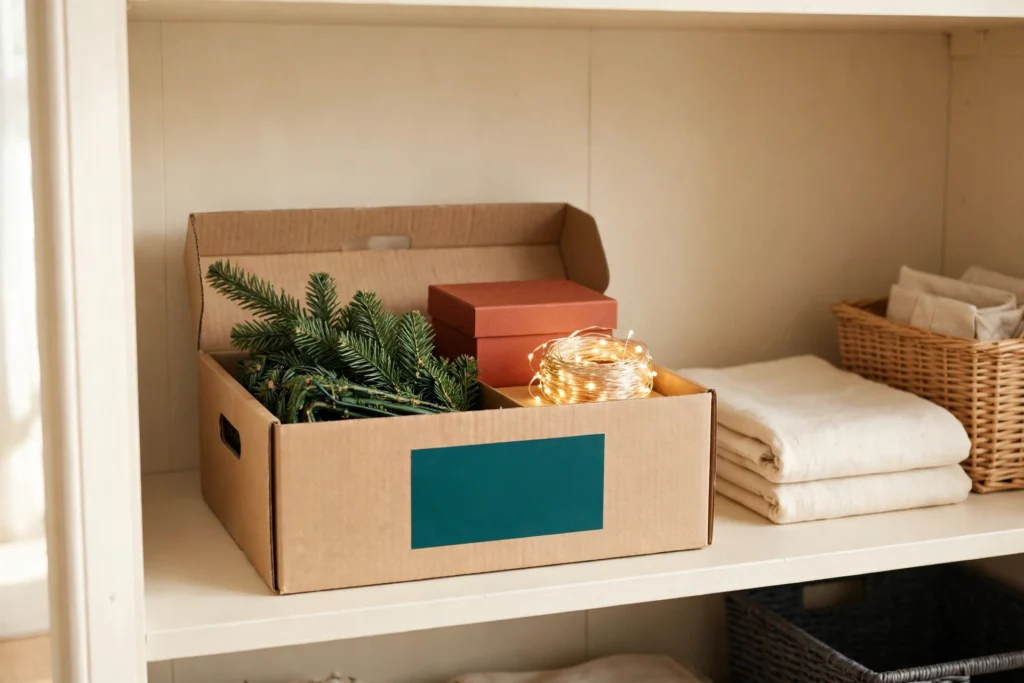
The storage rule is the other half of the system, and it comes from our Christmas decoration storage post: the tree plus its ornaments plus its lights go in ONE box. Not the tree in a bag in the cupboard, the ornaments in a box in the spare room, and the lights tangled in a drawer. One box, labeled, with everything the tree needs inside it. Next November, one box comes down, and the tree is up in thirty minutes, because everything is together.
Pack in reverse. Ornaments off first, wrapped in the tissue they came in or in a single layer of packing paper, into the ornament box. Lights off next, wound around a cardboard card so they do not tangle — a tangled strand is a strand that gets replaced, and replacement is how the box grows. Tree last, into the box or bag, stand in its section if it comes apart. Label the box: tree form, height, ornament count, and the year. “Pencil tree, 6ft, 12 ornaments, 2026” is a label that makes next November a thirty-minute job instead of a treasure hunt.
The January test. If the takedown takes more than thirty minutes, or the box does not close, the system has told you something: the tree owns too much. The ornament box needs the one-in-one-out rule applied, or the second string of lights needs donating, or the three spare toppers need to go. A one-box tree is a tree that fits the flat. A three-box tree is a tree that owns a cupboard, and a cupboard owned by Christmas in July is clutter wearing tinsel.
7 Rules That Keep the Tree Feeling Big
- Measure first, shop second. Ceiling minus a foot, corner width, walkway depth — three numbers, written down, before any tree is bought.
- One tree, one corner. One focal tree per flat. The rest of the home gets lights and small touches, not more trees.
- Twelve ornaments max on a pencil tree. Our edit rule. Heirlooms first, one palette, stop at twelve.
- Small ornaments, vertical styling. Big baubles make narrow trees lumpy. Small ornaments, one ribbon spiral, eye goes up.
- Pre-lit when you can. Even lights, no stringing step, and the narrow tree’s gaps disappear.
- One box for everything. Tree, ornaments, lights, topper — one labeled box, January in thirty minutes.
- One in, one out, for ornaments. Every new ornament retires one from the box. The collection stays tree-sized.
The Free Printable: Small-Space Tree Planner
One sheet, three sections. The top is the measure card: ceiling height, minus a foot, corner width and depth, walkway check — the three numbers, with space to write them. The middle is the decision box: pencil, tabletop, or wall, circled, with the reason in one line. The bottom is the 12-ornament checklist: twelve numbered lines, heirlooms marked, palette named, plus the one-box label line — “tree form, height, ornament count, year” — to copy onto the storage box in January. Print it, measure with it, and take it shopping. It is free, it is one page, and it is the only new thing this post asks you to bring to the tree — everything else you need is a tape measure, a box, and the willingness to stop at twelve.
Frequently Asked Questions
What is the best small Christmas tree for a tiny apartment?
A six-foot pencil (slim) tree for a corner, or a two-to-three-foot tabletop tree if floor space is truly zero, with a wall-mounted garland tree as the option when even a corner is unavailable. That is the small-space guide’s sizing, and it matches this post’s decision table — but your ceiling-minus-a-foot measurement is the rule that picks between them, not the guide’s numbers alone.
How many ornaments should a pencil tree have?
This post’s edit rule is twelve, maximum. Other guides suggest far more — one suggests 10 to 20 ornaments per foot — but a narrow pencil tree has fewer branches, and every ornament has to earn its place. Twelve, in one tight palette with heirlooms first, leaves breathing room and keeps the tree looking elegant instead of crowded. A fuller, wider tree can carry more; a pencil tree should not be asked to.
Can a small Christmas tree still look full?
Yes — fullness on a small tree comes from vertical styling, not from ornament count. A ribbon spiraling upward, micro lights following the same line, small ornaments with space between them, and a mirror behind a corner tree to double its visual fullness. A crowded tree looks smaller, not fuller, because the eye reads clutter as smallness. Breathing room reads as scale.
How do I store a small Christmas tree in one box?
Pack in reverse: ornaments off and wrapped into the ornament box, lights wound around a card, tree last into the same box or bag, stand in its section. Label the box with the tree form, height, ornament count, and year. If the box does not close, the tree owns too much — apply the one-in, one-out ornament rule before next December.
When should I buy a small Christmas tree?
Plan in October and shop early-to-mid November. Small-space guides note that popular slim trees and good faux garlands sell out, and shopping early is the real small-space strategy — but measure the corner first, whatever month you shop in. A tree bought on sale that does not fit the corner is not a bargain.
Related Reading
- Small-Space Christmas Decor: The Room Around the Tree — the room twin: lights, scent, and small touches for the whole flat, once the tree decision is made.
- Christmas Decoration Storage: The One-Box System — where the one-box rule comes from: one box per zone, labeled, so January takes thirty minutes.
- Declutter Christmas Decorations Before You Decorate — the pre-season bin audit to run before you keep, buy, or hang anything, ornaments included.
Sources
- Batch 11 brief #84, viral-topics-batch11-2026-10-26.md — tree-system angle, pencil vs tabletop vs wall decision, 12-ornament edit, one-tree-one-corner rule, one-box storage via #30, differentiation from #28 and #74, internal links.
- Keyword-pivot brief §1 #16 and §3, viral-keywords-tough-competition-2026-10-30.md — “small christmas tree ideas” focus keyword, head-term scale context (labeled publisher/third-party estimates in the brief), system-post wedge, retitle direction.
- Christmas Tree World product pages, https://www.christmastreeworld.co.uk/sale/the-pre-lit-7ft-snowy-pencil-tree and https://www.christmastreeworld.co.uk/the-6ft-snowy-pencil-tree — slim trees ideal for smaller spaces, easier to put up, take down, and store than full-sized trees; pencil trees a great option for limited space.
- Chosen Furniture, “15 Christmas Tree Decor Ideas to Try,” updated October 26, 2026, https://chosenfurniture.com/christmas-tree-decor-ideas/ — slim pencil tree for small spaces, small-to-medium ornaments, ceiling height minus about a foot for the topper, six-foot slim tree as a small-room fit.
- Aunonno, “Christmas Tree Decorating Ideas,” https://aunonno.com/christmas-tree-decorating-ideas-22859 — slim corner tree styling, mirror behind the tree to double visual fullness, tabletop mini-tree clusters in varying heights, and the 10-to-20-ornaments-per-foot rule of thumb cited here as the contrast to this post’s stricter 12-max edit rule.
- The Tiny Nest Home, “12 Christmas Decor Ideas for Small Spaces,” October 2026, http://thetinynesthome.blogspot.com/2026/10/christmas-decor-ideas-for-small-spaces.html — pencil tree footprint about a floor lamp’s, pre-lit recommendation, tabletop mini trees at two to three feet with zero floor space, wall-mounted garland tree when no corner is available, early shopping for slim trees.
- hgfind, “12 Christmas Tree Decor Ideas for a Beautiful Tree in 2026,” October 2026, https://www.hgfind.com/2026/10/christmas-tree-decor-ideas-2026.html — “christmas tree decor ideas is rising fast on both Google and Pinterest” (publisher claim, labeled as such in the keyword brief), wall-mounted half tree for studio flats, scale ornaments down on small trees, edit ruthlessly with fewer branches.
- The Glow Up System, “15 Best Christmas Tree Decorating Ideas 2026,” https://theglowupsystem.com/christmas-tree-decorating-ideas/ — slim pencil tree styling: small ornaments, vertical ribbon spiral, micro fairy lights, basket or tree collar instead of a wide skirt.
- Small-space decor post (blog #28), https://clutterandcalm.com/small-space-christmas-decor/ — the room twin this post differentiates from. Decoration storage post (blog #30), https://clutterandcalm.com/christmas-decoration-storage/ — the one-box storage system. Declutter decorations post (blog #49), https://clutterandcalm.com/declutter-christmas-decorations/ — the pre-season bin audit. No invented statistics are claimed in this post; the 12-ornament max, one-tree-one-corner, and one-box rules are this post’s own system rules, labeled as such.



One Comment