

Winter Outfits: The 10-Piece Capsule System
Every winter the same thing happens: the closet is full and getting dressed still takes twenty minutes. Three coats, six knits, a pile of bottoms that never quite work together — and on the coldest mornings the outfit that finally leaves the house is the one grabbed in a rush, layered until it barely fits under the coat, with a scarf competing against boots competing against a bag.
Winter outfits are not a shopping list. A winter outfit is a system: ten pieces that combine, five formulas that decide, three layers that hold, and a count that checks. One coat, two knits, two bottoms, two boots, three accessories — ten pieces, nothing more. Five outfit formulas, one per weekday need, so getting dressed is following the card, not deciding from scratch. A 3-layer rule with no bulk: base, knit, coat. And one statement piece per outfit — suede or fur, never both at once. That is the whole system — and it is the reason this post exists now: winter outfits are up 100% month over month on Pinterest (Market with Miranda, November Pinterest Trends 2026), and in the same read fall outfits are down 50% — the fall-to-winter turn is happening right now. Winter Style is up 80% too (PBC Weekly Trends Report, 13 November 2026), and the corroboration runs the same way: elegant chic outfits are up 125% over 30 days, simple chic everyday outfits up 108%, casual chic outfits up 96% (PinPinterest, third-party saves-based engine), fur coat outfits up 100% and brown suede boots outfits up 20% (Pinterest Trends Editors’ Picks). Winter outfit searches run through February, so this system keeps working long past December. No piece here is a shopping recommendation: the ten pieces are named once, as what fills each slot, and the system is the post.
The system at a glance
Five steps, in order. Then a printable, and a challenge.
- Step 1 — The 10-piece capsule: 1 coat, 2 knits, 2 bottoms, 2 boots, 3 accessories. Ten pieces, nothing more — the capsule is closed.
- Step 2 — The 5 outfit formulas: one per weekday need — work, errands, cold snap, evening, weekend — each formula names its pieces.
- Step 3 — The layering rule: 3 layers, no bulk — base, knit, coat. A fourth layer is not warmer, it is bulk arguing with the coat.
- Step 4 — The accent rule: one statement piece per outfit. Suede or fur, never both at once.
- Step 5 — The capsule count check: count the capsule before the season starts and after the first cold week. A piece that never made a formula leaves the capsule.
Five rules govern the whole capsule: ten pieces, no eleventh; every outfit comes from a formula; three layers, never four; one statement piece, never two; and the count decides what stays. An eleventh piece is not more choice. It is a second capsule arguing with the first.
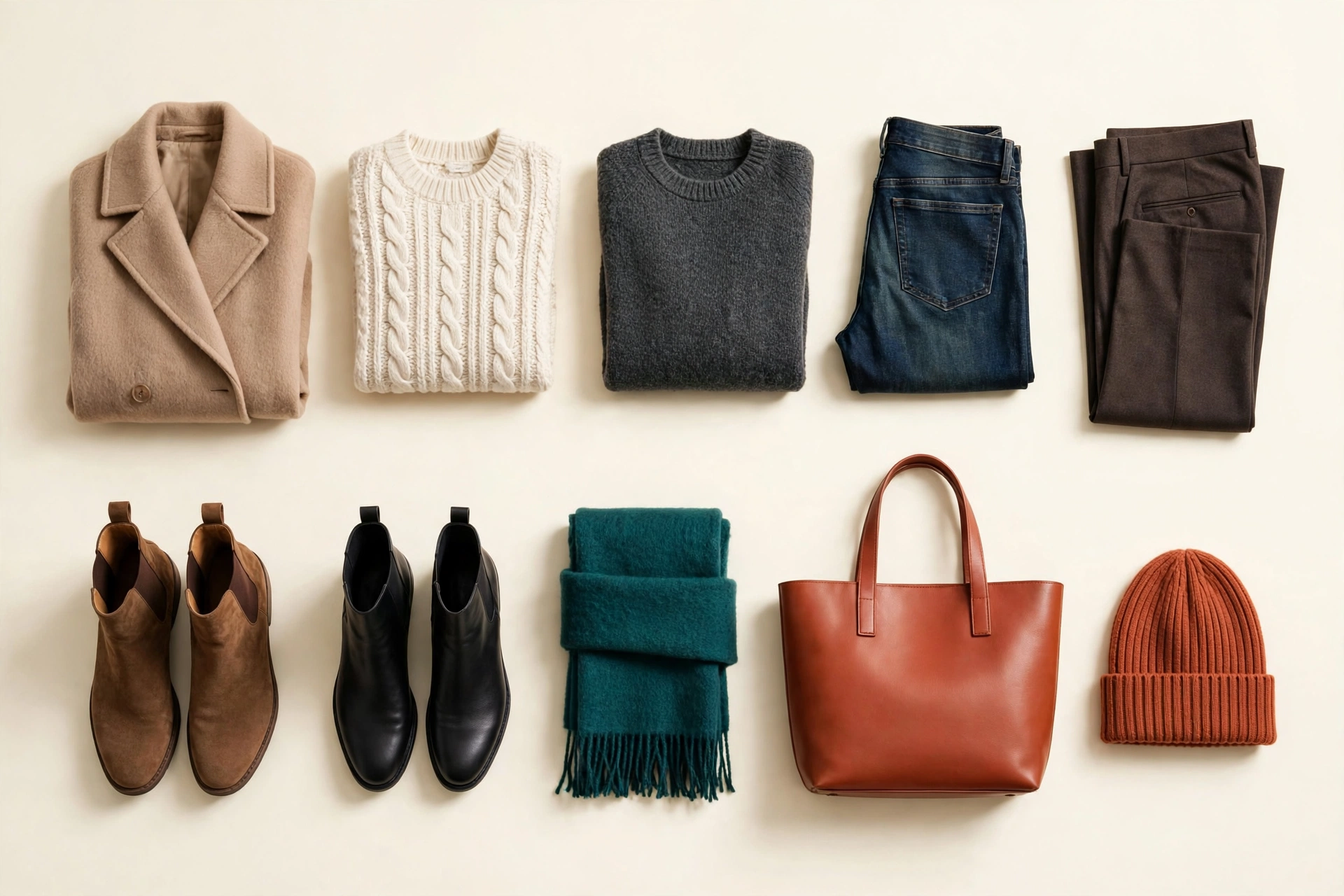
Step 1 — The 10-piece capsule: 1 coat, 2 knits, 2 bottoms, 2 boots, 3 accessories
Ten pieces. One coat, two knits, two bottoms, two boots, three accessories. That is the whole capsule, and the capsule is closed.
- The coat (1): one wool coat, long enough to cover the knit. One coat means no morning decision about which coat — the coat is the coat, and every one of these winter outfits is built under it.
- The knits (2): one cream knit, one charcoal knit. Two knits cover the whole week because the formulas rotate them: cream for the light outfits, charcoal for the dark ones. A third knit is not more warmth, it is a second capsule starting.
- The bottoms (2): dark denim and tailored trousers. Denim for errands and weekends, trousers for work and evenings. Two bottoms, five formulas — the formulas do the varying, not the closet.
- The boots (2): brown suede boots and black ankle boots. Suede for the statement days, black for the quiet ones. The suede boots are the capsule’s statement piece on the days they are worn — which is exactly why the accent rule exists.
- The accessories (3): a wool scarf, a leather tote, a knit beanie. The scarf is the warmth, the tote is the carry, the beanie is the cold-snap answer. Three accessories, each with one job.
Ten pieces, and every one of the winter outfits in this system is a combination of them. Nothing outside the capsule is worn, and nothing inside it is left unworn — Step 5 checks that. The capsule that feeds this system starts with an edit: the Winter Closet Edit is the purge-and-keep pass that leaves ten pieces standing, and this capsule is what those ten pieces become. And the build itself has a bigger sibling — the Winter Closet Organization post builds a 30-piece capsule from the same closet; this 10-piece winter capsule is the tighter version of it, ten pieces instead of thirty, formulas instead of options.
Step 2 — The 5 outfit formulas: one per weekday need
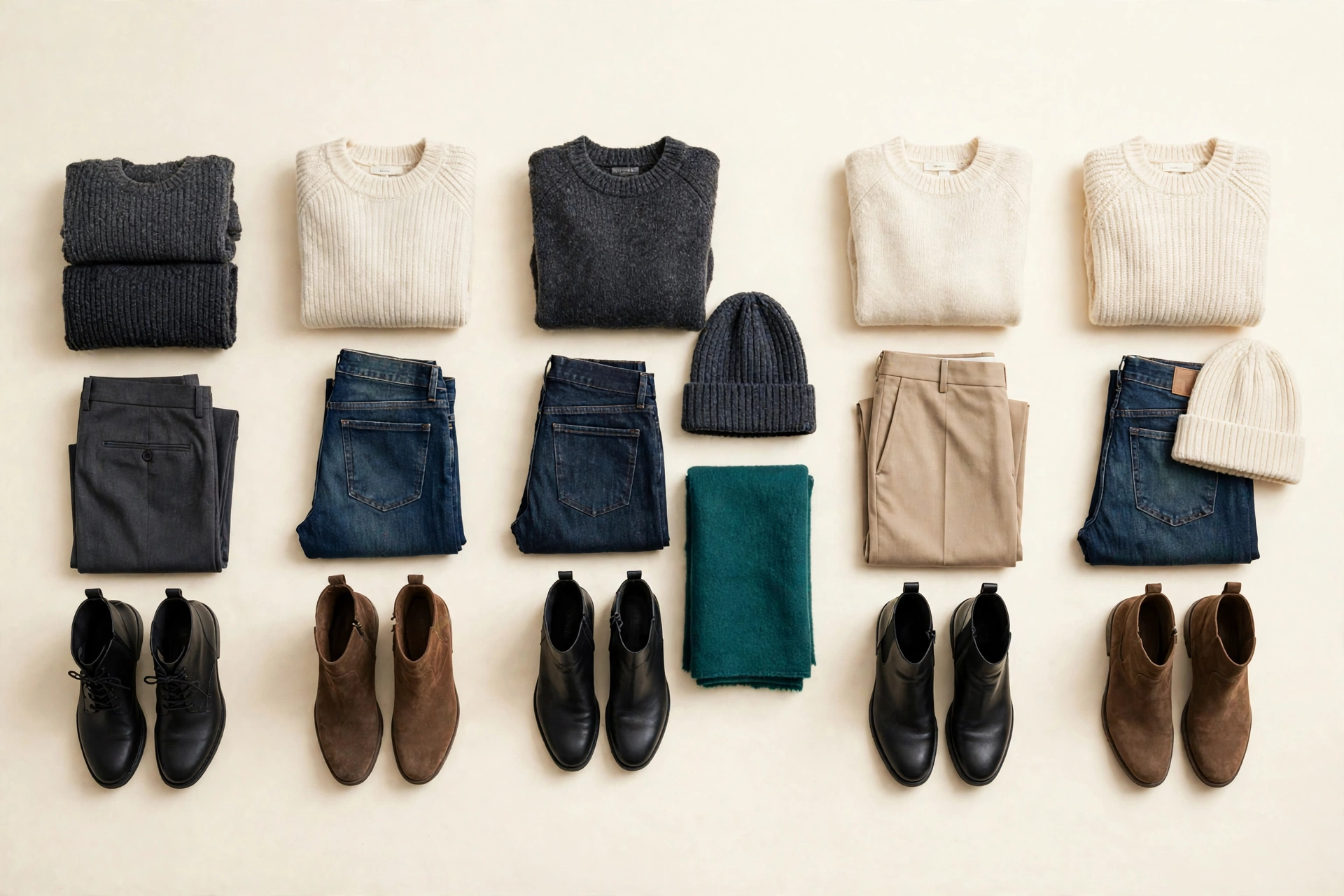
Five formulas, one per weekday need — work, errands, cold snap, evening, weekend. Each formula names its pieces from the capsule, so getting dressed is following the card, not deciding from scratch. If an outfit needs a piece outside the capsule, the formula is wrong, not the capsule.
- Work: charcoal knit, tailored trousers, black ankle boots, leather tote. The coat over the top, the scarf if the walk is long. Dark, quiet, finished.
- Errands: cream knit, dark denim, brown suede boots, leather tote. The suede boots are the statement piece here — one statement, lifting the whole outfit.
- Cold snap: charcoal knit, dark denim, black ankle boots, wool scarf, knit beanie. The scarf and the beanie are warmth, not statements — the statement slot stays empty on the coldest days, and the outfit is better for it.
- Evening: cream knit, tailored trousers, black ankle boots, leather tote. The same pieces as work, rearranged by the formula — the cream knit lightens what the charcoal knit darkened.
- Weekend: cream knit, dark denim, brown suede boots, knit beanie. The relaxed formula, and the suede boots take the statement slot again — one statement, never two.
Five formulas cover the whole week of winter outfits, and the week repeats them. Monday is work, Tuesday is errands, the cold snap arrives when it arrives — the card is followed, not re-decided. The seasonal series runs the same structure in every season: the Spring Wardrobe Swap runs the spring capsule the same way, the Summer Capsule Wardrobe Swap runs the summer one, and the Fall Wardrobe Reset is the autumn switch this winter capsule follows. Same swap structure, different season — the system is the constant, the pieces change with the weather.
Step 3 — The layering rule: 3 layers, no bulk
Three layers only — base, knit, coat. A fourth layer adds bulk, not warmth.
The base is the thin layer against the skin. The knit is the warmth. The coat is the shell. Three layers hold the warmth because each one has a job: the base traps air, the knit holds heat, the coat blocks wind. A fourth layer does none of those jobs better — it just argues with the coat, bunches at the shoulders, and makes the coat fit like it belongs to someone else. Winter outfits fail most often at the layering, not the pieces: four layers under a coat that was cut for three, and the whole outfit looks borrowed.
The rule also decides the morning, and it is what keeps these winter outfits looking neat instead of bulky. Base, knit, coat — in that order, every time, no negotiation. On a cold snap day the scarf and the beanie join, but they are accessories, not layers: they sit on top of the three, they do not become a fourth. The count is three, and three is the whole rule.

Step 4 — The accent rule: one statement piece per outfit
One statement piece per outfit. Suede or fur, never both at once — one statement piece lifts the outfit; two compete for the same eye.
The capsule’s statement pieces are the brown suede boots and, on the days it is worn, a fur-trimmed piece — the suede boots carry the statement slot in the errands and weekend formulas, and they carry it alone. A fur collar with suede boots is two statements in one outfit, and the outfit stops being an outfit and starts being a competition. One statement lifts; two compete, and the loser is always the outfit.
The rule is the reason the capsule works with only ten pieces — and why these winter outfits never look like a pile of good intentions. Without it, every outfit would reach for the loudest piece in the closet, and the quiet pieces — the charcoal knit, the black ankle boots — would never be worn. With it, the quiet pieces get their days, the statement pieces get theirs, and no outfit is ever two statements arguing. Winter outfits built on this rule look deliberate, because they are: the decision was made when the formula was written, not in front of the mirror. That is what makes winter outfits feel effortless: the effort happened once, on paper, before the season started.
Step 5 — The capsule count check: count before the season, count after the first cold week
Count the capsule before the season starts and after the first cold week. A piece that never made a formula leaves the capsule — the capsule stays at ten.
The first count happens before the season: lay out the ten pieces, write the five formulas, and check that every piece appears in at least one formula. A piece in no formula is not a capsule piece — it is a spare, and spares leave before the season starts. The second count happens after the first cold week: which pieces were actually worn? The cream knit that stayed on its hanger through the whole cold week was never part of the system — it leaves, and the capsule stays at ten, with a gap that the formulas already cover. The method behind the count is the same one that runs the whole house: the How to Declutter Your Home post tests three viral methods on one closet, and the count check is the winter-capsule version of it — keep what the system uses, release what it does not.
The count is what keeps the capsule a capsule — and what keeps these winter outfits working all season instead of falling apart by January. Without it, ten pieces become twelve by February, and twelve become a closet full of almost-outfits again. With it, the capsule ends the season at ten, the formulas still work, and next winter starts from a system instead of a pile.
Before you start: lay out the ten pieces tonight
Lay out the ten pieces tonight, not on the first cold morning. Put the coat, the two knits, the two bottoms, the two boots and the three accessories on the bed, and write the five formulas on the printable — work, errands, cold snap, evening, weekend — checking each formula against the pieces before any of them is worn. Does every piece appear in at least one formula? Does any formula reach outside the capsule? A piece in no formula goes back to the closet, and a formula that needs an eleventh piece gets rewritten, not the capsule.
The challenge is simple: lay out the ten pieces tonight, write the five formulas — the count decides, you just follow the card. Winter outfits work best as a system, and the system is already written. The only decision left is which ten pieces fill the ten slots.
The free printable: capsule card + 5 formula cards
The printable for this post is a 10-piece capsule card and five formula cards: the capsule card lists the ten slots — 1 coat, 2 knits, 2 bottoms, 2 boots, 3 accessories — with a line to name each piece, and each formula card names one weekday need with its pieces written in, plus a box for the 3-layer check (base, knit, coat) and the one-statement-piece check.
Print it, name the ten pieces, write the five formulas, and follow the cards all winter — the winter outfits on the cards are the only outfits you need to decide. The challenge is simple: lay out the ten pieces tonight, write the five formulas — the count decides, you just follow the card.
Frequently asked questions
What is the winter outfit capsule system?
Winter outfits, as a system: a closed 10-piece capsule (1 coat, 2 knits, 2 bottoms, 2 boots, 3 accessories), five outfit formulas, a 3-layer rule with no bulk, a one-statement-piece accent rule, and a capsule count check.
How many pieces do I need for a winter capsule?
Ten — 1 coat, 2 knits, 2 bottoms, 2 boots, 3 accessories. That is the whole capsule; an eleventh piece is a second capsule.
What are the 5 outfit formulas?
One per weekday need — work, errands, cold snap, evening, weekend — each naming its pieces from the capsule, so getting dressed is following the card.
How do I layer without bulk?
Three layers only — base, knit, coat. A fourth layer adds bulk, not warmth.
Can I wear suede and fur together?
Not in this system — one statement piece per outfit. Suede or fur lifts the outfit; both compete.
How is this different from the Winter Closet Edit (#92)?
#92 edits the closet — purge and keep. #122 builds outfits from the capsule that survives the edit: formulas and layering, not the purge.

5 Comments