
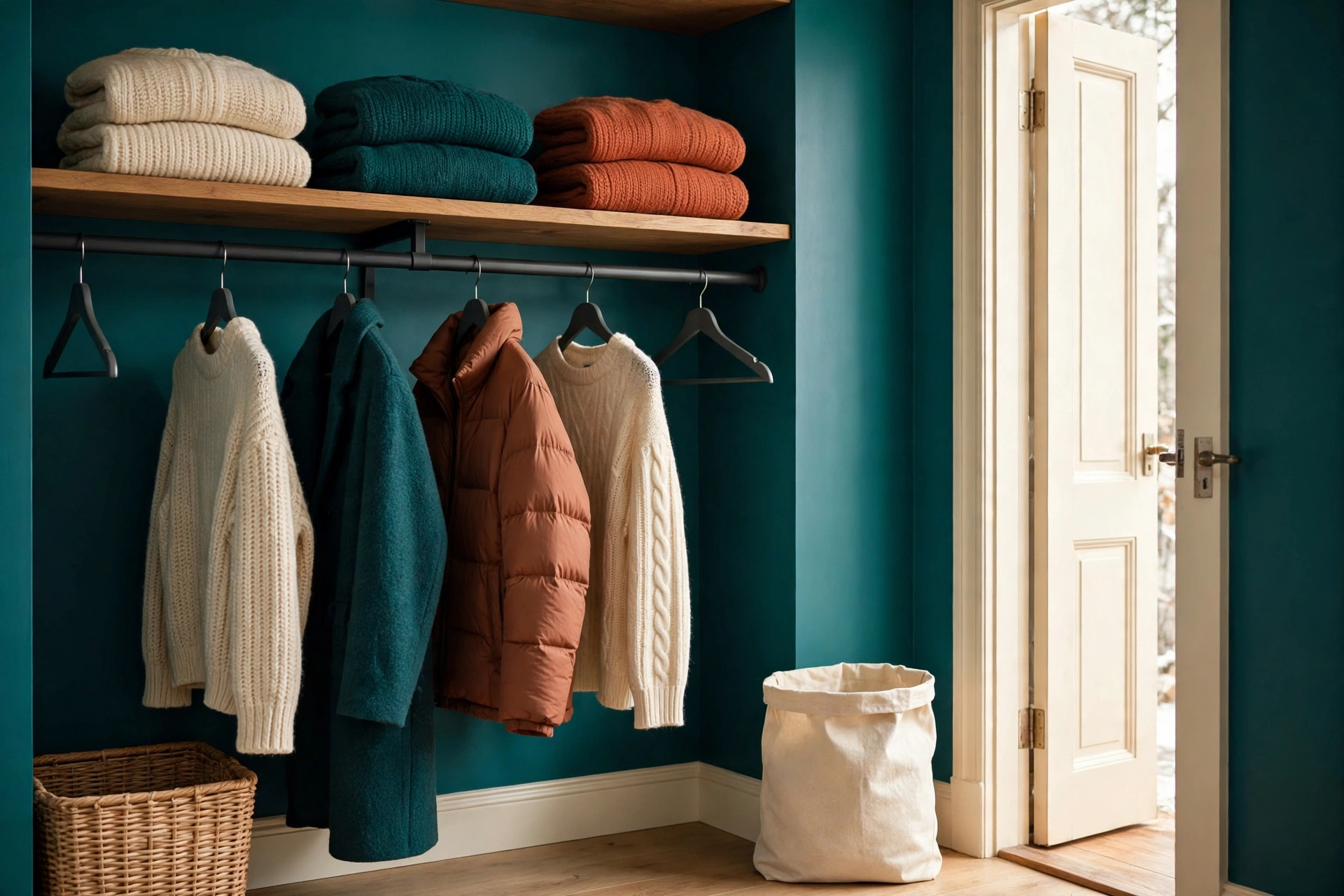
Closet Organization: The Winter Edit & Donate-Bag System That Feeds Your Capsule
Closet organization fails in winter for a reason that has nothing to do with storage. The closet is full, the mornings are cold, and every piece looks necessary until you try to wear it over a thick layer and discover it does not close, does not reach, or does not go with anything else you own. So you wear the same safe combination again, and the rest of the closet becomes decoration: expensive, bulky, and in the way. This post does not build another closet system. It edits the closet you already have, in four zones, until what is left feeds a capsule that works — and it keeps a donate bag moving out of the house so the edit cannot quietly undo itself.
This post does a different job from our three closest posts, and the difference is the whole point. Our Fall Wardrobe Reset was the seasonal switch: swap the fabrics, swap the shoes, clean the empty closet, and make a keep, toss, or donate decision on every item touched as autumn arrived. Our Winter Closet Organization post builds the destination: a 30-piece winter capsule you can count, a coat edit of three coats, and a layering formula for cold mornings. This post is the edit between the two. The fall switch moved the seasons; the capsule counts the result; the winter edit decides, piece by piece, what earns a place in that count — and carries the rest to the door in a bag that leaves within 48 hours. And our 2027 Declutter Challenge counts the year: every piece this edit removes counts toward its 2,027, but only once it has left the house. Fall switched it. This edit decides it. The capsule holds it. The challenge counts it.
Closet organization, done this way, is a January job with a November start: the seasonal swap from autumn often finishes halfway, the winter pieces are finally all in use, and the sale season is about to test every gap in the closet at once. Edit now, and the capsule you feed is the closet you dress from all winter. The rules below are this post’s own system rules, labeled as such throughout.
Where the Winter Edit Comes From
Credit where it is due. This post adapts two credited pieces of timing and genre evidence and invents the rest: the January room-by-room genre, and the January declutter peak. A January room-by-room guide from Shelfwize describes the closet as the room where January’s energy is usually highest and most productive, because the payoff is immediate and visible, and names January as the natural moment to finish the previous autumn’s seasonal clothing swap if it did not fully happen. This post borrows that timing and that finish-the-swap framing only; its four zones, wear test, bag system, and gap list are its own. The Declutter Hub’s hosts describe January as the peak of their popularity for decluttering demand, a recurring seasonal peak reported as a seasonal peak, not a percentage spike. No statistics, percentages, or studies are claimed in this post, and no ranking promise is made for the focus keyword: “closet organization” is a tough, crowded head term, and this post earns its place by being a system with a count attached, not by claiming a result.
The Edit Order: Four Zones, One Zone Finished Before the Next
The edit runs in four zones, in this order, and the order is load-bearing: rail, shelf and drawers, floor, door. Finish one zone completely before starting the next. A half-edited rail plus a half-edited shelf looks exactly like a closet nobody touched, and the effort evaporates. This post’s own rule, borrowed in spirit from the room-by-room guide’s finish-one-job rule, is: one zone, finished, then stop for the day if the day is done. A finished rail beats a half-sorted closet every time, both for momentum and because a finished zone stays finished while the next zone waits its turn.
Work with three destinations ready before the first hanger moves: a donate bag (the bag that lives by the door, below), a repair pile (one small pile, one place), and a bin bag for pieces that are stained, stretched, pilled beyond rescue, or broken. Nothing gets a fourth destination. A “maybe” pile is a closet that has moved six feet to the left and will move back. Every piece touched gets one decision in the zone it lives in, and pieces that are not touched this edit stay untouched: this is an edit, not a whole-house purge, and an untouched zone is honest in a way a half-touched zone is not.
Set a timer. Ninety minutes for the whole edit is the working number in this post’s system: thirty for the rail, twenty for shelves and drawers, fifteen for the floor, ten for the door station, and fifteen in hand for the coat and layering check below. If the timer ends mid-zone, finish that zone’s last three pieces and stop. The edit resumes at the next zone, not at the beginning. Starting over is how edits become weekends.
Zone 1: The Rail Edit
The rail is where the closet lies most. Start at one end and work to the other, touching every hanger. For each piece, run the wear test below — over the layers it would actually be worn with, not over a thin top in a warm room. A piece that has not been worn this winter, does not fit over the thickest layer it would be worn with, or combines with fewer than three other pieces in the closet goes in the donate bag. The three questions are this post’s own wear-test rules, and all three must be answered yes for a piece to keep its hanger:
Did I wear it this winter? Not last winter, not “I might.” This winter, since the cold arrived. A piece unworn for a full winter has already had its audition. Sentiment is not a wear. A piece kept for one named occasion — the smart dress, the occasion coat — is exempt from this question only, and must still pass the other two.
Does it fit over real layers? Try it on over the thickest knit it would be worn with, with the scarf or accessory that goes with it. Shoulders must sit, the front must close without pulling, and both arms must rise without the layers riding up. A knit that fits over a thin top but not over a shirt is not a layering knit. A coat that closes over a tee but not over a jumper is not a winter coat. Fit in winter is fit over layers, or it is not fit.
Does it combine with three others? Name three pieces it works with, from the closet as it stands, not from a shop. A piece that only works with one outfit is a costume, and costumes earn a place only if the occasion is real and named. Most closets already hold the combinations; they are just never counted. Count them now, piece by piece, and the rail starts to tell the truth.
As pieces leave, take their hangers out of the closet. Empty hangers are the fastest way to refill a rail: they look like invitations, and the next sale piece accepts. Keep only as many hangers as the rail should hold, with air between them. The finished rail, in this post’s system, has visible space between hangers — that air is the edit working, and it is also the room the capsule needs to breathe.

Zone 2: Shelves and Drawers
Shelves and drawers fail differently from the rail: they fail by stacking. Knits slide, folded piles lean, and the piece at the bottom of a stack is a piece that does not exist. Work one shelf or one drawer at a time, and take everything out of that shelf or drawer before deciding anything. Deciding inside a full drawer is guessing; deciding with the drawer empty is editing.
Fold by category, not by color alone: knits together, tops together, bottoms together, and each stack no higher than it can stand without leaning. The wear test applies here too, with one change: the fit question becomes a condition question. Check for pilling, loose buttons, broken zips, stretched cuffs, and stains that only show in daylight. A piece that needs a five-minute repair — a button, a hem — goes in the repair pile with a date on it, and is re-tested within the week. Anything needing more is not a capsule piece this winter; it goes in the donate bag if it is wearable, or the bin bag if it is not.
The shelf rule, this post’s own rule, is one stack, one category, one hand-width of air above it. A shelf crammed to the board above it cannot be used without disturbing the stack beside it, so it will not be used at all. Leave the air. The air is what makes the shelf a system instead of storage. Drawers get the same treatment at drawer scale: one category per drawer section, folded so the top of every piece is visible when the drawer opens. If a drawer must be dug through, it is not organized; it is a box with a handle.
Zone 3: The Floor — Shoes, Boots, and the Things That Live There
The floor is the smallest zone and the easiest to skip, which is why it is a zone of its own. Take every pair of shoes and boots out, and every bag, box, and stray item that has migrated to the closet floor. The floor holds only what belongs there: the shoes and boots in use this winter, in their pairs, and nothing else. Everything else — off-season shoes, bags for other rooms, the box that was “temporary” in October — leaves the floor today, to its own home or to the donate bag.
Shoes get the wear test in its shortest form: worn this winter, comfortable for a full day, and in repair or beyond it. A pair that pinches, a boot with a broken zipper that was meant to be fixed two winters ago, a pair kept because it was expensive — the floor does not negotiate. Boots count inside the shoe count the capsule keeps, and the floor shows the count at a glance: pairs in a row, no pile, no single shoe waiting for its partner. If a pair has no partner, it is not a pair; it is one shoe, and one shoe goes in the bin bag.
Vacuum and wipe the floor and the lowest shelf before anything goes back. The empty floor, like the empty closet in the fall switch, tells the truth about space: if the floor cannot hold the winter shoes with room to step, the shoe count is too high, and the edit — not a new rack — is the fix.
Zone 4: The Door — The Donate-Bag Station
The donate bag lives by the door, and that placement is the system. A bag in the closet gets filled and forgotten. A bag in the spare room gets filled and unpacked. A bag by the door, tagged and dated, gets filled and leaves. This zone is built last because it receives everything the first three zones decided: every donate piece goes straight into the bag, the bag is tagged the day the edit ends, and the bag leaves the house within 48 hours.
The 48-hour rule is borrowed from the 2027 challenge, where an item counts only once it has left the house, and it is applied here as this post’s bag rule: a donate bag leaves within 48 hours of being filled — in the car, at the drop-off, handed to its new owner. A bag that stays becomes furniture, and furniture gets unpacked one piece at a time on tired evenings. Put the bag in the car the day the edit ends if the drop-off is not today. The next errand is the drop-off. If 48 hours pass and the bag is still in the house, the edit is not finished; it is paused, and the pause is the risk.
The bag’s tag is the printable’s second page: the date filled, the count of pieces inside, and the drop-off it is bound for, written on the tag before the bag moves. Counting the pieces matters twice: the count goes on the tag so the bag is a known quantity, and the same count goes on the 2027 challenge tracker, where the pieces count toward the year’s 2,027 only once the bag has left. A bag with no count is a bag that can be quietly raided. A bag with a count is a decision with a number on it.
Keep one empty donate bag by the door all year, not just on edit day. When a piece fails during the year — a knit that pills, a top that stops fitting over layers, a coat that loses its zip — it goes straight in the bag, the tag gets a new line, and the bag leaves when it is full or when 48 hours have passed since the first piece went in, whichever comes first. The station is permanent. The edit is the day it was built.

The Coat and Layering Check: Against the Capsule
After the four zones, run the check that connects this edit to the capsule it feeds. Take the three coats the capsule allows — everyday, smart, and weather-proof, one per purpose — and test each one over the thickest layer it would be worn with, with the scarf and gloves that go with it. A fourth coat, or a coat that fails the layer test, goes in the donate bag even if it was loved: coats are the bulkiest, most expensive, most emotional category in a winter closet, and the capsule holds three because three is the number that covers the purposes without covering the rail. If two coats serve the same purpose, the one that passes the layer test over the thickest knit wins, and the other leaves. Purpose, not affection, decides coats.
Then test the layering formula the capsule uses — base, mid, shell, plus one accessory — with the pieces that survived the edit. Dress in base, mid, and shell, and check the same three things the capsule post checks: both arms rise without the layers riding up, the shell closes without pulling, and sitting comfortably for ten minutes is possible. If any answer is no, change one layer — usually the mid — and test again. Most closets already contain the layers; they are just never combined in this order. The check’s job is to prove the edited closet can dress a cold morning from its own pieces. If it cannot, the missing piece is a genuine gap, and gaps are handled below — not by keeping a piece that failed the wear test “just in case.”

The Gap List and One-In-One-Out
The edit ends with a gap list, not a shopping list. Write down only the gaps the count and the layering check proved: a warm layer that fits under a coat, trousers that work with boots, a weather-proof shoe that is not also the smart shoe. One gap at a time, filled only after the count shows it, and only when the piece that fills it passes the wear test over real layers before its tags come off. This post’s own one-in-one-out rule, shared with the capsule post, is absolute: before a new piece crosses the threshold, name the counted piece that leaves to make room for it. If no piece can be named, the new piece waits twenty-four hours in its bag while the decision is made. Sale urgency fades in twenty-four hours. The capsule does not.
Keep the gap list where the edit happened: on the closet door, or on the printable’s checklist page. Cross a gap off only when the piece that fills it is in the closet, tested, and counted — not when it is ordered, not when it arrives. A gap list with crossed-off gaps nobody can find in the closet is a shopping record. A gap list that matches the rail is the edit still working, months later.
Keeping the Edit: The Monthly Ten Minutes
An edit with no maintenance is a January photograph. The maintenance is ten minutes, once a month, on one rail section: run the three wear-test questions over that section only, move failures straight to the donate bag by the door, and re-hang what survives with air between the hangers. The bag leaves under the same 48-hour rule. One section a month means the whole rail is re-checked across the winter without another ninety-minute edit, and a section that needs more than ten minutes returns next month, on the same day, until it fits.
When the edit drifts, it drifts in the same two places. The rail refills: sale pieces arrive without a named departure, empty hangers multiply, and the air between hangers disappears. The fix is the one-in-one-out rule applied again, before the next piece enters, with the gap list as the judge. The bag stays: the donate bag by the door becomes furniture, pieces creep back out of it, and the edit’s count never reaches the tracker. The fix is the 48-hour rule applied again, today: bag in the car, drop-off on the next errand, tag counted. Both fixes are the system’s own rules applied again, not new systems. The edit is maintained by its own rules, once a month, ten minutes at a time.
The Free Printable: Closet Edit Checklist + Donate-Bag Tag
Two pages, one edit. The first page is the closet edit checklist: the four zones in order, the three wear-test questions, the coat and layering check, and the gap list with room for three gaps and the piece that fills each one. Work straight down the page, one zone at a time, and tick a zone only when it is finished. The second page is the donate-bag tag: date filled, piece count, drop-off destination, and a line for the 2027 tracker total after the bag has left. Print the checklist once, at the edit; print the tag page and cut one tag per bag, all year. Tape the checklist inside the closet door until the monthly ten minutes have run twice — by then, the edit is a habit, and the door can hold the gap list instead.
Frequently Asked Questions
What is closet organization, and what does this edit include?
Closet organization in this post is a winter edit in four zones — rail, shelves and drawers, floor, and the donate-bag station by the door — run with a three-question wear test over real layers, a coat and layering check against the 30-piece capsule, a donate bag out within 48 hours, and a gap list governed by one-in-one-out. It is the edit that decides what earns a place in the capsule, not a storage-buying project. The zones, wear test, bag rule, and gap list are this post’s own system rules, adapting the credited January room-by-room timing evidence in the Sources.
How is the winter closet edit different from the fall wardrobe reset?
The fall wardrobe reset is the seasonal switch: swap the fabrics, swap the shoes, clean the empty closet, and decide keep, toss, or donate on every item touched as autumn arrives. The winter edit happens after the switch, when winter pieces are all in use: it wear-tests every piece over real layers, edits the rail, shelves, and floor zone by zone, and carries the failures to a donate bag by the door. The switch moves the seasons. The edit decides what survives winter. A household that switched in October still needs the edit in January, because winter wear — not autumn handling — is the test that finds the pieces that do not work.
How is the winter closet edit different from the 30-piece winter capsule?
The capsule is the destination: 30 counted pieces, a coat edit of three, and a layering formula, built in the winter closet organization post. The edit is the road to it: the four-zone process that removes what fails the wear test, checks coats and layers against the capsule, and produces the gap list the capsule is counted against. Build the capsule without the edit and the count fills with untested pieces. Run the edit without the capsule and the removals have no target to feed. The edit decides; the capsule holds.
How does the donate bag work, and what is the 48-hour rule?
The donate bag lives by the door, tagged with the date filled, the piece count, and the drop-off it is bound for. Every piece the edit removes goes straight in the bag, and the bag leaves the house within 48 hours of being filled — in the car, at the drop-off, or handed to its new owner. The rule is borrowed from the 2027 declutter challenge, where an item counts only once it has left the house: the edit’s pieces count toward the challenge’s 2,027 only after the bag has left. One empty bag stays by the door all year, so a piece that fails mid-year goes straight in instead of back on a hanger.
What is one-in-one-out, and how does the gap list stop sale buys?
One-in-one-out means a new piece enters only when a counted piece is named to leave for it, and the capsule stays at its count. The gap list records only gaps the edit proved — a layer that fits under a coat, trousers that work with boots — and a gap is crossed off only when the piece filling it is tested, in the closet, and counted. A sale piece that fills no gap on the list waits twenty-four hours in its bag while the decision is made. The list is the judge; urgency is not evidence.
Related Reading
- Winter Closet Organization: The 30-Piece Capsule System — the destination this edit feeds: a 30-piece winter capsule you can count, a coat edit of three coats, and a layering formula for cold mornings. Edit here first, then count there.
- Fall Wardrobe Reset: The 5-Step October Closet Switch — the seasonal switch this edit follows: swap the fabrics, swap the shoes, clean the empty closet, and decide keep, toss, or donate on every item touched. The switch moved the seasons; this post decides what survives winter.
- The 2027 Declutter Challenge: 2,027 Items, One Counting System — the year-long count this edit feeds: 2,027 items, 39 a week, a 48-hour rule for donate bags. Every piece this edit removes counts toward the 2,027 only once its bag has left the house.
Sources
- Batch 12 brief #92, viral-topics-batch12-2026-10-30.md — the winter closet edit, donate-bag system angle (rail-to-shelf edit, donate bag by the door out within 48 hours, one-in-one-out for winter buys, coat and layering check against the #81 capsule); internal links to #81, #24, and #88; overlap check against #81 flagged as twin. Keyword-pivot brief, viral-keywords-tough-competition-2026-10-30.md §3 — retitle “Closet Organization: The Winter Edit & Donate-Bag System” and focus keyword “closet organization” (tough-competition head term; no ranking promise made). No invented statistics, percentages, or studies are claimed in this post; the evidence below is genre and timing evidence, labeled honestly as such.
- Shelfwize, “The New Year declutter, room by room,” https://www.shelfwize.site/blog/new-year-declutter-room-by-room.html — January room-by-room genre and timing only: the closet as the room where January’s energy is usually highest and most productive because the payoff is immediate and visible, January as the natural moment to finish the previous autumn’s seasonal clothing swap, and the finish-one-job rule. URL and contents verified by text fetch 2026-11-03. None of its room guides are reproduced in this post.
- Declutter Hub, plan-2026, https://declutterhub.com/plan-2026/ — January peak timing only, as cited in the batch-12 brief and quoted in the 2027 challenge post: the hosts describe January as the peak of their popularity for decluttering demand, a recurring seasonal peak. No percentage is claimed for it.
- The fall wardrobe reset post (blog #24), https://clutterandcalm.com/fall-wardrobe-reset/ — title “Fall Wardrobe Reset: The 5-Step October Closet Switch,” verified live by text fetch 2026-11-03. The winter capsule post (blog #81), https://clutterandcalm.com/closet-organization-ideas/ — title “Winter Closet Organization: The 30-Piece Capsule System,” verified live by text fetch 2026-11-03 (the slug “closet-organization” already serves this post, so this post uses the distinct slug “winter-closet-edit”). The 2027 challenge post (blog #88), https://clutterandcalm.com/2027-declutter-challenge/ — title “The 2027 Declutter Challenge: 2,027 Items, One Counting System,” verified live by text fetch 2026-11-03. Note this post’s slug “winter-closet-edit” was verified free (HTTP 404, “Page Not Found”) by text fetch and by a live-browser read 2026-11-03, and its focus keyword “closet organization” is distinct from #81’s “closet organization ideas.” The four-zone edit order, three-question wear test, shelf and floor rules, donate-bag station, coat and layering check, gap list, one-in-one-out application, monthly ten-minute maintenance, drift fixes, and printable described here are this post’s own system rules, labeled as such throughout.



4 Comments