
The Paper Mountain: A Simple System for Mail, Bills & Documents
There is a special kind of clutter that doesn’t look like much — until one day you realize you can’t see your kitchen counter anymore. It’s not clothes. It’s not toys. It’s paper: the mail you meant to open, the bills you already paid, the school flyers, the catalogs you never asked for, the “important documents” living in a drawer you haven’t opened since spring.
Nourishing Minimalism lists paper first among the top things to declutter in the new year (5 Things To Declutter In The New Year) — and it deserves the top spot. Paper arrives daily, it looks official and scary, and nobody ever taught us what to do with it. So it piles up.
The fix is simple: a small station by the door, three categories, and one rule — touch each piece of paper exactly once. No filing cabinet required. And with tax paperwork season starting, January is the perfect moment. Let’s tame your paper mountain.

Why Paper Piles Win (and Why They’re Beatable)
Paper clutter has a superpower other clutter doesn’t: it regenerates daily. You can declutter your closet once and enjoy it for months. But the mail comes tomorrow. And the next day. Without a system, every piece of mail becomes a tiny decision you’re too tired to make at 6pm — so it lands on the counter “for now.” A hundred “for nows” later, you have a paper mountain.
Most paper systems fail because they were designed for offices, not homes. As theorderexpert notes in its 14 paper decluttering tips, the win comes from a simple, repeatable process for what arrives — not fancier organizers. This system has exactly three categories. If a piece of paper doesn’t fit one, it doesn’t stay.
Step 1: Build a Mail Processing Station by the Door
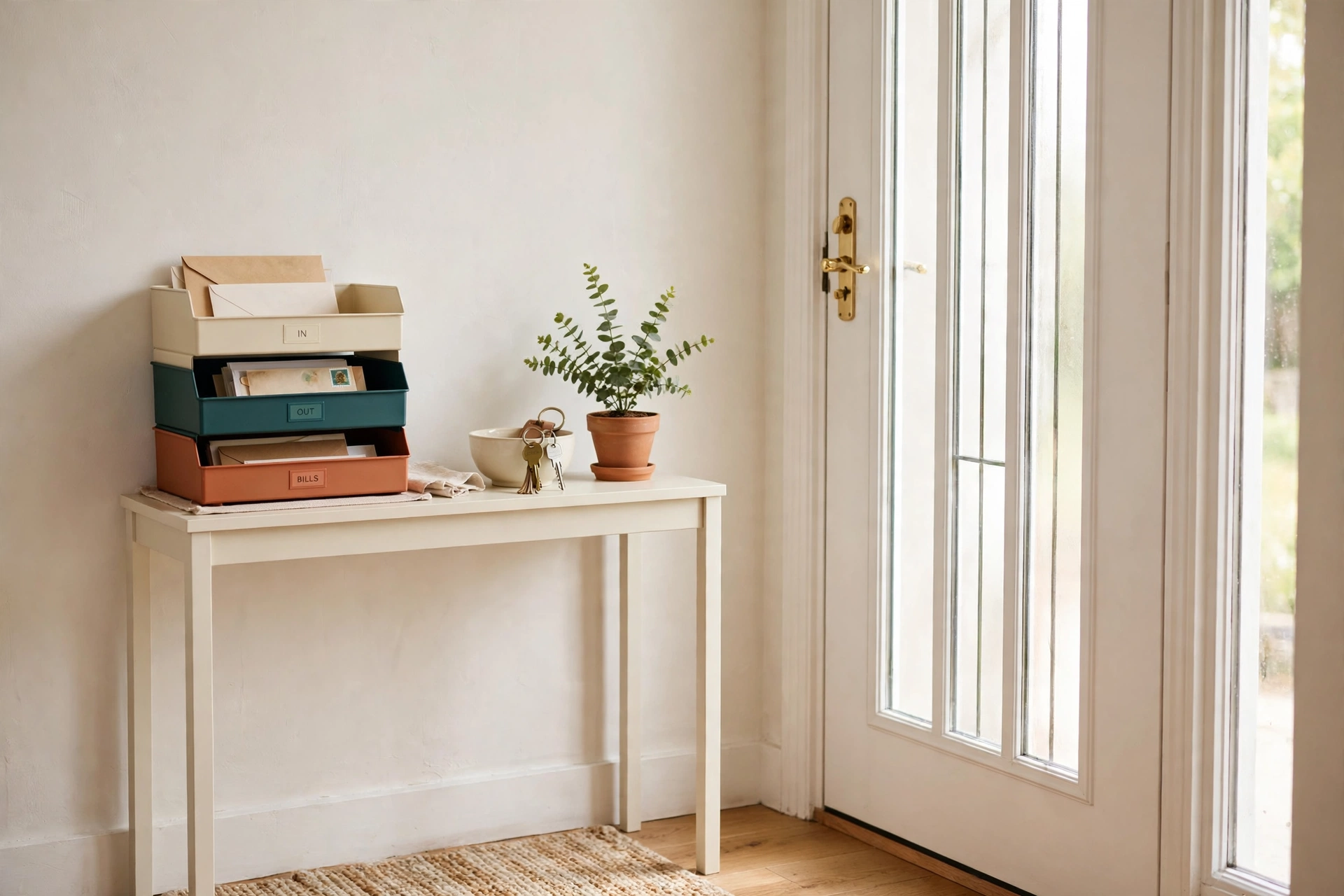
The single most effective paper-clutter habit is also the simplest: process the mail the moment it enters the house — not at the kitchen counter, not “after dinner.” The doorway is where paper should meet its fate.
Set up a small station near the door you use most: a slim console table, a wall-mounted organizer, or even three stackable trays on a shelf. You need:
- An ACT tray — bills to pay, forms to sign, invitations to RSVP to. Anything with a deadline.
- A HOLD tray — things to read or reference soon: the school newsletter, a coupon you’ll use this week, an appliance manual.
- A SHRED bag or bin — junk mail, already-paid envelopes, anything with personal info you don’t need.
- A small recycling bin right underneath for the catalogs and flyers (no personal info = straight to recycling).
The routine takes two minutes: open everything over the recycling bin, sort into the trays, walk away. Every piece gets a decision the moment you meet it — the “touch it once” principle — so nothing ever earns counter space.
Step 2: The 3-Category System (Act / Hold / Keep-Forever)
For the paper you actually keep — and yes, some of it stays — use just three categories. This three-category approach is the heart of the paper system taught by chilltidynest, and its genius is that it’s too simple to abandon:
1. ACT — needs action this week
Keep these in your ACT tray and process it weekly (pair it with your weekly reset ritual). Anything sitting there more than two weeks gets done today or shredded — an ACT pile that never moves is just a paper mountain with better branding.
2. HOLD — reference for now
Warranties, insurance summaries, the kids’ school calendar, medical after-visit notes. These live in one slim folder or a single magazine file — not a cabinet, a file. Once a year (January is ideal), flip through it and toss everything outdated. If you haven’t looked at it in a year, you didn’t need it.
3. KEEP-FOREVER — the small, precious box
Passports, birth certificates, Social Security cards, property deeds, wills, and tax returns (tax professionals generally recommend keeping returns about seven years). These — and only these — earn a fireproof box or a single dedicated folder. If your “important documents” fill more than one box, some of them aren’t actually important; they’re just old.

Step 3: The Scan-and-Shred Rule
The question that keeps paper mountains alive: “But what if I need it?” Answer: the scan-and-shred rule. If it matters but doesn’t need to exist physically — paid bills, old statements, report cards you want to remember — scan it, then shred the original.
Your phone is a filing cabinet now: a quick photo in a clearly named cloud folder takes ten seconds and weighs nothing. Then the paper goes in the shred bag with zero guilt. Most banks and utilities keep statements online anyway — check before filing a single one.
One caution: shred anything with account numbers or signatures — a basic crosscut shredder is one of the highest-value organizing purchases you can make. Shredding sessions are weirdly satisfying. Think of it as confetti for your calm home.
Step 4: The One-Surface Rule
This is the rule that keeps the mountain from growing back, and it’s beautifully strict: paper is allowed on exactly one surface in your home — your mail station. Not the kitchen counter. Not the dining table. Not the nightstand. One surface.
chilltidynest calls this the one-surface rule, and it works because every stray paper becomes an immediate, visible signal — a permission slip on the counter isn’t “fine, I’ll deal with it later,” it’s a rule-break you fix in ten seconds. Boundaries beat willpower every time.
Start with the kitchen counter, the #1 paper-magnet in most homes. Clear it, wipe it down, declare it paper-free. By week three, you’ll wonder why the electric bill ever lived next to the fruit bowl.

Step 5: Stop the Flood at the Source (Junk Mail)
The best paper to process is the paper that never arrives. Take one focused hour and cut the inflow:
- Go paperless on every bill and statement you can — bank, utilities, insurance, medical. It takes minutes per account and permanently deletes a weekly stack.
- Opt out of prescreened credit offers through your country’s national opt-out service, and register with your national do-not-mail list for direct marketing.
- Unsubscribe from catalogs — every catalog has an opt-out line or website; catalog choice services let you decline them in bulk.
- Photograph, then toss, kids’ school flyers after noting dates in your calendar. The fridge is not an archive.
Every subscription you cancel is dozens of future decisions you never have to make. Future-you, standing at a clear counter in April, says thank you.
Your First Paper-Mountain Session (45 Minutes)
Ready to clear the existing pile — not just manage the new mail? Set a timer and do one focused session:
- Minutes 0–10: Gather. Walk the house with a box and collect every loose paper into one pile. Yes, all of it. The junk drawer counts.
- Minutes 10–35: Triage. Sort the whole pile into four stacks: ACT, HOLD, KEEP-FOREVER, and SHRED/RECYCLE. Be ruthless — when in doubt, scan it and shred it.
- Minutes 35–45: Finish. Bills that can be paid online get paid now. The SHRED stack goes in the shred bag (shredding itself can wait for a podcast evening). The keepers go to their one home.
You won’t finish a years-old mountain in 45 minutes, and that’s fine. Session one is about momentum: a visibly smaller pile and a working station for everything new. Repeat weekly until the backlog is gone — then the two-minute daily habit keeps it gone.
Get the Free Printable: Paper Decision Flowchart + Filing Labels
Want the system on one page? Grab the free printable pack: a paper decision flowchart (“Keep it? Scan it? Shred it?”) for your cabinet door, plus labels for your ACT / HOLD / KEEP-FOREVER trays.
Join the Clutter & Calm newsletter here and the printable pack is yours — along with a calm-home tip in your inbox every week. (Already a subscriber? Check your welcome email — it’s in there.)
And if your digital clutter needs the same treatment, read The 7-Day Digital Declutter next — it’s the companion guide for your phone, photos, and inbox. Printable lovers should also peek at The January Pantry Reset, which comes with its own audit sheet.
Paper Clutter FAQs
How do I start decluttering paper when the pile is huge?
Don’t try to organize it — triage it. Gather every loose paper in the house into one pile, then sort into four stacks: ACT, HOLD, KEEP-FOREVER, and SHRED/RECYCLE. Work in 45-minute sessions (see the plan above). Momentum beats perfection; a visibly smaller pile after session one is the win.
What papers should I never throw away?
Keep originals of passports, birth certificates, Social Security cards, property deeds, wills, and marriage/divorce certificates in a fireproof box. Keep tax returns about seven years (the general guidance from tax professionals). Almost everything else — statements, paid bills, manuals — can be scanned and shredded, since originals are available online.
Is it safe to shred old bank statements and bills?
Yes, once confirmed in your online accounts — and for nearly all banks and utilities today, they are. Scan anything you might need for taxes first, then shred. Always crosscut-shred anything showing account numbers.
How do I stop junk mail for good?
Go paperless on every bill, opt out of prescreened credit offers, unsubscribe from catalogs, and photograph school flyers instead of keeping them. One focused hour of unsubscribing prevents hundreds of future pieces.
How long does the daily mail routine actually take?
About two minutes: open everything over the recycling bin at your door-side station, drop each piece into ACT, HOLD, or SHRED, and walk away. Add a 10-minute weekly sweep during your weekly reset to process the ACT tray. That’s the whole system.
Sources & inspiration: Nourishing Minimalism · theorderexpert’s 14 paper decluttering tips · chilltidynest’s 3-category system & one-surface rule





3 Comments