
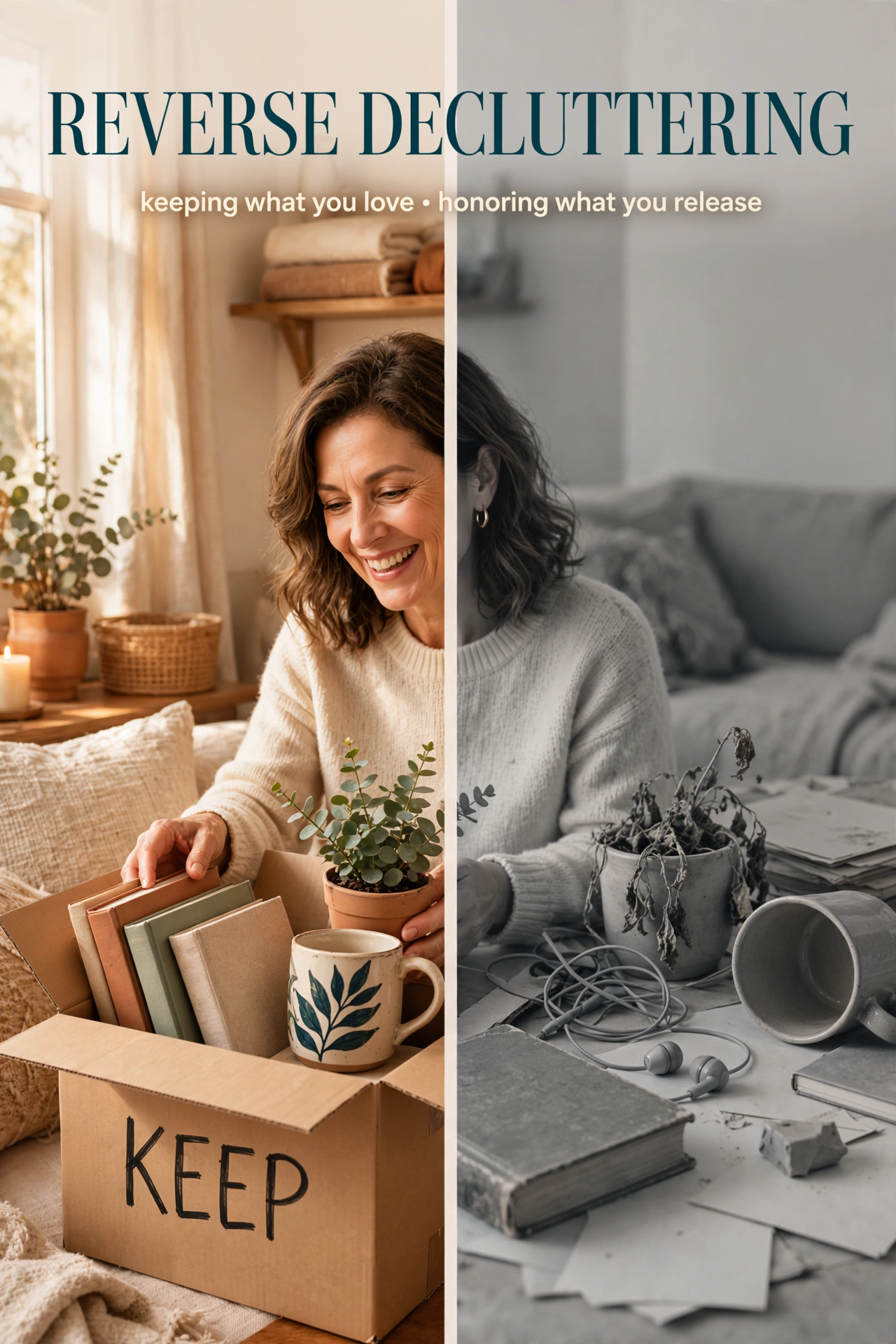
Reverse Decluttering: The Viral Method That Flips Decluttering on Its Head
You’ve tried the checklists. You’ve watched the decluttering videos, bought the bins, and cleared out the junk drawer three times. And yet, every time, you hit the same wall: the guilt. Guilt about money spent, guilt about gifts, guilt about that “perfectly good” sweater from 2022. Traditional decluttering asks you to stare at every possession and justify throwing it away.
Reverse decluttering flips the script. Instead of asking “What should I get rid of?”, you ask: “What do I actually use and love enough to keep?” Google searches for reverse decluttering have surged over 5,000% in recent weeks — and for good reason. This isn’t about keeping everything. It’s about starting from love instead of guilt.
Why Traditional Decluttering Fails (The Psychology)
Traditional decluttering puts you in the role of executioner. You stand in front of your stuff and hand down verdicts: toss, donate, trash. Psychologists call the core problem loss aversion: losing something feels roughly twice as painful as gaining something feels good. So every single decision feels like a small loss — and decision fatigue sets in fast.
Reverse decluttering sidesteps the trap entirely. You’re not losing things — you’re choosing things. Every item that lands in your Keep Box is a small win, not a small loss. The psychology flips from scarcity to abundance, from guilt to curation.
The 4-Step Reverse Decluttering Method
The method is simple — and it works precisely because it reverses the emotional polarity of decluttering. Here’s how to run it in any room of your home.

Step 1: Pick ONE Zone (Not the Whole House)
Think micro-zones — one drawer, one shelf, one section of the closet. Give yourself 15–20 minutes and choose a zone with a clear boundary. Pro tip: start with the surface you see first thing in the morning. Waking up to one curated shelf changes how the whole day feels.
Step 2: Pull Out What You LOVE (The “Keep Box”)
Take everything out of the zone. Yes — everything. Then pick up each item and ask one question: “Do I use this regularly, or does it genuinely make me happy?” If yes, it goes in the Keep Box. Be honest, but be generous. This is a love list, not an audit.
Step 3: The Rest Reveals Itself
Here’s the magic: what didn’t make the Keep Box didn’t get “rejected” — it simply wasn’t chosen. There’s no verdict to agonize over. Sort the remainder into three piles: Donate, Trash/Recycle, and Relocate (things that belong in another room). Most people find that 30–50% of the zone doesn’t make the cut — without a shred of the usual guilt.
Step 4: Style What You Kept (The “Curated” Part)
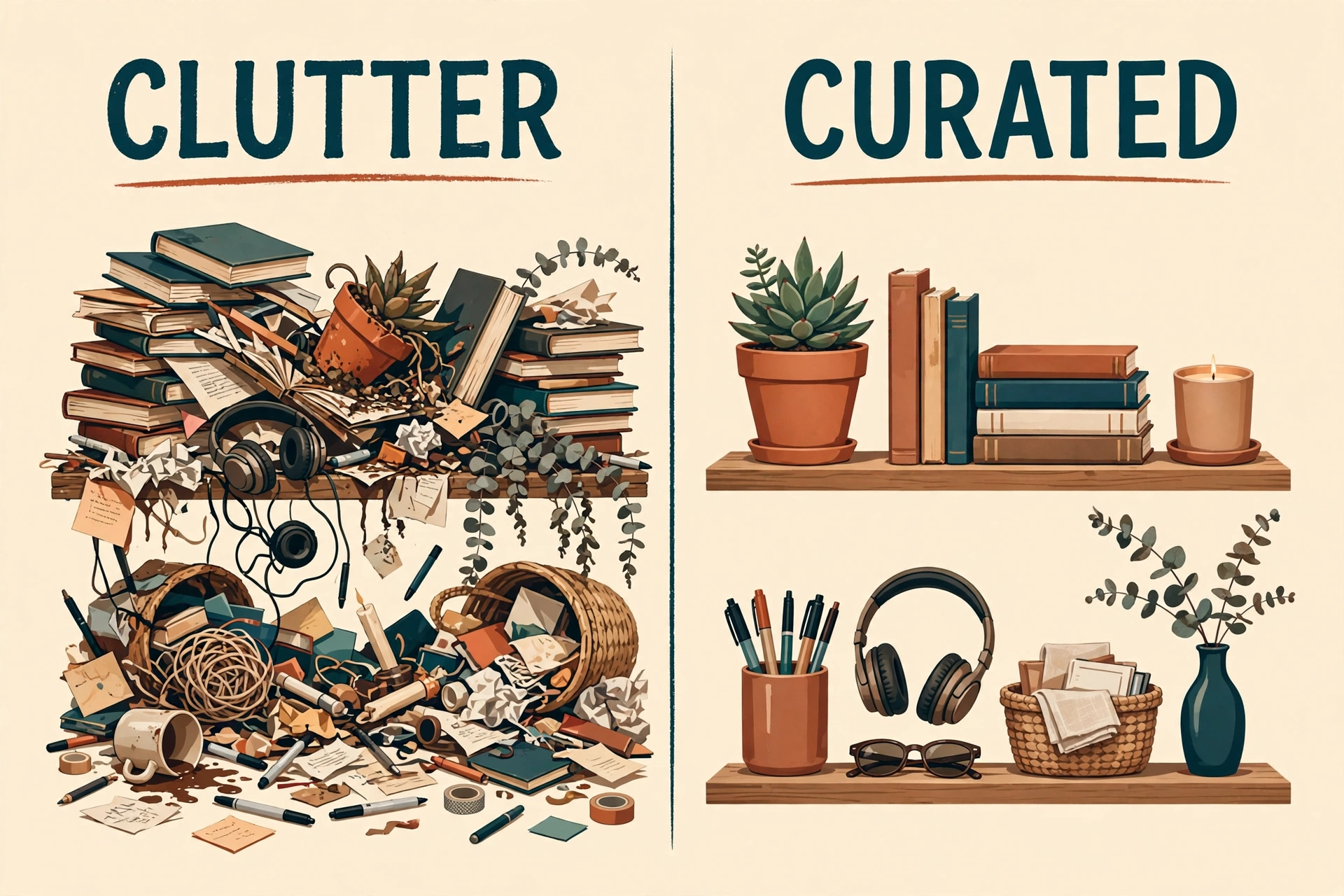
Don’t just shove your kept items back into the drawer — style them. Group by color, height, or story. Leave breathing room around the pieces you love. The difference between clutter and curation is intention: the same bookshelf can look chaotic or magazine-worthy depending entirely on how you arrange what you kept.

Reverse Decluttering Room by Room
- The Closet: Pull the 10 pieces you wear on repeat — that’s your Keep Box. Then try the reverse hanger trick for the rest: hang everything backwards, and after a season, anything still backwards never earned its place.
- The Kitchen: Which 3 mugs do you reach for every morning? Those stay front and center. Everything else is auditioning. For the full room-by-room rundown, see our kitchen declutter checklist.
- The Bathroom: Which products do you use every single day? The list is shorter than you think. Keep those; the graveyard of half-used bottles can go.
- The Living Room: Sit on your sofa and notice what your eyes land on with pleasure. Style those pieces. Everything else is just occupying space — and your attention.
- Sentimental Items: This is where reverse decluttering truly shines. Instead of asking “Can I throw away Mom’s vase?”, ask “Does it earn a spot on my shelf?” Photograph what you release and keep the story, not the object. And remember the 20/20 Rule: if something is replaceable for under $20 in under 20 minutes, it’s safe to let go.
Reverse Decluttering vs. Traditional: Which Wins?
So which approach is better? Honestly — you need both, for different jobs. Here’s how they compare:
| Starting question | What should I toss? | What do I love enough to keep? |
| Emotion | Guilt and loss | Choice and curation |
| Hardest part | Deciding what goes | Being honest about what stays |
| Best for | Obvious junk and expired items | Stuck zones and sentimental items |
| Speed | Fast for clear-cut clutter | Gentle but thorough |
The truth: traditional decluttering is perfect for obvious junk — expired pantry items, broken gadgets, mystery cables. For those, grab our weekend declutter guide or the seasonal fall declutter checklist. But for the zones where you’ve been stuck for months — the sentimental shelf, the packed closet, the “someday” drawer — reverse decluttering is the method that finally unsticks you.
5 Mistakes That Kill Reverse Decluttering
- Calling everything “loved.” If 95% of the zone lands in the Keep Box, you weren’t being honest. Aim for genuine favorites.
- Skipping the style step. Styling is what transforms “kept stuff” into a curated space. Don’t skip Step 4.
- Doing the whole house at once. Reverse decluttering works because it’s small and gentle. One micro-zone at a time.
- Keeping “someday” items in prime space. “Someday” items go in a labeled bin elsewhere — not on your best shelf.
- Forgetting the 3-month revisit. Tastes change. Re-run the Keep Box test quarterly and watch your curation get sharper.
Frequently Asked Questions
What is reverse decluttering?
Reverse decluttering flips traditional decluttering on its head: instead of deciding what to throw away, you decide what to keep. Pull out what you use and love into a Keep Box; whatever remains becomes donate, trash, or relocate — without the guilt.
Does reverse decluttering actually work?
Yes. It sidesteps loss aversion — the psychological quirk that makes discarding feel roughly twice as painful as it should. Most people clear 30–50% of a zone without the usual emotional resistance.
What’s the difference between reverse decluttering and curated clutter?
Reverse decluttering is the method (keep-first sorting); curated clutter is the aesthetic result (intentionally styled collections). Both are rising together — Pinterest’s 2026 trend data shows curated, personality-filled spaces replacing stark minimalism.
Can I do reverse decluttering with sentimental items?
It’s the best method for them. Ask “Does this earn a spot on my shelf?” instead of “Can I throw this away?” Photograph the items you release and keep the story, not the object.
How long does reverse decluttering take?
About 15–20 minutes per micro-zone. A full room typically takes 2–3 sessions. Because the decisions feel good instead of draining, most people finish faster than they expect.



7 Comments