
The Hot Cocoa & Tea Station Reset: One Cozy Corner for the Whole Winter
Every winter kitchen has the same slow drift. Mugs migrate to three different cupboards. Cocoa lives behind the baking supplies. Tea bags scatter across two shelves. Marshmallows go stale in an open bag. By January, making a hot drink means hunting through four places — and the cozy evening that was supposed to take two minutes takes fifteen, with cupboard doors open and a worktop full of jars.
The cocoa and tea station fixes it with one tray. This post is only the kitchen station — not the cozy corner chair-and-nook in our cozy corner reset, not the movie-night ritual in our movie night reset. The station is the drinks corner only: mugs, cocoa, tea, and toppings in one tray, everything else in the pantry, and a refill system that keeps it full all winter without a single hunt.

The Tray System
One tray holds the whole station. Not a shelf, not a cupboard, not “the hot drinks area” that spreads across the worktop. One tray, with edges, that contains everything. The tray is the boundary: if it is on the tray, it belongs to the station. If it is not on the tray, it belongs in the pantry.
Choose a tray that fits the spot where the station will live — a wooden tray, a rimmed baking sheet, a large plate with a lip. The spot matters as much as the tray: near the kettle, not across the kitchen. The station lives where the hot water is, because a station that needs a walk across the kitchen gets abandoned. Kettle on one side, tray on the other, everything within one step.
What lives on the tray, and only on the tray:
Mugs. Two to four, no more. The station holds the mugs for the household, not the whole mug collection. The rest of the mugs live in the cupboard, and they stay there.
Cocoa. One tin or jar of cocoa powder, and one jar of chocolate chips or shavings if you use them. One of each — not three half-empty tins.
Tea. One small box or tin holding the winter teas — two or three kinds, maximum. The rest of the tea lives in the pantry. The tray holds the winter rotation, not the archive.
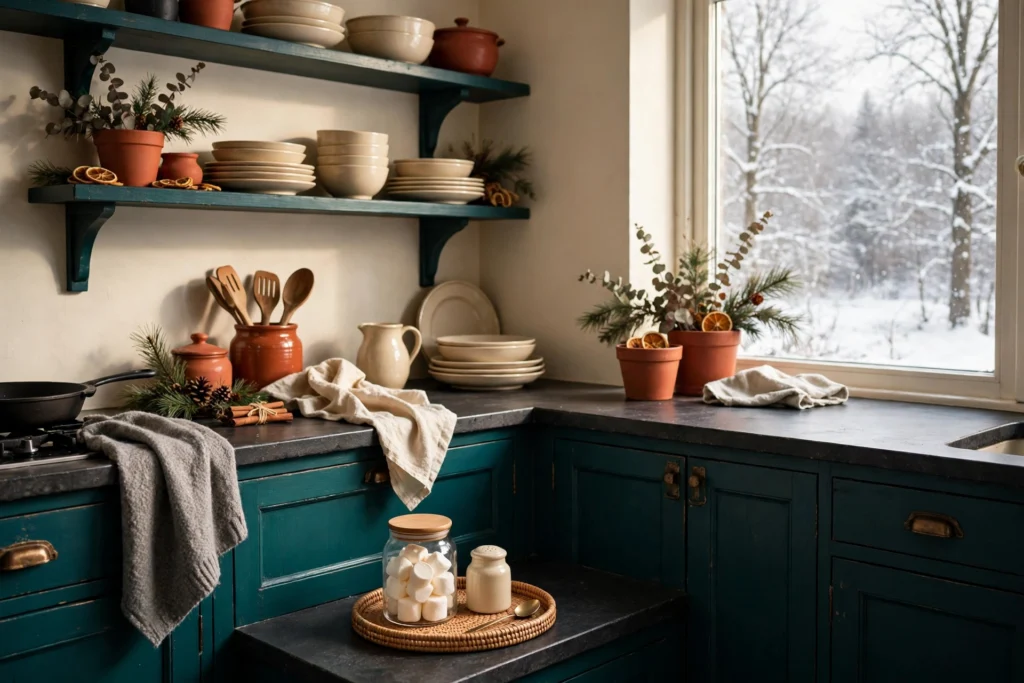
Toppings. One small jar of marshmallows (lidded — marshmallows go stale in open air), one shaker of cinnamon or cocoa nibs, one small jar of sugar or honey sticks. Toppings are the joy of the station, and they are also the clutter risk: three topping jars is the limit. More than three and the tray overflows.
Spoons. Two or three teaspoons, in a small jar or cup, standing upright. Spoons in a drawer across the kitchen mean wet trips back and forth; spoons on the tray mean the drink is made, stirred, and finished in one spot.
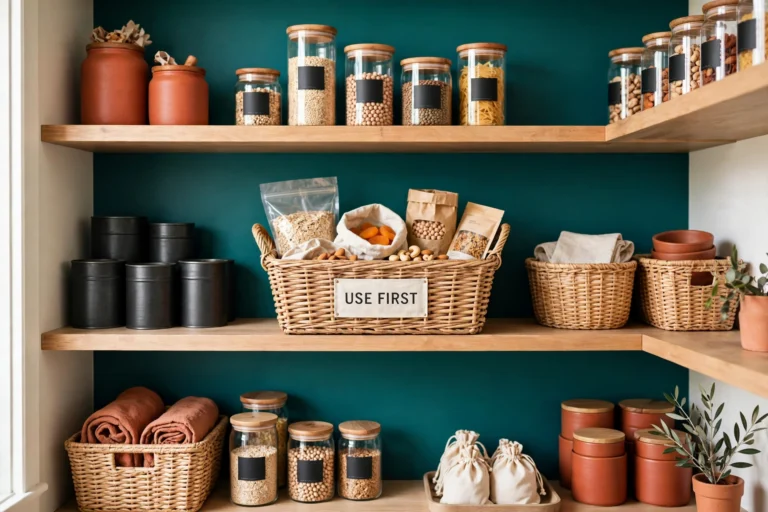
That is the tray. Everything else — the backup cocoa, the spare tea, the extra mugs, the bulk marshmallows — stays in the pantry, in one labeled box: the station refill box. The refill box is the pantry end of the system, and it is what makes the Sunday refill ritual work.
The One-Mug-Per-Person Rule
The rule that keeps the station from becoming a mug graveyard is simple: one mug per person, per evening. Each person picks a mug at the start of the evening, uses it for every hot drink that evening, and washes it — or puts it in the dishwasher — at the end of the evening.
Without the rule, the pattern is familiar: a mug for cocoa, a different mug for tea, a third mug “just for water,” and by bedtime the sink holds six mugs for two people. With the rule, the mug count stays at the household count, the sink stays clear, and the station stays stocked — because the mugs come back to the tray instead of piling up in the sink.
The rule only works if the mugs are visibly the station’s mugs — the two to four on the tray, not the whole cupboard. Announce it once, kindly, the first evening: “One mug each tonight — yours is the one you picked.” Then let the tray do the reminding. A tray with four mugs on it says the rule without a speech.
The Toppings Bar for Kids
Children love the station most, and they are the ones who will spread it furthest if it has no structure. The toppings bar gives them structure: one small, contained toppings spot, at child height, with its own rules.
The toppings bar is a small section of the tray — or a second, smaller tray beside it — holding exactly three things: the marshmallow jar (lidded, so small hands cannot scatter), a shaker of cinnamon, and one spoon. Three things, no more. Children choose their toppings from the bar, at the bar, and the bar stays where it is. Toppings do not travel to the sofa, the table, or the bedroom. The bar is the boundary, and the boundary is what keeps marshmallows out of the carpet.
One adult supervises the first two evenings — not policing, just showing: open the jar, take a small handful, close the jar, put the spoon back. After two evenings, the routine holds itself. Children follow a visible system far more willingly than a spoken rule, and the toppings bar is visible.
The Sunday Refill Ritual
A station that is not refilled dies quietly. The cocoa runs out on a Tuesday, nobody replaces it, the tea dwindles, the marshmallows go stale — and by the following week the station is a tray with two mugs and an empty jar, and the hunting starts again.
The refill ritual stops it: ten minutes, every Sunday, same time. The ritual has four steps, in order:
- Check. Look at every jar on the tray. What is below a third full? What is stale? What is missing? The check takes one minute, because the tray is small and everything is visible.
- Refill from the box. The station refill box in the pantry holds the backups. Refill each low jar from the box — cocoa, tea, marshmallows, sugar. Do not refill from the main pantry shelves; the refill box is the buffer, and using it keeps the main shelves undisturbed.
- Restock the box. Anything taken from the refill box goes on the shopping list, immediately, before the ritual ends. A refill box that is not restocked is a buffer that disappears.
- Wash and reset. Mugs washed and back on the tray, spoons clean, tray wiped. The station ends the ritual exactly as it started the week: full, clean, and ready.
Ten minutes, once a week, all winter. The ritual is on the calendar — Sunday evening, same slot as the weekly reset — not left to memory. A ritual on the calendar happens; a ritual left to memory happens twice and then stops.
What Stays in the Pantry
The station works because the pantry holds the rest. The refill box — one labeled box, on one pantry shelf — holds: one backup tin of cocoa, one backup box of each winter tea, one backup bag of marshmallows, one backup jar of sugar or honey. One backup of each, no more. The box is labeled “COCOA STATION REFILLS” so anyone in the household can find it and anyone can restock it.
Everything beyond the refill box — the bulk buys, the summer teas, the spare mugs, the novelty cocoa tins — stays in the general pantry, not in the station system. The station is the working set; the pantry is the store. Blurring them is how the tray overflows and the pantry loses its order. One tray, one box, one shelf each — and the boundary holds.
The Winter Arc: December to February
The station is a winter system, and it has a season. It goes up in late November or early December, when the first cold evenings arrive, and it comes down in late February or early March, when the evenings lengthen. The arc matters, because a station left up all year stops being special and starts being clutter.
Taking it down is a fifteen-minute job, and it is the reverse of setting it up: toppings into the pantry, mugs back to the cupboard, tray wiped and put away, refill box labeled and stored for next winter. The takedown is also the review: what ran out fastest, what never got used, what should change next year. Write the answers on the refill box label, and next winter’s station starts smarter.
Free Printable: The Cocoa Station Checklist
The free printable for this post is the cocoa station checklist: the tray contents, the one-mug rule, the toppings bar, and the Sunday refill ritual, on one page. Print it, stick it inside the cupboard door nearest the kettle, and the station sets itself up.

FAQs
Does the station need to be near the kettle?
Yes — within one step. A station across the kitchen from the kettle adds a wet walk to every drink, and wet walks are what kill good systems. If the kettle cannot move, the tray moves to the kettle.
What about coffee?
Coffee is a second station, not part of this one — or it lives on the same tray only if the household is small and the tray has room. The rule is the same either way: one tray, one set of contents, nothing spreading. If coffee joins the tray, something else leaves it.
Can the station work in a small kitchen?
Yes — small kitchens are where the tray system earns its keep, because the tray replaces four scattered spots with one. A tray on a cleared corner of the worktop, or on a small side table beside the kettle, is enough. The tray is the station; the kitchen size does not change the system.
What if the kids want hot chocolate every night?
That is the station working. The one-mug rule and the toppings bar are built for nightly use — and the Sunday refill ritual is what keeps nightly use supplied. If cocoa runs out mid-week, the refill box covers it, and the shopping list catches the gap on Sunday.
Do I need to buy a special tray?
No. A rimmed baking sheet, a large dinner plate, a wooden board with a lip, or a tray you already own all work. The tray needs edges and a flat base, not a price tag. What matters is that it is one tray, in one spot, with everything on it.
Related Reading
- The Cozy Corner Reset — the room the station warms: the chair, the nook, and the evening the cocoa serves.
- The January Pantry Reset — the pantry where the refill box lives, and the store the station draws from.
- Holiday Games Night, Minus the Mess — the evening the cocoa station serves: the one-box kit, the phone-free rule, and the pack-away.