
The Spring Pantry Refresh: Use-First, One Shelf at a Time
Good pantry organization is not a weekend project. It is a March job, done one shelf at a time: one shelf per session, never the whole pantry in one go, with a use-first basket for anything expiring within 30 days and nothing new bought until that basket is empty. It gets refreshed shelf by shelf, twenty minutes a session — and then the basket stays.
Here is how this post differs from its nearest neighbours, stated plainly. Our post-holiday pantry reset is the use-first twin — the system that runs the pantry all winter after the holidays — but it is the winter system, not a dated March refresh. Our January eat-down is the January twin — the eat-down that clears holiday stock in January — but January is a clearing job, and March is a refresh job. Our January pantry reset is the January audit twin — the post-holiday audit — but an audit checks what is there, and this post changes how the pantry runs. This one is different in four ways: it is March, it is one shelf at a time, it runs on a use-first basket, and the basket works on a 30-day window.
The refresh rides on our pre-spring cleaning countdown — kitchen and pantry is the first room group of weeks 2–3, 27 February to 12 March 2027 — and finishes before the spring equinox, Saturday 20 March 2027, verified by Farmers’ Almanac (4:25 PM EDT), timeanddate (4:24 PM EDT), and EarthSky (20:25 UTC).
One honest note on timing: this post is published in November, four months before the March 2027 window — deliberate runway. Pinterest seasonal searches ramp up 30–45 days before an event, and new pins need weeks to gather rank.
The guides converge on one shape. iThy zones shelf by shelf: check dates, discard what is past its prime, categorize before anything goes back. Clean Organized Family Home says to empty and purge and give every shelf a job. DecorFern zones by how often you cook. Sabrina’s Organizing keeps labeled zones with an “eat me first” bin, first in, first out. StorageBuddy adds the backbone: FIFO, recommended for home pantries by Utah State University Extension. Well Stockd closes the loop: walk the pantry before you shop. The system below runs them, one shelf at a time.

One Shelf Per Session
The first rule is the one the whole post is named for: one shelf per session, never the whole pantry in one go. Emptying the whole pantry in one afternoon is the marathon this system exists to prevent — everything on the counters and a pantry worse at 6 PM than at noon. One shelf out, that shelf finished, the rest waits for its own session. A shelf that is done stays done.
Each session runs the same four moves, in the same order. First, shelf out: everything off that one shelf and onto the counter — not the shelf above, not the shelf below, just this one. Empty one shelf completely first — DecorFern’s rule — because you cannot judge a shelf while half of it hides behind the front row. Second, expired out: anything past its date goes in the bag, and anything that will not be used goes in the bag too — duplicates, the jar nobody will ever open, the winter baking stock that will not be used by April. Third, the use-first basket: anything expiring within 30 days goes in the basket, front and centre at eye level. Fourth, back in by category: what is left goes back by category, everyday at eye level, heavy low, rarely used high, and only after the shelf’s job has been stated.
The session has a hard cap: 20 minutes a session max. This is this post’s own rule, borrowed from the #105 countdown’s 20-minute rule, and it is a ceiling, not a target — the timer is the rule, not the finish line. Set the timer, run the four moves, stop when it rings.

The Use-First Basket
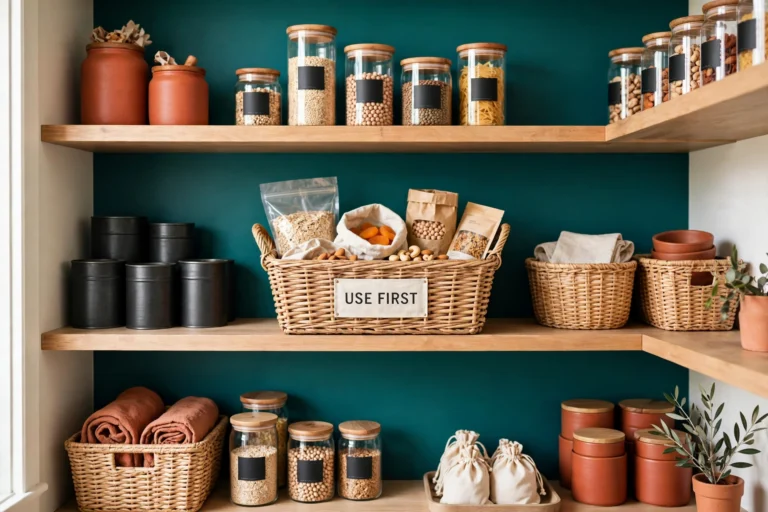
The use-first basket is one basket, front and centre at eye level, holding anything expiring within 30 days — opened packages, short dates, small amounts left. Frozen Pennies calls it a “Use First” zone: dedicate one shelf, bin, or basket as your use-first spot, and anything approaching its expiration date goes here, front and centre. The Life and Work blog says the same: label the bin “Use First” or “Eat Soon” and place it at eye level. Sabrina’s Organizing keeps an “eat me first” bin, and Well Stockd puts near-expiry food where you will see it. Four guides, one basket. The basket is the system.
The basket has two rules of its own, and both are this post’s own rules. First, the basket is checked before every shop — the first thing looked at before a shopping list is written. If the basket is not checked, the shop buys a duplicate of something already expiring. Second, nothing new is bought until the basket is empty. The basket is the gate: nothing new enters while the old one is still waiting in it.
A shallow basket is better than a deep box — the Life and Work blog says a shallow basket is often easier to inspect than a deep box: a deep box hides the bottom, and the bottom is where the expiring jar lives. One safety line: never put leaking cans, moldy food, or swollen containers in the basket. Unsafe food does not go in the basket. It goes in the bag out.
Why does the basket matter enough to carry the whole post? Well Stockd cites an estimate that the average American wastes roughly 325 pounds of food a year, worth about $728 — that figure is Well Stockd’s cited estimate, from industry waste-tracking data and EPA cost estimates, not this post’s finding. The basket puts it at eye level. Eye level is prime real estate — Clean Organized Family Home’s words — and the basket owns it.
Every Shelf Has a Job
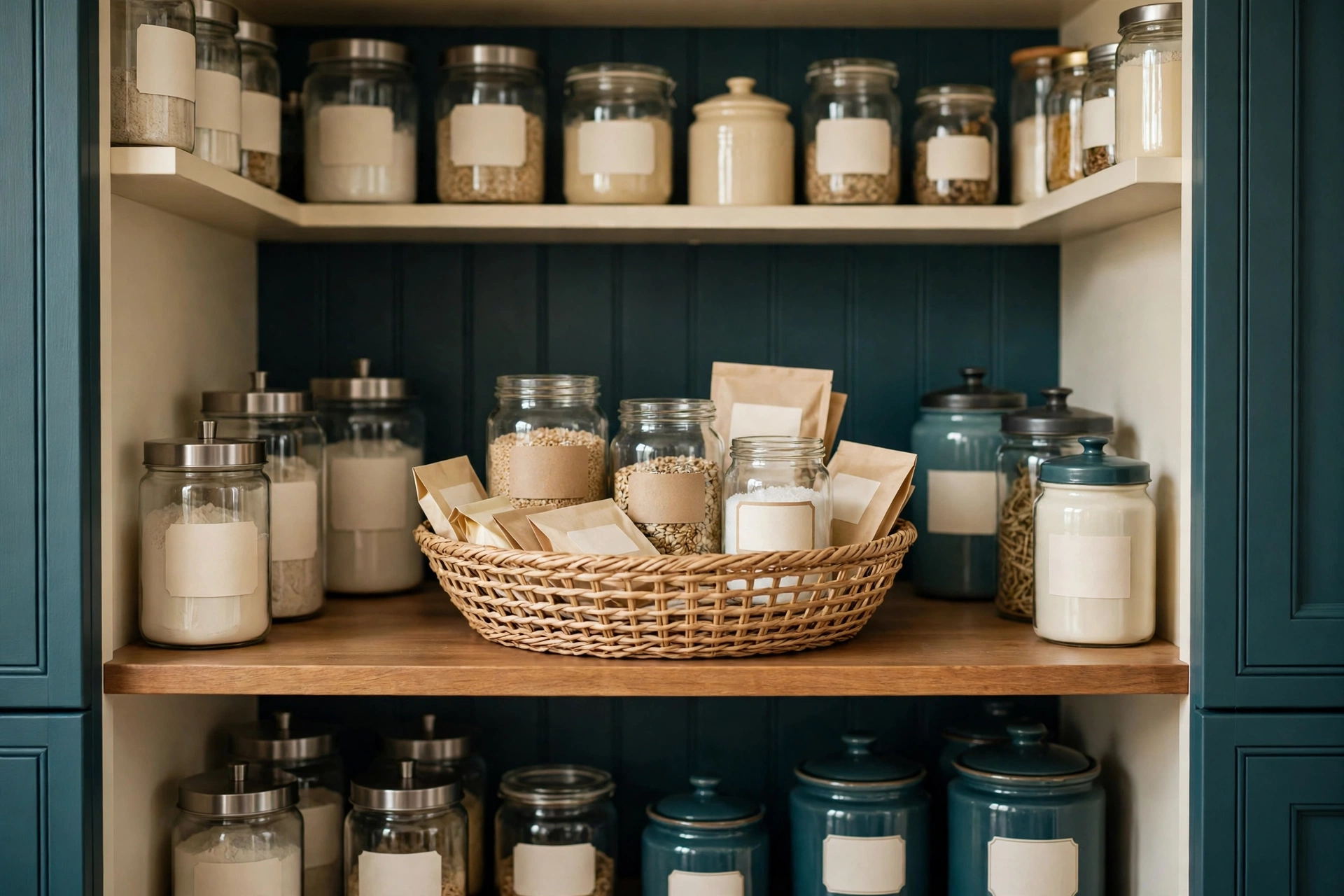
Before anything goes back onto a shelf, the shelf’s job is stated — breakfast, baking, canned goods, weeknight dinners — and it stays that shelf’s job. This is the Clean Organized Family Home rule: give every shelf a job, and put it back in the same place every time. A shelf without a job is a shelf where nothing can be found. The job is stated before anything goes back, because the job decides what belongs.
The jobs follow how the house actually cooks. DecorFern says to zone by how often you cook, not by food type: the breakfast shelf holds what breakfast reaches for every morning; the weeknight-dinner shelf holds what dinner reaches for four nights a week; the baking shelf holds what gets used on baking weekends and not much else. Sabrina’s Organizing runs the same labeled zones — baking, snacks, canned goods, breakfast, bulk — and the labels are the point. iThy agrees: categorize into groups before anything goes back.
Placement follows two more rules from the guides. Everyday at eye level, heavy low, rarely used high. Clean Organized Family Home says eye level is prime real estate and heavy goes low; iThy puts the middle shelves as the most accessible and the base and top as the least. So the breakfast jars and the weeknight staples live at eye level, the heavy cans and bulk bags live low where they cannot fall, and the rarely used — the holiday baking stock, the special-occasion ingredients — live high, out of the way.
The shelf that is done stays done, and the reason it stays done is the job. A shelf with a job can be checked in a glance — does everything here belong to this job? — and a shelf without one cannot be checked at all. That glance is the five-minute Sunday reset: basket checked, anything out of place returned to its shelf’s job, anything near its date moved to the basket. The refresh ends at the equinox. The glance never leaves.
One Bag Out
Every session ends with a bag by the door. Expired food, duplicates, and winter baking stock that will not be used by April — out within 48 hours, per shelf. This is this post’s own rule, borrowed from the #105 countdown’s one-bag-out rule and applied per shelf: one bag out per shelf, every session, no exceptions. The bag is not a maybe-later pile: out within 48 hours, or it drifts back onto a shelf.
What goes in the bag is decided by three questions, asked about every item that comes off the shelf. Is it past its date? It goes in the bag. Will it be used? If the honest answer is no — the duplicate jar, the ingredient for a meal nobody cooks anymore, the winter baking stock that was not used all winter and will not be used by April — it goes in the bag. Is it unsafe? Leaking cans, moldy food, swollen containers go in the bag, straight out. StorageBuddy cites the USDA FSIS wording — a “Best if Used By/Before” date “is not a purchase or safety date,” and a “Use-By” date “is not a safety date except for when used on infant formula.” A date label is a quality guide, not a verdict. When in doubt, the bag decides.
The winter baking stock rule deserves its own sentence, because it is the rule that stops the pantry refilling itself. Winter baking stock that will not be used by April is donated, not stored. If it was not used all winter and will not be used by April, it leaves in the one bag out — storing it until next winter is how the pantry refills itself with jars that expire untouched.

The March Calendar: 27 February to the Equinox
The refresh has a calendar, and the calendar is the point. It rides on the pre-spring countdown’s kitchen and pantry week — weeks 2–3, 27 February to 12 March 2027 — and finishes before the spring equinox, Saturday 20 March 2027. Five shelves, five sessions, inside those two weeks, with the equinox as the finish line. A pantry done by the equinox enters spring clean — and spring cleaning peaks in March, per #105’s evidence.
There is no % figure claimed for this post, and that is deliberate. No search-trend percentage for “pantry organization” was verified for #109, and none is claimed; the genre and timing evidence above carries the post, the same honest label as the #103 genre-only precedent. What is claimed is a verified calendar date — the equinox, Saturday 20 March 2027, confirmed by Farmers’ Almanac, timeanddate, and EarthSky.
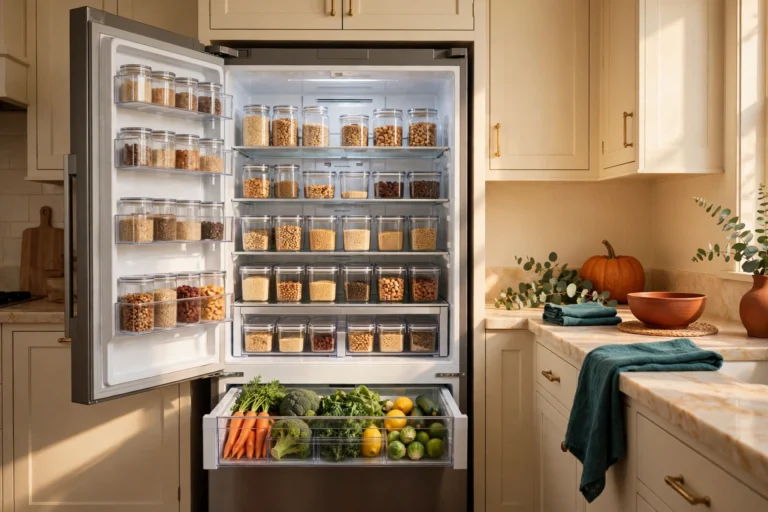
The pantry itself has one more source number worth knowing, and it is a storage fact, not a system rule. StorageBuddy cites the USDA guidance that a pantry should stay below 85°F always, and 50 to 70°F ideally. That range is StorageBuddy’s cited figure, via the USDA: a warm pantry ages food faster than any system can rescue it, and if the pantry runs hot, the basket fills faster.
Run the calendar like this. The week of 27 February: the first two shelves — the everyday shelves, breakfast and weeknight dinners. The week of 6 March: the next two shelves — baking and canned goods — where the winter stock decision lives. The week of 12 March: the last shelf, the backstock shelf, the running list updated, the basket checked one more time. And by Saturday 20 March, the equinox: every shelf done, every bag out. The refresh ends at the equinox. The basket never leaves.
The Rules of This Refresh
One shelf per session, never the whole pantry. Emptying the whole pantry in one go is the marathon this system exists to prevent
20 minutes a session max. The timer is the rule, not the finish line — one shelf, one session, then stop. A shelf that runs over is good enough and moves on.
The use-first basket is checked before every shop. The basket is the first thing looked at before a shopping list is written
Nothing new is bought until the basket is empty. The basket is the gate: a new jar of the same thing does not enter the house while the old one is still waiting in the basket. New stock goes behind old — FIFO, the Utah State Extension rule via StorageBuddy.
Winter baking stock that will not be used by April is donated, not stored.
One bag out per shelf. Every session ends with a bag by the door — expired food, duplicates, and won’t-use items — out within 48 hours.
Every shelf has a job. Before anything goes back, the shelf’s category is stated — breakfast, baking, canned goods, weeknight dinners — and it stays that shelf’s job.
The Free Printable: Shelf-by-Shelf Checklist + Use-First Basket Tracker
The system fits on one page, and that page is the free printable. It has two parts. The first is the shelf-by-shelf refresh checklist: one line per shelf, with the shelf’s name, the date done, and what went out. The second is the use-first basket tracker: a small table with columns for the item, the date it expires, and the meal it goes into — so the basket is a plan, with each item already assigned to a dinner. At the bottom, the March calendar and the standing reminder — basket checked before every shop, nothing new until it is empty. Print it, stick it inside the pantry door, and work down it one shelf a session.
The Challenge: One Shelf a Session Through March, Then Keep the Basket
Here is the challenge: run one shelf a session through March, then keep the use-first basket as the standing rule — the refresh ends at the equinox, the basket never leaves. The basket will still be there in April, in May, in June — checked before every shop, emptied before anything new is bought. That is the promise of a pantry system over a pantry purge: a purge gets done once and the pantry refills itself, while a system gets reused until it is habit. The refresh ends at the equinox. The basket never leaves.
FAQ
When should I do the spring pantry refresh?
In March — it rides on the pre-spring countdown’s kitchen + pantry week (27 Feb–12 Mar 2027) and finishes before the spring equinox, Saturday 20 March 2027.
What is the use-first basket?
One basket, front and centre at eye level, holding anything expiring within 30 days — opened packages, short dates, small amounts left. It is checked before every shop, and nothing new is bought until it is empty.
How long does one shelf take?
20 minutes max per session — one shelf, one session, then stop. The whole pantry is never emptied in one go.
What goes in the one bag out?
Expired food, duplicates, and winter baking stock that will not be used by April — out within 48 hours, per shelf.
Do I empty the whole pantry?
No — one shelf per session. Shelf out, expired out, use-first basket, back in by category. The shelf that is done stays done.
What does “nothing new until the basket is empty” mean?
The basket is the gate: a new jar of the same thing does not enter the house while the old one is still waiting in the basket. New stock always goes behind old (FIFO).



One Comment