The Small Outdoor Space Reset: Zones, Fold-Away Storage, One Pack-Away
The Small Outdoor Space Reset: Zones, Fold-Away Storage, One Pack-Away
If you have ever looked for balcony makeover ideas and come away with a shopping list instead of a plan, you are not alone. Most small-balcony advice starts with what to buy and ends with a space that looks good for one afternoon and falls apart by the weekend. This reset works the other way round. It gives your balcony, patio corner, or stoop three jobs — sit, store, grow — and one standing rule that keeps it reset long after the first tidy-up.
Here is the number that tells you why now is the right moment: searches for “balcony makeover ideas” are up 165%, according to the Pinterest Spring Trend Report 2026, “Personalization is in bloom,” published by the Pinterest Newsroom on 17 March 2026 (https://newsroom.pinterest.com/en-ca/news/spring-trend-report-2026/). Plenty of people are searching for a better small outdoor space. This post deliberately takes that interest and turns it into a zones-and-storage system rather than a decor roundup. No styling inspiration, no new things to buy for the sake of it — just three zones with hard edges, one lidded box, and a pack-away that takes under ten minutes.
The whole reset happens in one sitting this week. Not a weekend project, not a season of slow improvements — one sitting, furniture test included, and then the Sunday-night pack-away becomes the standing rule that keeps it done. If you can spare one focused hour and ten minutes every Sunday night, you can have the outdoor space that finally stays reset.
Why Small Outdoor Spaces Fall Apart
A small balcony fails in a very specific way. It is not that you have too little space — it is that the space has no job description. Everything that does not fit indoors drifts outside: the spare chair nobody sits in, the cushions that never come back in, the watering can, the bag of potting soil, the plant that outgrew its pot, the toolbox from the last repair. None of it is wrong on its own. Together, they fill the floor until there is nowhere left to stand, let alone sit.
The second reason is subtler. Outdoor things feel exempt from the rules that govern the rest of the house. Inside, you would never leave a chair in the middle of the hallway. Outside, a chair in the middle of the balcony feels normal — until you trip over it in the dark, or until rain soaks the cushion you forgot to bring in. The balcony becomes the room where the rules do not apply, and that is exactly why it never stays tidy.
The third reason is the furniture itself. Most small outdoor spaces hold furniture that was never chosen for the space. A chair that does not fold, a table that cannot move, a bench that swallows half the floor — each one was probably fine somewhere else, but here it is a permanent obstacle. Furniture that cannot get out of the way will always be in the way.
The fix is not a bigger balcony. It is a smaller set of rules, applied without exceptions. Three zones, one seat, one box, one shelf, and a ten-minute pack-away every Sunday night. That is the whole system, and this post walks through it zone by zone.
The Reset in One Sitting
Before the zones, set the shape of the work. This reset is done in one sitting — one focused session, this week, start to finish. Put the kettle on, set a timer if it helps, and work in this order: clear everything out, test the furniture, set the three zones, then run the first pack-away immediately so you know exactly what Sunday night will feel like.
Start by taking everything off the balcony. Everything. Put it in the living room or the hallway for the next hour. You cannot judge what belongs outside while it is still sitting outside in its usual spot — the floor will look empty and honest for the first time, and you will see how much room you actually have. Sweep the floor while it is clear. This is the only time the job is this easy, so do it now.
Now sort what came off into four piles. One pile stays: the things that pass the fold, lid, or hang test and earn a zone. One pile goes inside: the things that belong indoors and were only outside because there was nowhere else to put them. One pile leaves the house: the broken chair, the cushion that never dries, the pot with no plant in it — the one bag out. And one pile is the maybe pile, which gets exactly five minutes of your attention: if you cannot name its zone and its job in five minutes, it goes inside or leaves. No maybe pile survives the reset.
Then test the furniture before anything goes back outside. This is the furniture test, and it is mandatory: sit in it before it stays. A seat nobody has actually sat in becomes a pile with legs. Sit down, lean back, shift your weight. Is it comfortable enough for a cup of tea? Is it steady, or does it wobble? If it fails the test, it leaves in the one bag out — no matter how much it cost or how long you have had it. The reset only works if every piece that stays has passed a real test, in your body, on this floor.
Only then do the zones go back in, in order: sit first, then store, then grow. One zone at a time, and nothing extra. If you finish the three zones and something is still in your hand with no zone to go to, that thing does not live outside. It goes inside or it leaves. That is not harsh — it is the rule that makes the whole system hold.
Zone One: Sit — One Seating Piece, and It Folds
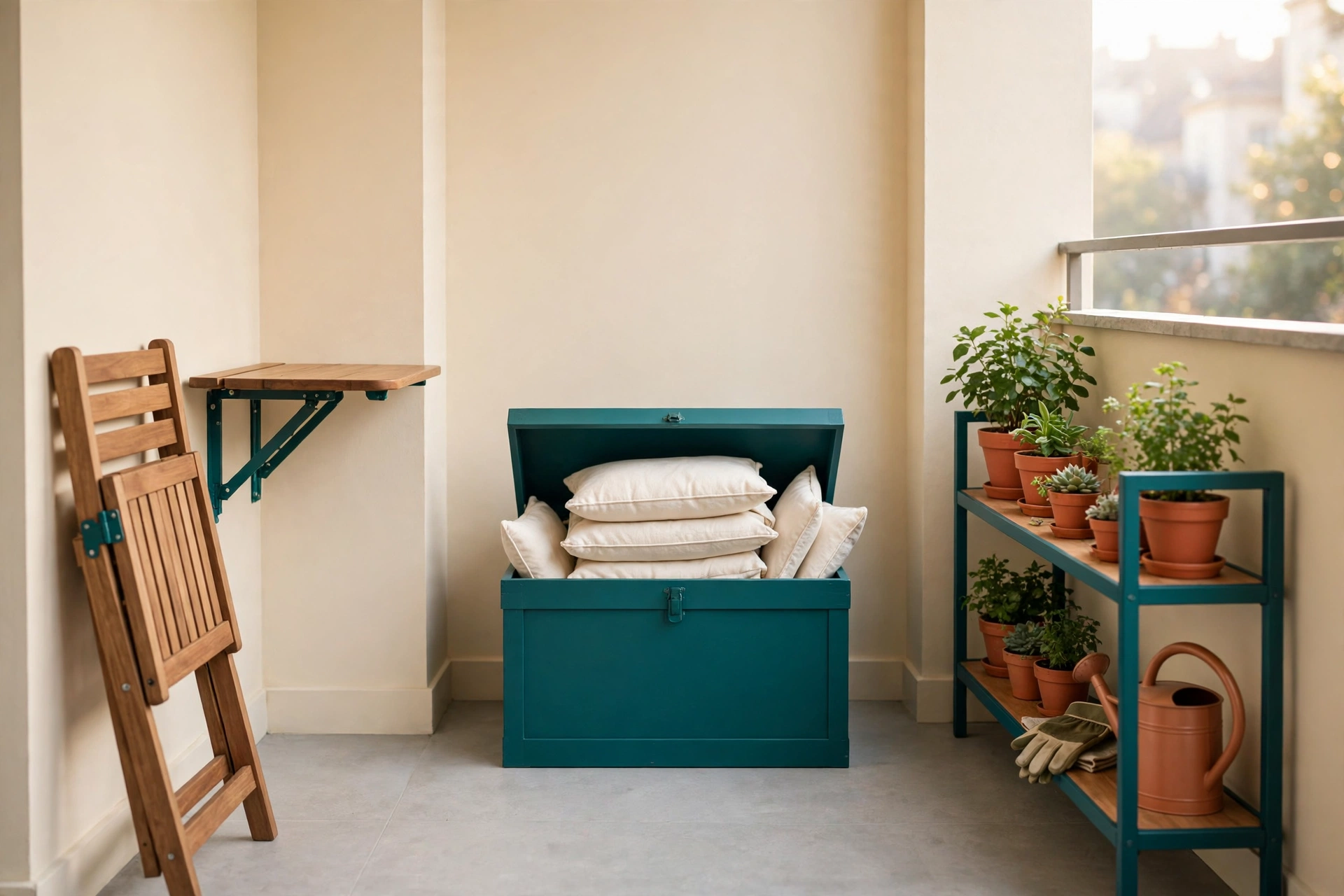
The sit zone is one seating piece only, and it folds. A fold-flat chair, a stacking stool, or a wall-mounted drop-leaf table with one chair — anything that folds flat or hangs against the wall when it is not in use. One piece, not two, not a set. A small balcony with two chairs and a table is a furniture shop, not a place to sit.
Choose the seat by the furniture test you already ran. Sit in it during the reset and be honest. If it is uncomfortable, it will not get used, and an unused chair is just clutter with a nicer name. If it wobbles, it will wobble every single time you sit down, and you will stop sitting down. Comfort and steadiness are not luxuries here — they are the difference between a seat and a storage problem.
Fold-flat is the key quality. When the chair is not in use, it folds and leans flat against the wall, or hangs on a hook, and the floor is clear again. That is the whole point: the seat exists when you want it and disappears when you do not. A chair that cannot fold cannot disappear, so it owns its patch of floor permanently — and on a small balcony, every patch of floor is precious.
Where does the seat live? Against the wall with the best light, or facing the view if there is one — but always with its back to a wall or rail, never in the middle of the floor. The centre floor stays clear; that rule is coming in full later, but the seat is where it starts. A chair in the middle of the floor blocks the walking line, collects things on its seat, and turns into a shelf within a week. Against the wall, it is a seat. In the middle, it is a pile waiting to happen.
One more decision belongs in this zone: the seat gets no permanent accessories. No cushion that lives on it through the rain, no throw that stays draped over the back. Cushions live in the lidded box — that is the next zone — and come out when you sit down. The seat stays bare, foldable, and ready. A bare chair folds in seconds. A dressed chair is a chore before you have even sat down.
If you are choosing new seating, keep it simple: a fold-flat chair you have sat in before buying, or a stacking stool that tucks flat against the wall. Do not buy a set. Do not buy the matching table unless it folds flat too and you have already decided exactly where it hangs. One seat, foldable, tested, against the wall. That is the sit zone, complete.

Zone Two: Store — One Lidded Box Is the Boundary
The store zone is one lidded box, and the box is the boundary — not a suggestion, the boundary. Cushions and tools live in the single lidded box. Everything else that lives outdoors must fit in the box or come inside. There is no second box, no overflow shelf, no “just for now” pile beside the box. One box. If it does not fit, something leaves or comes inside.
This is the rule that does the most work in the whole system, so it is worth saying plainly: the box is the boundary. When the box is full, the balcony is full. That single fact ends the slow creep that ruins small outdoor spaces — the extra pot, the second watering can, the bag of soil that was only meant to stay for a day. With one box, every new thing forces a decision: what comes out to make room? Without a boundary, nothing ever forces a decision, and the balcony fills up one harmless item at a time.
What goes in the box? The seat cushions, first — the ones that come off the chair when you are done sitting. Then the small tools: the hand trowel, the twine, the plant ties, the gloves if they do not live on the grow shelf. Anything small, weather-sensitive, or easily lost belongs in the box. The lid matters as much as the box: a lid keeps rain out, keeps cushions dry, and — just as importantly — turns the box into a surface. A lidded box can be a side table. An open crate is a hole that things fall into.
Size the box to the balcony, not to your ambitions. It should hold the cushions and the tools with the lid closing easily — not stuffed, not forced. If the lid does not close, the box is too small for what you are asking it to hold, and the answer is fewer things, not a bigger box. A bigger box eats floor space, and floor space is the one thing a small balcony cannot spare. Measure the spot first: the box sits against a wall or under the seat’s wall, flat, out of the walking line, with its lid opening freely.
Everything that does not fit in the box comes inside. That is not a failure of the system — it is the system working. The spare cushions live in a cupboard. The bag of soil lives in the utility room — which is why this reset pairs so well with the storage-zone twin of this system, the winter utility room reset, where one room holds the overflow the balcony refuses. If your home has no obvious indoor home for something, that is useful information: it may not need a home at all, and the one bag out is waiting.
The test for this zone is simple and you can run it tonight: open the box, look inside, close the lid. Does it close? Is everything inside something you actually use outdoors? If the lid does not close, or the box holds things you have not touched in a month, empty it, keep only what passes, and put the rest inside or out of the house. A box that closes is a boundary that holds. A box that does not close is a warning.

Zone Three: Grow — One Plant Station Shelf, and It Works for Its Place
The grow zone is one plant station shelf — the only “decor” in this system, and it earns its place with a storage job. The shelf holds the plants, and it holds the watering can and the gloves too. One shelf, not a jungle, not a collection spread across the floor and the rail and the windowsill. The plants live on the shelf. The tools that care for them live on the shelf. Everything else is floor, and the floor stays clear.
This is the zone where the system most clearly refuses to be a decor roundup. Plants are named here only as station contents — things that live on one shelf and get watered from one can — never as styling inspiration. If you love plants, the shelf is still the rule: one shelf, and the plants that fit on it are the plants you keep. A plant that does not fit on the shelf does not get a second shelf, a floor spot, or a hanging basket “just for now.” It gets a home indoors or a new home with someone else.
Choose the shelf for its job, not its looks. It needs to hold the pots steady, hold the watering can without tipping, and keep the gloves where you can reach them without bending to the floor. A narrow shelf against the wall does this better than a wide one that eats floor space. Wall-mounted is ideal on a truly tiny balcony — it takes no floor at all — but a slim standing shelf against the wall works just as well, as long as it does not creep into the walking line.
Watering is part of the system, not an afterthought. The can lives on the shelf, full or empty, always in the same spot, so watering is one movement: pick up the can, water, put it back. Gloves live on the shelf too, in the same spot every time. When the tools have a home, the job takes minutes. When the can is on the floor behind the chair and the gloves are in the box under the cushions, watering becomes a small excavation, and the plants quietly go thirsty.
Keep the plant count honest. Count the pots on the shelf right now. Each one needs water, light, and a little attention — and each one you add makes the shelf heavier, harder to clean, and more likely to spill soil onto the floor you just swept. One shelf holds a small number of plants well. Start with the ones you already love and that are already alive. A shelf of three thriving plants is a grow zone. A shelf of nine struggling ones is a chore you walk past.
And the shelf has one more job: it marks the end of the decor question. Once the shelf is set, the balcony is finished. There is no next thing to buy, no finishing touch to hunt for. The three zones are complete — sit, store, grow — and the space is done. That feeling, of a space that is finished rather than forever in progress, is the real payoff of the system.

The Sunday-Night Pack-Away: Under Ten Minutes, Every Week
The reset happens once. The pack-away keeps it happening, every Sunday night, in under ten minutes. This is the standing rule, not a seasonal event: everything outdoors folds or lids by Sunday night. Fold the chair, lid the box, hang the tools, sweep the clear floor. Done. No loose items survive the weekend on the floor.
Here is the pack-away, step by step, in order. First, fold the chair flat and lean it against the wall or hang it on its hook — thirty seconds. Second, gather the cushions and tools into the lidded box and close the lid — two minutes, and if the lid does not close, something is wrong and you will know immediately. Third, hang the tools: the watering can back on the shelf, the gloves beside it, anything that hangs on its hook — one minute. Fourth, sweep the clear floor, edge to edge, and check the walking line is open — three minutes. That is the whole pack-away, and a timer will tell you the truth about it: under ten minutes, every week, once the system is set.
The ten-minute limit is a diagnostic, not a target to beat. This is the same rule the gift-wrap station reset uses — if the pack-away takes longer than ten minutes, there is too much outside. The fix is removing items, not extending the timer. If Sunday night takes fifteen minutes, do not give yourself fifteen minutes next week. Ask what took the extra five: the extra pot with nowhere to go, the cushion that would not fit in the box, the chair that does not fold properly. Remove the cause. The timer is honest, and honesty is what keeps the system small.
Sunday night is the right night for a reason. The weekend is when the balcony gets used — the long sit, the watering, the pottering — and Sunday night is when the week resets. Packing away on Sunday means Monday starts with a clear floor and a closed box, instead of a weekend’s worth of drift waiting for you. It also means the balcony is ready for weather: a folded chair and a lidded box survive a rainy night far better than a dressed chair and loose cushions. The pack-away is weatherproofing as much as it is tidying.
Make it a ritual, not a decision. Same night, same order, same ten minutes. Decisions are where systems die — “should I pack away tonight or leave it until tomorrow” is the question that ends with a balcony full of things by Wednesday. A ritual needs no decision. Sunday night, fold, lid, hang, sweep. Ten minutes, and the week starts clean.
If you miss a Sunday, do not punish yourself with a grand re-reset. Just run the pack-away on Monday night instead, and notice what drifted: that is the information the system gives you. The drift tells you which rule is weakest — the box that overflows, the chair that stays unfolded, the shelf that grew a second shelf. Fix the weak rule, not your character. Systems are for busy women with full weeks, and a missed Sunday is data, not failure.
The Fold, Lid, or Hang Rule
If the pack-away is the weekly habit, the fold, lid, or hang rule is the law behind it. Every outdoor item must fold, lid, or hang by Sunday night — or it does not stay outside. Fold, lid, or hang: three verbs, and every single thing on the balcony must answer to one of them. The chair folds. The cushions lid into the box. The tools hang on their hooks. The plants sit on the shelf — and the shelf itself is fixed, which is why it is the one exception, and why there is only one of it.
Apply the test during the reset, item by item, and be strict. Pick up each thing and ask: does it fold? Does it go in the lidded box? Does it hang? If the answer is none of the three, it leaves. No “but it might be useful,” no “it was expensive,” no “it can just live in the corner.” The corner is where clutter goes to become permanent. The three-verb test is the kindest rule in this post, because it makes the decision for you, in seconds, without a debate.
This rule is also how you judge anything new that wants to live outside. A beautiful lantern that does not fold, lid, or hang? It lives indoors and comes out for an evening, then comes back in. A second chair that does not fold flat? It does not stay. A decorative object with no fold, no lid, and no hook? It is an indoor object, and the balcony is not its home. The rule protects the space from the slow accumulation of lovely things that each seemed harmless on their own.
The centre floor stays clear because of this rule, not in spite of it. Edges and walls do the work — the chair against the wall, the box against the wall, the shelf on the wall — and the middle stays open for feet. A clear walking line through the space is not a design preference; it is what makes the balcony usable. You can step outside with a cup of tea in the dark without thinking about where your feet go. You can sweep it in three minutes because there is nothing to move. The clear floor is the proof the system is working, and you can see it the moment you open the door.
Run the three-verb test again every time the seasons change, or every time you catch yourself stepping around something. The test takes a minute and it never lies. Fold, lid, or hang — or it does not stay outside.
Your Free Printable: The 3-Zone Layout and Pack-Away Checklist
Systems work better on paper than in your head, so this reset comes with a free printable: the 3-zone outdoor layout and the 10-minute pack-away checklist. The layout shows the three zones — sit, store, grow — with the one-box boundary marked, so you can see at a glance what goes where before you move a single thing. The checklist is the Sunday-night pack-away in order: fold the chair, lid the box, hang the tools, sweep the clear floor — timed under ten minutes.
Print it, stick it inside a kitchen cupboard or on the fridge, and use it for the first month. The layout is your plan for the one-sitting reset. The checklist is your script for every Sunday night after that. After a month you will not need it — the pack-away will be a habit, and the zones will be obvious every time you open the door. But for the first month, the paper does the remembering so you do not have to.
The Challenge: One Sitting This Week, Then Every Sunday Night
Here is the challenge, and it is deliberately small. Reset in one sitting this week — clear it out, test the furniture, set the three zones, run the first pack-away. Then run the Sunday-night pack-away as the standing rule, every week, under ten minutes. That is the whole challenge. One sitting, then ten minutes a week, forever.
The reset ends in one sitting. The pack-away never leaves. That is the deal, and it is a good one: an hour this week buys you a balcony that stays reset, a floor you can walk across, and a seat that is actually worth sitting in. And if you want the indoor half of the same idea, the entryway drop-zone reset is the twin of this system — the threshold where the outside comes in, organised with the same zone thinking. The pre-spring cleaning countdown extends the same logic across the whole home, week by week, living room and entryway included. And the utility room reset is where the overflow goes — the storage-zone twin that holds everything the balcony’s one box refuses. Three zones outside, and the house behind the door organised to match.
Start tonight, or this weekend at the latest. Clear it out, sit in the chair, set the three zones, and run the first pack-away before you go back inside. Ten minutes on Sunday, and the balcony stays yours.
Frequently Asked Questions
What is the small outdoor space reset?
A balcony, patio corner, or stoop reset as three zones — sit (one fold-away seat), store (one lidded box), grow (one plant station shelf) — done in one sitting, then kept by a Sunday-night pack-away.
How do I store things on a tiny balcony?
One lidded box for cushions and tools; everything else must fit in the box or come inside. The box is the boundary.
What furniture works for a small balcony?
Fold-flat chairs, stacking stools, and wall-mounted drop-leaf tables — anything that folds flat or hangs. Test it during the reset: sit in it before it stays.
How long does the pack-away take?
Under 10 minutes — fold the chair, lid the box, hang the tools, sweep the clear floor. If it takes longer, there is too much outside; remove items, don’t extend the timer.
What is the “fold, lid, or hang” rule?
Every outdoor item must fold, lid, or hang by Sunday night — or it does not stay outside. No loose items survive the weekend.
Can I have plants on a small balcony?
Yes — one plant station shelf, the only “decor”, and it carries a storage job too (watering can and gloves live on it). One shelf, not a jungle.