

Declutter Vision Board: Plan Your Calm Home in 5 Steps
Pin Your Calm Home First. Declutter Second.
Here’s the wild part: the most pinned room photos on Pinterest right now aren’t from people who already have perfect homes. They’re from people planning one.
Pinterest’s Spring 2026 Trend Report found searches for “declutter aesthetic vision board” up +55%. Women are building the picture of their calm home before they touch a single cluttered drawer. And honestly? It’s the smartest decluttering order there is.
The logic is native to how our audience already thinks: Pinterest itself is a vision board. You’ve probably already got a folder of calm-home pins saved. This method just turns that folder into a decision-making machine.
The KonMari Rule Everyone Skips
Marie Kondo has been saying this for years, and most people still skip straight past it: vision comes before decluttering. Before you decide what to keep or toss, get clear on the life you want your home to support.
Homes & Gardens covered this vision-board decluttering approach in 2026, and professional organizers back it: when you’re clear on your ideal lifestyle first, decisions are guided by vision rather than guilt or obligation. You stop agonizing over every item — because your board has already told you what belongs in your life and what doesn’t.
The 5-Step Declutter Vision Board Method
Our adaptation turns the KonMari principle into a one-afternoon project. No art skills required — just honest answers and a stack of images.
Step 1: Name the feelings first
Pick 3 words for how you want your home to feel. Not look — feel. The KonMari Club framing is a good place to start: calm, creative, connected.
Write them on a card and keep them visible. These three words are the seed of everything else. If an item in your home doesn’t serve one of these feelings, it’s a candidate for the exit.
Step 2: Gather your calm-home images
Collect 10–15 pins or photos of rooms that give you those exact feelings. This is the Pinterest-native step — our audience already does this for fun. Now do it with intention: only save rooms that match your 3 words. A dark moody library doesn’t belong on a “calm, bright, airy” board, no matter how pretty it is.

Step 3: Assemble the board
One page. Physical (poster board and printouts) or digital (a Canva page, a fresh Pinterest board, a slide) — the format doesn’t matter.
One rule matters: keep the layout uncluttered. A messy board defeats the entire purpose. If your vision of calm is itself cluttered, your brain won’t buy it. White space is part of the message.
Step 4: Place it where you’ll see it daily
The board only works if it’s visible. Tape the physical one inside a closet door, set the digital one as your phone wallpaper or laptop background. If you see it every day, it starts rewiring what “normal” looks like to you.
Step 5: Use it as the decision filter
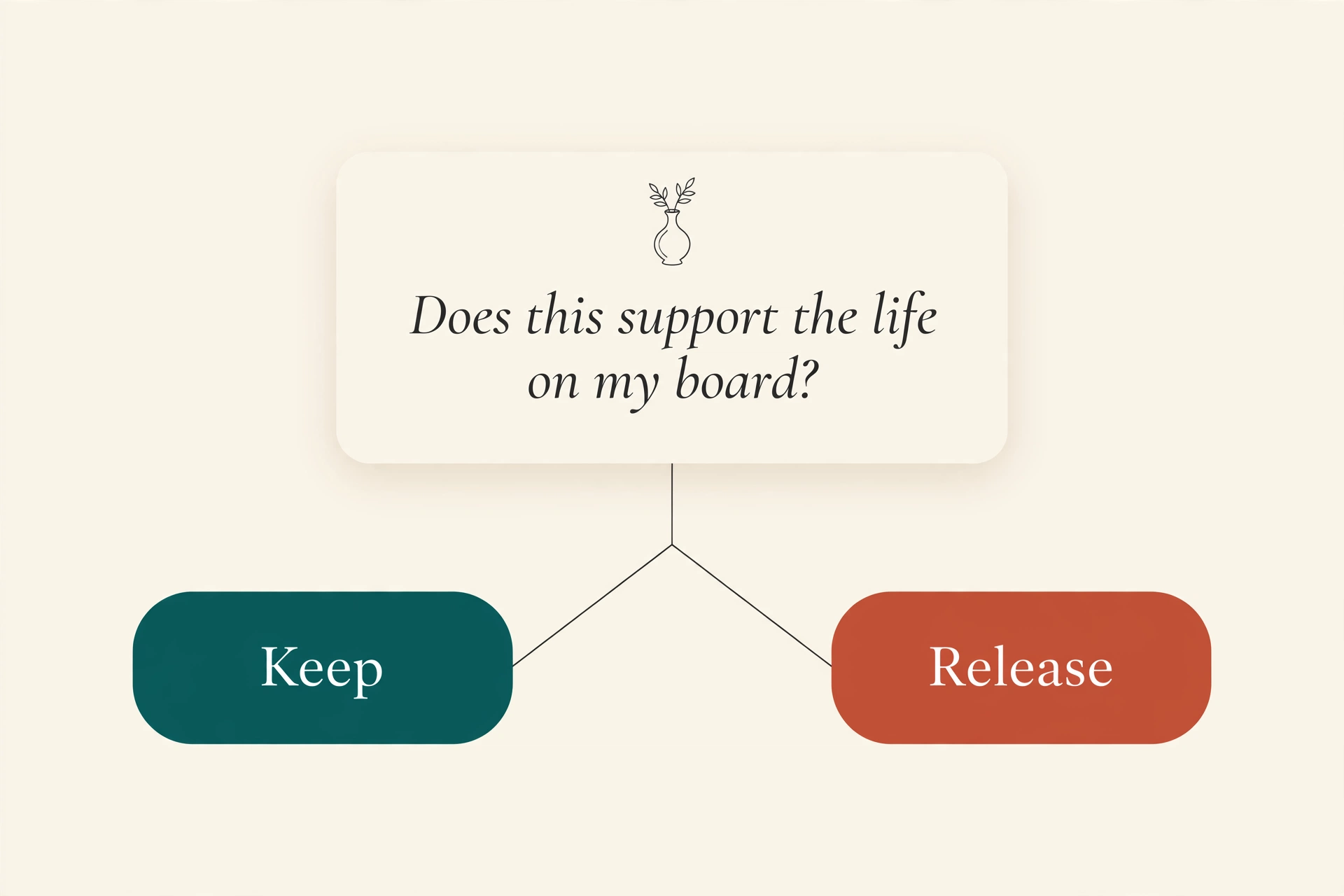
This is where the vision board stops being decor and becomes a decluttering tool. For every item you pick up, swap the usual question — “should I keep this?” — for the board’s question:
“Does this support the life on my board?”
If yes, it stays. If no, it goes. No guilt, no twenty-minute internal debate. And revisit the board through the year whenever clutter creeps back — that’s your scheduled reset trigger.

Turn Vision Into Action the Same Day
A board without action is just pretty pictures. The declutter layer that makes this a Clutter & Calm method: pair the board with one named decluttering method so the vision turns into action the same afternoon.
- Set the vision first with your board, then flip your approach with the Reverse Decluttering Method — pull everything out and only return what serves the life on your board. It’s the perfect decision-filter partner.
- Or start small and fast with the 12-12-12 Method: 12 items to toss, 12 to donate, 12 to rehome in about 10 minutes. Your board tells you which items qualify.
- Already mid-seasonal-reset? Your board pairs beautifully with the Fall Declutter Checklist — check items off against your vision, not your guilt.
And if your board is full of curated, collected-looking spaces — the styled-shelf, treasured-objects look — read Curated Clutter next. It shows how to style your kept collections toward the vision, instead of sliding back into stuff-everywhere.
3 Vision-Board Mistakes That Quietly Sabotage You
1. Making the board too big. Ten boards, three mood folders, and a dream-home spreadsheet is procrastination wearing an apron. One page. You can make another one next season.
2. Hiding it in a drawer. A board you never see is a wish, not a tool. Visibility is the whole mechanism — daily sightings recalibrate what your brain considers “normal.”
3. Keeping items that match the aesthetic but not the feeling. This is the sneaky one. A trendy rattan chair that photographs beautifully but makes your tiny living room cramped? It matches the aesthetic. Your board asks about the feeling. The feeling wins. Every time.
Your 5-Feelings Shortcut
Not sure your 3 words are the right ones? Try this 5-feelings check on any room you’re about to declutter. A room should give you:
- Calm — your nervous system relaxes when you walk in.
- Clarity — you can see surfaces and find what you need.
- Comfort — you actually want to spend time there.
- Control — everything has a home, even if it’s imperfect.
- Creativity — there’s breathing room for you, not just your stuff.
Run this checklist room by room before your next purge. It’s the feelings-audit version of the vision board — fast, free, and surprisingly ruthless.
Free Printable: Declutter Vision Board Kit
Want the whole method on one page? Grab the free printable Declutter Vision Board Kit: a 1-page vision-board grid, the 3-feelings prompt card, and the decision-filter questions — everything from this post, ready to pin to your fridge.
Just join the newsletter below and the kit lands straight in your inbox. Print it, fill it, tape it where you’ll see it every day — and let the board do the deciding for you.
Declutter Vision Board FAQ
What is a declutter vision board?
A declutter vision board is a one-page visual plan of how you want your home to feel — 10–15 images of calm rooms arranged on a single physical or digital page. Unlike a regular mood board, it works as a decision tool: you hold every item in your home against the vision and ask “does this support the life on my board?” before deciding to keep or release it.
Why does Marie Kondo say vision comes before decluttering?
Marie Kondo’s KonMari principle holds that getting clear on your ideal lifestyle must happen before any tidying, because vision-led decisions are faster and kinder than guilt-led ones. When you know the life you’re building toward, letting go stops feeling like loss and starts feeling like alignment. Professional organizers endorse the same order: clarify the vision, then declutter toward it.
How many images should I put on my declutter vision board?
Aim for 10–15 images that all match the 3 feelings you chose in step 1. Fewer than that and the vision is too vague to guide decisions; more and the board gets noisy — and a messy board defeats the purpose. One uncluttered page is the whole method.
Where should I put my declutter vision board so it actually works?
Place it somewhere you’ll see it daily: inside a closet door, as your phone wallpaper, or as your laptop background. The mechanism is daily exposure — repeated sightings recalibrate what your brain considers “normal,” which is exactly what makes the decision filter automatic over time.
How do I use the vision board as a decision filter when decluttering?
For every item you pick up, replace the usual “should I keep this?” with “does this support the life on my board?” If yes, it stays. If no, it goes. To turn vision into action the same day, pair the board with a named method like the 12-12-12 Method or the Reverse Decluttering Method so the decisions become actual decluttering within the hour.
Source credits: trend data — Pinterest Spring 2026 Trend Report; vision-board decluttering coverage — Homes & Gardens (2026).



One Comment