Which ClutterBug Are You? The 4 Organizing Styles That Explain Your Mess
You bought the matching bins. You watched the pantry tour. You even labeled everything — for about six days. Then life happened, the lids came off (literally), and the “system” became a very expensive pile.
Here’s the uncomfortable truth most organizing advice skips: the system didn’t fail because you’re lazy. It failed because it was built for someone else’s brain.
That’s the entire insight behind one of the most viral organizing frameworks of the decade — and once you see it, you can’t unsee it.
The Idea That Changed Organizing
The framework comes from Cassandra “Cas” Aarssen, author of Real Life Organizing, host of HGTV’s “Hot Mess House,” and the creator behind the ClutterBug YouTube channel. Aarssen noticed something her fellow organizers kept missing: two people could follow the exact same organizing method and get opposite results. One would thrive; the other would abandon it within a week.
Her conclusion was simple and kind of revolutionary: there is no universally “right” way to organize — there are just four different organizing brains. Most systems on the market are designed for one of them. If you’re one of the other three, you’ve spent years thinking you were the problem.
You were never the problem. You were just using someone else’s map.
The idea has traveled far beyond organizing circles — Gretchen Rubin (of The Happiness Project and the Happier podcast) interviewed Aarssen about the styles, Apartment Therapy covered the quiz, and millions have taken some version of the test (including popular third-party versions like this one). You can watch Aarssen explain it herself here.
The Two Questions That Reveal Your Type
Every ClutterBug type is built from two simple questions about how your brain naturally sorts the world:
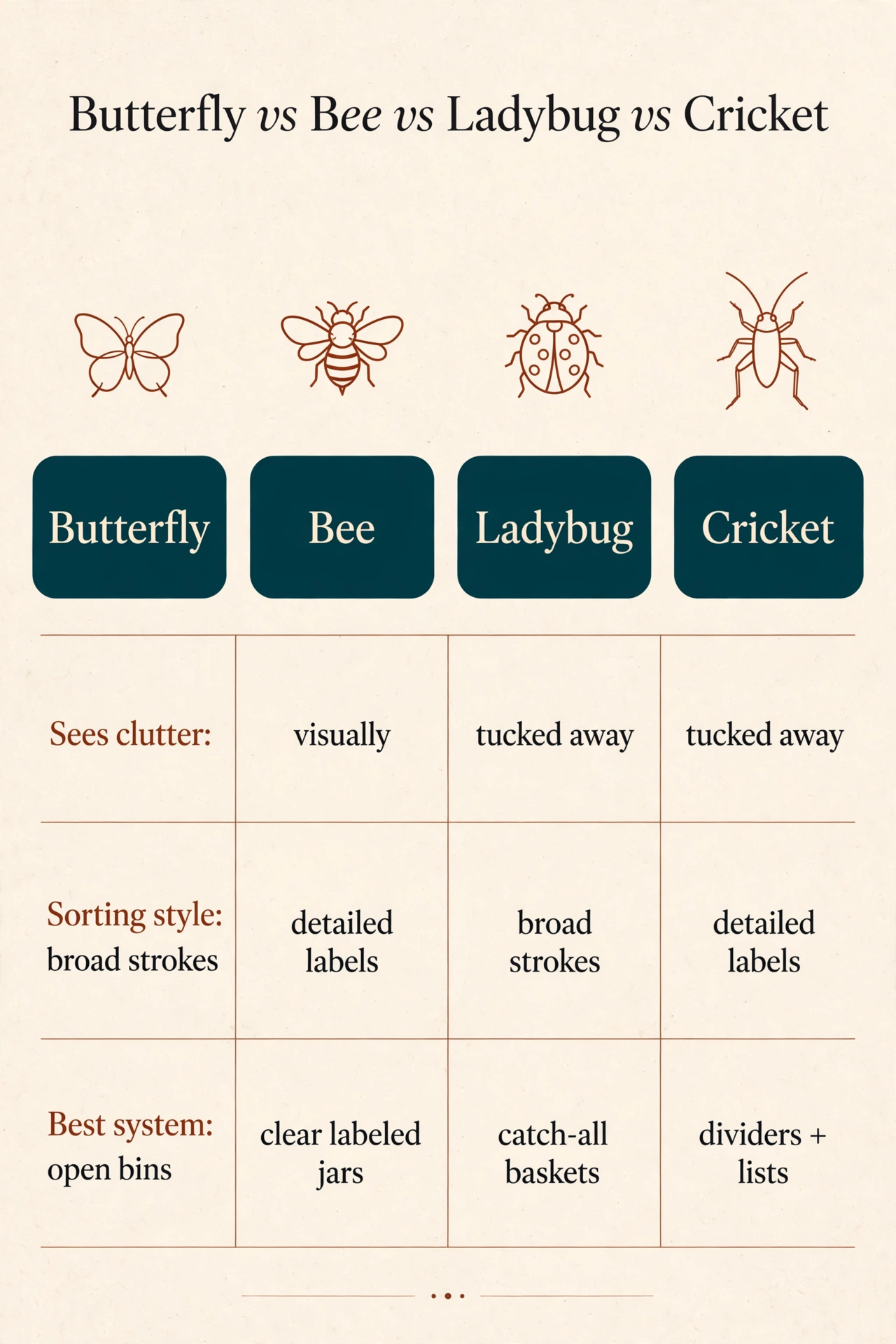
- Visual or hidden? Do you need to see your things to remember they exist — or are you perfectly happy with them tucked out of sight?
- Macro or detail? Do you sort in big, broad strokes (“kitchen stuff”) — or do you naturally want precise little categories (“spices, baking, snacks, oils”)?
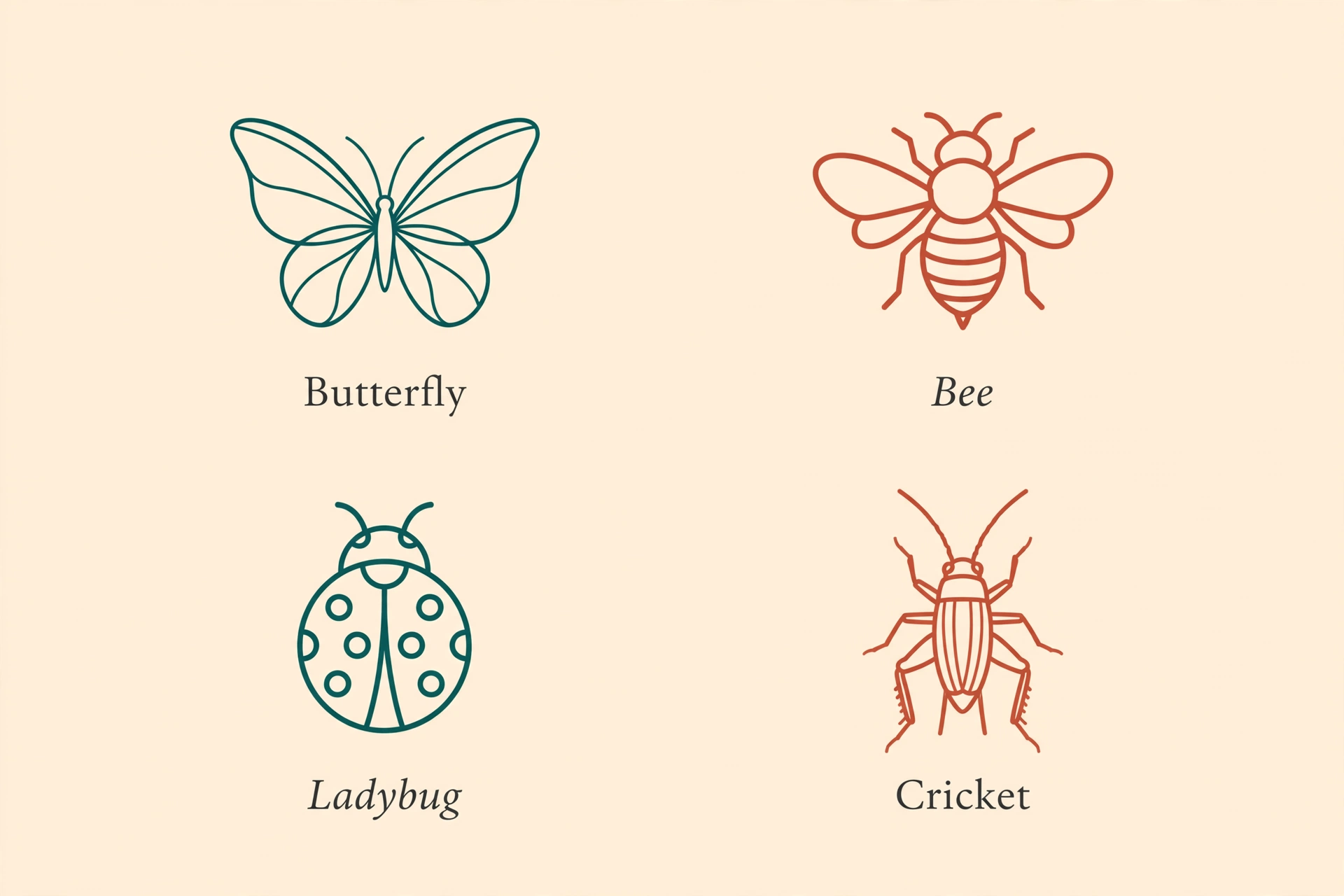
Two answers × two answers = four types, each named for a bug. (Everything below is described in our own words — for the actual quiz, take the official free test at clutterbug.me.)
Meet the 4 ClutterBug Types
🦋 The Butterfly — Visual Macro-Thinker
The Butterfly lives by one law: out of sight, out of mind — literally. If you file the bills in a drawer, the bills cease to exist. If the vitamins go in the cabinet, you will forget to take them for a month. Butterflies don’t lose things because they’re careless; they lose things because their brain only tracks what it can see.
Signs you’re a Butterfly: piles that you call “my system” (and honestly, the pile is your system — you know exactly what’s in it). Closed storage with lids you never replace. A graveyard of abandoned filing systems. You’ve probably cried in a container store.
Systems that finally stick for Butterflies:
- Open everything. Open bins, hooks, wall shelves — ditch lids and doors wherever you can.
- Few, broad categories. “Paperwork” beats “bills / medical / school / warranties / receipts.” Macro thinkers drown in subcategories.
- Labels face out — but keep them big and simple.
- Hooks > drawers for coats, bags, and tomorrow’s outfit.
Butterflies pair beautifully with visual, keep-first approaches — reverse decluttering, where you pull everything out and only keep what you love, is basically a Butterfly’s natural habitat: you can see every option before you decide.
🐝 The Bee — Visual Detail-Lover
The Bee also needs to see everything — but unlike the Butterfly, the Bee wants it seen and tidy. Detailed categories? Labels on everything? Clear containers lined up like a boutique? Yes, please. The Bee is the friend whose open shelving looks like a magazine shoot.
Signs you’re a Bee: you own a label maker and you are not ashamed. You decant things. Closed cabinets make you twitchy because you can’t see at a glance what’s inside. “A place for everything” isn’t a slogan — it’s a lifestyle.
Systems that finally stick for Bees:
- Clear containers + labels on everything. Visibility with precision is the whole game.
- Open shelving in kitchens and closets, styled intentionally.
- Detailed zones: baking zone, snack zone, tea zone — go granular, it genuinely makes you happy.
- Pretty bins matter. If it’s going to be visible, make it beautiful and you’ll maintain it.
Bees are the natural audience for our thrift-flip organization guide — thrifted glass jars, matching labels, and a unified color story turn visible storage into decor, which is exactly how a Bee stays motivated.
🐞 The Ladybug — Hidden Macro-Thinker
The Ladybug is the Butterfly’s mirror image: perfectly happy with things out of sight — even shoved in a drawer — as long as the system is dead simple. Ladybugs don’t need to see it and don’t need it precise. They need it easy. One big bin per category, lids optional but welcome, minimal steps between “in my hand” and “put away.”
Signs you’re a Ladybug: your drawers look chaotic but you can find anything in ten seconds. Detailed sorting systems bore you to actual tears. You’ve “organized” by shoving everything in a closet before guests arrive and felt zero guilt. (Same.)
Systems that finally stick for Ladybugs:
- Big catch-all bins. One for batteries-and-random, one for the junk drawer, one per kid’s stuff. Broad and forgiving.
- Fewer steps = better. A lid you have to open is a step; a toss-in basket is freedom.
- One junk drawer per zone — not twelve micro-organized ones.
- Speed over perfection. A 10-minute 12-12-12 session (12 toss, 12 donate, 12 rehome) is the perfect Ladybug maintenance rhythm: fast, simple, done.
🦗 The Cricket — Hidden Detail-Lover
The Cricket wants everything put away AND precisely organized. Closed cabinets, drawer dividers, subcategories within subcategories — and it all stays that way because maintaining the system is genuinely satisfying. The Cricket is the person traditional organizing advice was written for, and if this is you, congratulations: the container store was built for your brain.
Signs you’re a Cricket: you file-fold. You have opinions about drawer dividers. A “miscellaneous” drawer causes you physical discomfort. Your spice drawer is alphabetical and you will defend it.
Systems that finally stick for Crickets:
- Subcategories welcome. Spices → baking spices / savory spices / blends. Go as deep as you like.
- Drawer dividers, file-folding, inventory lists — the full precision toolkit.
- Labels inside cabinets so the precision survives busy weeks.
- Decide instantly. Crickets thrive on the OHIO method (Only Handle It Once): every item gets a verdict the moment you touch it — keep to its precise home, donate, trash, or relocate. No maybe piles, ever.
How to Actually Use Your Type (This Is the Important Part)
Knowing your bug is fun. Using it is life-changing. Here’s the three-step version:
Step 1: Take the official quiz. The free test at clutterbug.me is the real one from Aarssen herself — skip the copycats and start at the source.
Step 2: Audit your current systems for type-mismatch. Walk through your home and ask of every “system”: was this built for my brain? The Butterfly forcing herself to maintain a six-drawer filing cabinet with lids is a mismatch. The Ladybug with a 40-category label system is a mismatch. The Cricket with one giant “stuff” bin is a mismatch. Mismatches are why you keep “failing.”
Step 3: Rebuild with type-matched rules — and give it two weeks. Don’t renovate the whole house. Pick ONE zone (the entryway, the junk drawer, the pantry shelf) and rebuild it for your type. If it sticks effortlessly, you’ve found your operating system. Then roll it out room by room.
What If Your Household Has Four Different Bugs?
It probably does. This is the part nobody warns you about: your partner, your kids, and you are almost certainly different types — and that’s why shared spaces collapse.
The fix isn’t converting anyone. It’s negotiating zones:
- Let the Butterfly keep open landing zones by the door (hooks, open tray for keys).
- Give the Cricket the pantry with dividers and labels — and let them own it.
- The Ladybug gets the big catch-all basket in the living room; nobody is allowed to judge it.
- The Bee styles the open shelves and keeps them camera-ready.
Different brains, different rules, same peaceful house. And when the whole household needs a reset, start everyone together with the weekend declutter checklist — then let each bug maintain their zones their own way.

FAQ
What are the four ClutterBug types?
The four types are the Butterfly (visual macro-thinker — needs to see things, sorts in broad strokes), the Bee (visual detail-lover — needs to see things, loves precise categories), the Ladybug (hidden macro-thinker — happy with things tucked away, wants dead-simple systems), and the Cricket (hidden detail-lover — wants everything put away and precisely organized). They were created by organizer Cassandra “Cas” Aarssen.
Is the ClutterBug quiz really free?
Yes — the official quiz at clutterbug.me is free. Take it there rather than on third-party copycat sites so you’re getting Aarssen’s actual framework.
Which ClutterBug type is the most common?
Aarssen hasn’t published official distribution statistics, so any “most common type” claim you see online is guesswork. Anecdotally, the two macro types (Butterfly and Ladybug) seem to show up most often in her community — which makes sense, since most traditional organizing advice is written for detail-lovers, leaving macro-thinkers feeling like failures.
Can my ClutterBug type change over time?
Your underlying style is fairly stable — it’s about how your brain naturally sorts, not a mood. But life seasons change what systems are practical: a new baby, a move, or a busier job can shift which type-matched strategies work best. If your systems stop sticking, re-taking the quiz is a good reset.
What if I’m a mix of two types?
Totally normal — most people lean strongly toward one type with a secondary flavor (a “Butterfly with Bee tendencies,” for example). Design your systems for the dominant type and borrow tricks from the second. The quiz result is a starting point, not a cage.
Your Mess Was Never a Character Flaw
A decade of abandoned organizing systems doesn’t mean you’re messy. It means you were handed maps drawn for someone else’s brain. Find your bug, build for your bug, and watch what happens when the system finally fits the person using it.
Take the free official quiz at clutterbug.me — then come back and tell us: which ClutterBug are you? 🦋🐝🐞🦗





One Comment