
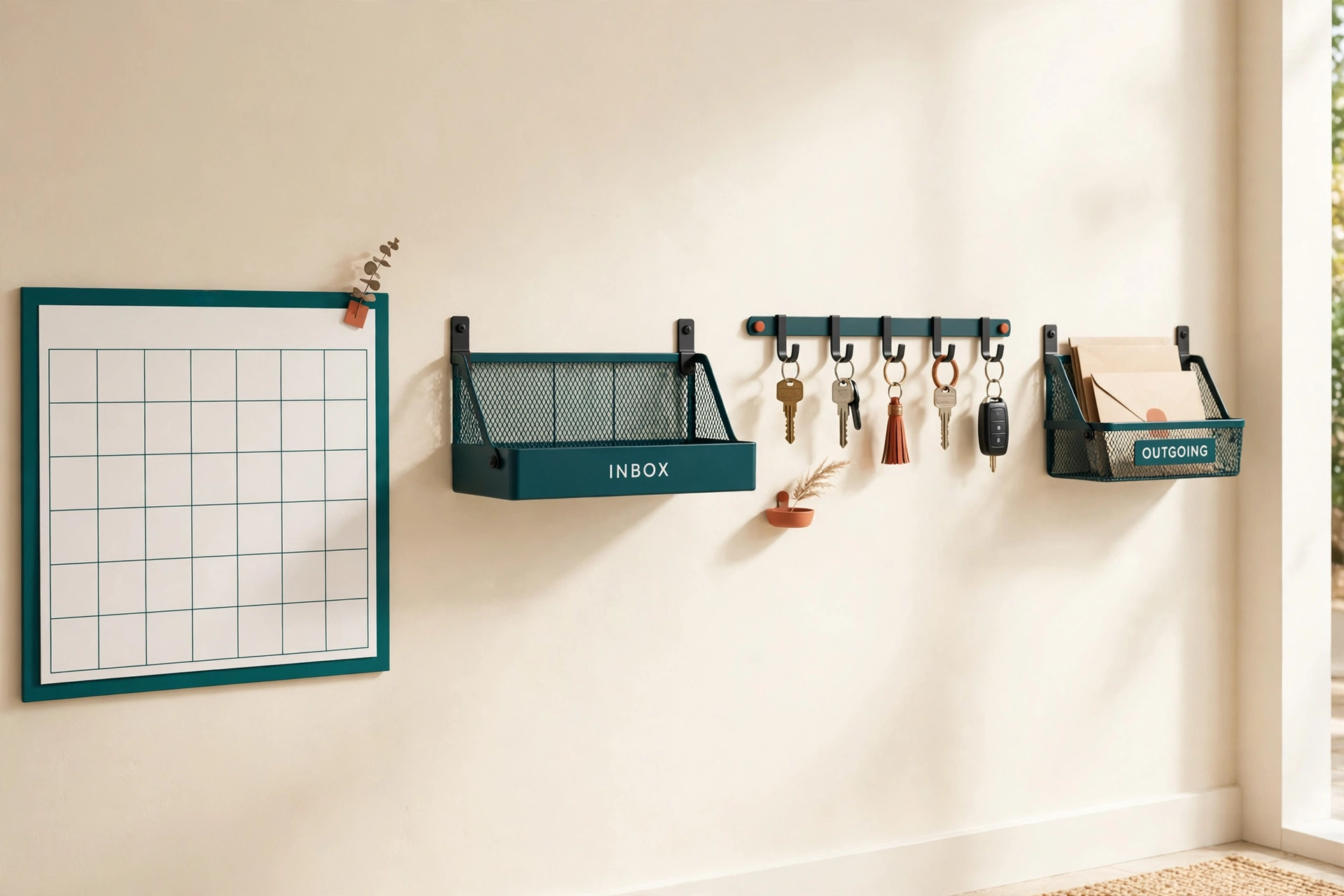
The January Reset Command Center: One Wall Runs Your New Year
January arrives with good intentions and a pile of paper. The decorations come down, the school notes come home, the bills from December land in a heap, and every flat surface in the house quietly becomes a filing system nobody agreed to. By the second week of January, the kitchen counter is doing three jobs at once — mail tray, key bowl, homework station — and doing none of them well. That is not a willpower problem. That is a missing wall. New year reset organization is the system that gives every piece of incoming family paper exactly one home: a command center — one wall, four zones, and a ten-minute Sunday reset that keeps it from becoming the next paper mountain.
This post builds one thing, and one thing only: the wall. It is deliberately not our paper triage post, and it is not our weekly reset ritual, though it borrows from both and links to both below. Our paper mountain post is the triage system — the three categories (act, hold, keep-forever) and the touch-it-once rule for every piece of paper that enters the house. Our weekly reset ritual is the maintenance habit — sixty minutes, once a week, that returns the whole house to calm. And our January declutter challenge touches a command center exactly once, on day 24, as a single fifteen-minute mission. This post is the build: the calendar, the inbox tray, the keys, and the outgoing tray, assembled on one wall, with the rule that nothing else is allowed to live there. Triage with the paper mountain post. Maintain with the weekly reset. Build the wall here.
The timing is the reason to build it now, not in March. January is decluttering’s peak season — the January reset genre is built on it: the post-holiday reset guides all say the same thing in plainer language, that after the decorations come down the house gets a room-by-room reset, with paper and systems first (post-holiday reset genre guidance, via https://medium.com/@clutterawaynwa/post-holiday-organization-how-to-reset-your-home-in-january-a385049509b5). The category leaders confirm the season is real: Declutter Hub calls January the peak of its popularity and runs a January “Reset Your Home” challenge that draws thousands and thousands of signups, and Allie Casazza’s annual January declutter challenge draws tens of thousands of women (Declutter Hub, January 2026, https://declutterhub.com/plan-2026/; Allie Casazza, 2026, https://alliecasazza.com/dlam — figures as reported by those organizers, labeled as such). Pinterest’s own Spring 2026 Trend Report adds the reset language: “reset aesthetic” searches up 200%, “weekly reset aesthetic” up 100% (Pinterest Spring Trend Report 2026, via the published figures on our weekly reset post). None of that is a promise that this post will go viral — it is timing evidence, labeled honestly, for why a January system built in January gets used, while a January system built in March gets filed under “someday.” New year reset organization works when the wall exists before the paper arrives. Build it the first weekend of January, and the rest of the month runs itself.
Why the Counter Always Loses
Every home already has a command center. It is just horizontal, unlabelled, and shared with the fruit bowl. The kitchen counter collects keys because it is the first flat surface after the door. It collects school papers because a child hands them to the nearest adult, who puts them down “for a second.” It collects mail because the mail gets opened standing up, over the counter, and the pieces that need action never make it to a tray. One surface, three jobs, no labels, no owner — and every evening, someone clears it in a hurry, moving the pile to a drawer, where it becomes a paper mountain with a drawer front.
A wall fixes this because a wall has zones and a counter does not. A wall can hold a calendar at eye level, where everyone sees it. A wall can hold hooks, where keys live by person, not by pile. A wall can hold one inbox tray, where incoming paper waits in exactly one place, and one outgoing tray, where things that must leave the house wait to be taken. A counter invites piling. A wall invites placing. That difference — piling versus placing — is the whole system. New year reset organization is not about buying a prettier organizer. It is about moving the family’s daily paper from a horizontal pile to a vertical wall with four named zones, and then defending those zones with one rule: nothing lives on the command center wall except the four zones.
THE FOUR ZONES: CALENDAR, INBOX, KEYS, OUTGOING
The new year reset organization wall has exactly four zones. Four is a load-bearing number: three zones leave something homeless (usually the outgoing mail, which ends up back on the counter), and five zones invite clutter creep (the fifth zone becomes a display shelf, then a junk shelf, then a pile). Four zones, one wall, nothing else.
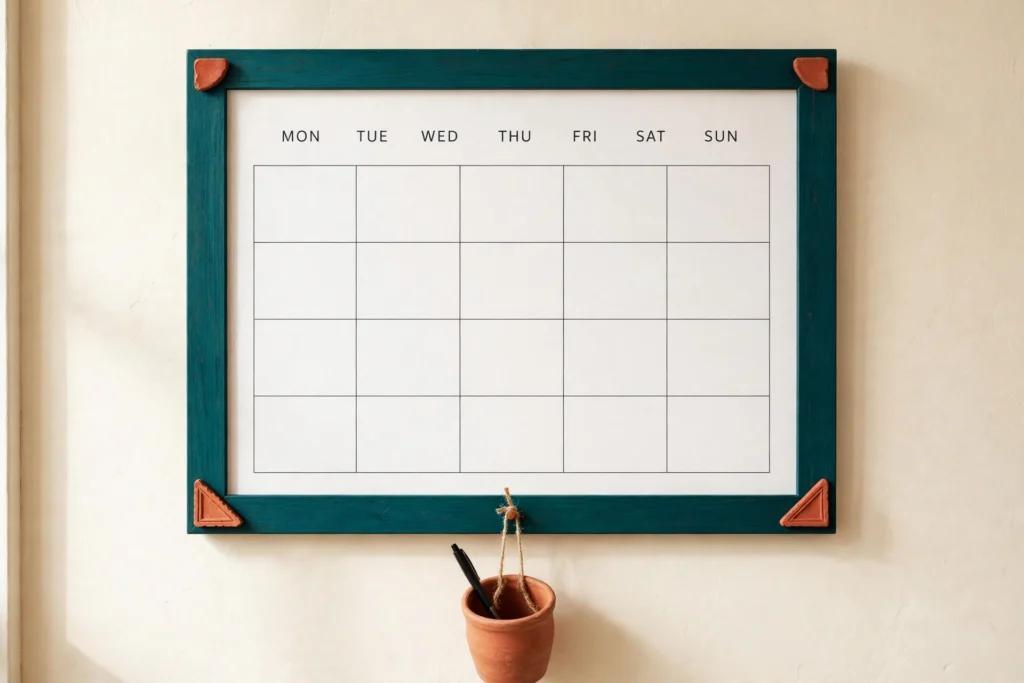
Zone 1: The calendar. One family calendar, at eye level, big enough to read from two steps back. Paper or whiteboard, it does not matter — what matters is that it is the ONLY calendar the family uses for shared dates. School dates, appointments, deadlines, and the weekly reset slot all go here, in one color per person if that helps, and nowhere else. A date that lives only on a phone, or only on a fridge note, is a date that will be missed by the person who needed it. The wall calendar is the shared truth. Write on it the day a date is learned, not the week it happens.
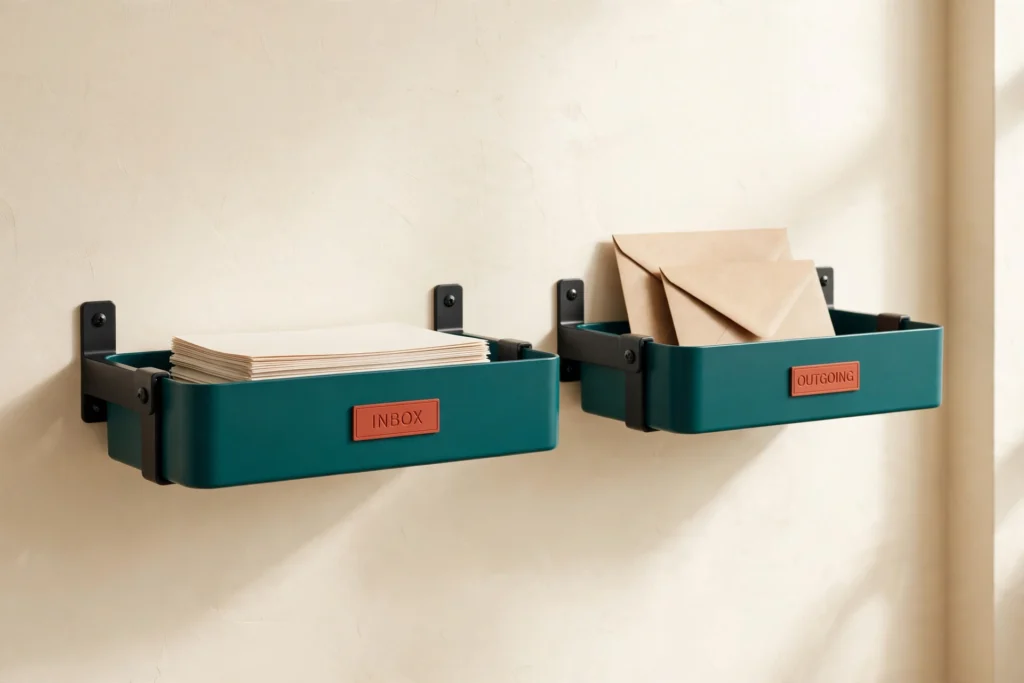
Zone 2: The inbox tray. One tray, one slot, labeled INBOX. Every piece of paper that enters the house and needs action — a form to sign, a bill to pay, a permission slip, an invitation to answer — goes in the inbox tray, and nowhere else, the moment it arrives. Not on the counter. Not on the dining table. Not in a bag by the door. The inbox tray is processed in the Sunday reset, and only in the Sunday reset, which is why it can hold a week’s worth of paper without becoming a mountain: it has a scheduled emptying. If the tray overflows before Sunday, that is information, not failure — it means the family had a heavy paper week, and the tray gets processed early, once, that evening.
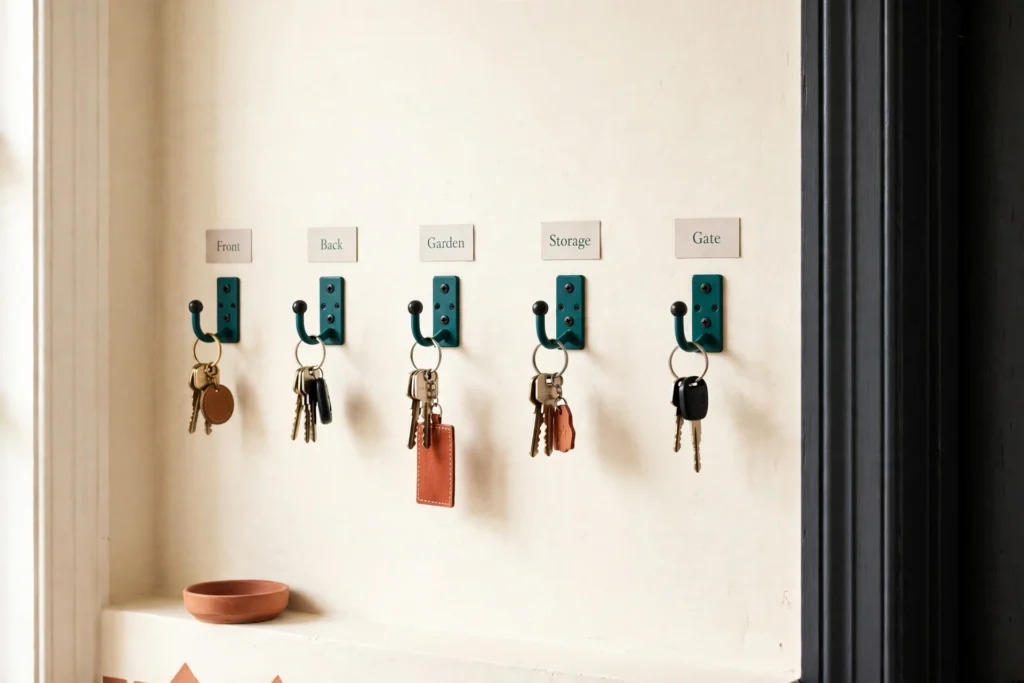
Zone 3: Keys and hooks. One hook per person, labeled with names, at the height each person can reach. Keys, and only keys, plus one small item per person if the hook demands it — a lanyard, a dog lead, nothing more. The hook rule is the strictest rule on the wall: a hook that holds a bag, a hat, and three coats is not a key hook, it is a closet that lost its door. Coats go to the coat hooks by the door. Bags go to their homes. The command center hooks hold keys, so that leaving the house never starts with a search.
Zone 4: The outgoing tray. One tray, labeled OUTGOING or GOING OUT. Everything that must leave the house — a signed form for school, a letter to post, a library book to return, a borrowed item to give back — goes in the outgoing tray, and the tray is checked every morning before anyone leaves. The outgoing tray is the zone most homes are missing, and it is the zone that stops the “I forgot it on the counter” conversation forever. If it is in the tray, it leaves. If it is not in the tray, it was never going to leave. The tray is emptied daily, not weekly: a daily tray that is checked every morning stays empty, and an empty tray is proof the system is working.
Everything else — the school papers that need keeping, the reference sheets, the warranties — does not live on the wall. It lives in the paper system: one slim folder, three categories, one surface, as our paper mountain post teaches. The wall is for action and departure, not storage. A command center that stores paper becomes a paper mountain standing up. A command center that moves paper — in, processed, out — stays a command center.
STEP 1: PICK THE WALL
The command center wall must be the wall you pass every day, near the door the family actually uses — not the front door you never open, the side door or kitchen door you come through with bags and mail in your hands. The wall needs to be reachable with full hands: you arrive, you hang the keys, you drop the mail in the inbox tray, you glance at the calendar, you keep walking. If building the wall requires a special trip to another room, it will not be used. Convenience beats beauty here, every time.
Measure before you buy anything. The wall needs roughly one metre of width for the four zones side by side, or a tall narrow strip if the zones stack vertically — calendar on top, inbox below it, hooks beside it, outgoing tray at the bottom. Either layout works. What does not work is a wall so crowded that the zones touch and merge, or a wall so far from the door that the counter wins by default. Stand at the door, walk in with imaginary bags, and put your hand where the keys would hang. That spot is the wall. If two walls compete, pick the one with the least foot-traffic furniture in front of it — nobody processes paper while climbing over shoes.
Clear the chosen wall completely before you build. Everything currently on it — the old calendar, the unlabelled hooks, the artwork nobody chose — comes off, and only the four zones go back. A command center built on top of existing clutter inherits the clutter. Start with a bare wall, and the zones will look intentional, because they will be.
STEP 2: BUILD THE ZONES IN ORDER
Build in this order, and do not skip ahead. The order is the system: each zone earns its place by being used before the next one is added.
First, the calendar. Hang it at eye level, centered on the wall, with a pen attached — a pen on a string, a pen in a cup below it, any pen that cannot wander off. Write in this week’s shared dates immediately, from phones, school notes, and memory, all in one sitting. A calendar that starts empty stays empty, because nobody trusts a blank calendar. A calendar that starts full, with this week’s truth on it, gets consulted the next morning.
Second, the hooks. One hook per person, labeled with names — a label maker, masking tape, a marker on the wall, it does not matter how, only that each hook has exactly one owner. Hang every set of keys on its hook, right now, and take a photo of the wall with the keys in place. That photo is the “after” picture, and it is also the standard: keys on hooks, always, is what calm looks like here.
Third, the inbox tray. One tray, wall-mounted or on a slim shelf below the calendar, labeled INBOX in letters big enough to read from the door. Gather every piece of action paper currently scattered through the house — the counter pile, the dining table pile, the bag pile — and put it all in the inbox tray, in one pile, in one place. That pile is the backlog, and it gets processed in Step 3. Do not sort it yet. The tray’s job today is gathering, not sorting.
Fourth, the outgoing tray. One tray, beside or below the inbox tray, labeled OUTGOING. It starts empty, and it should stay mostly empty — an outgoing tray with nothing in it is a tray doing its job. Put one thing in it today, if you have one: the form that needs signing, the book that needs returning. One item proves the tray works. Tomorrow morning, take it when you leave, and the tray is empty again, which is the point.
Total build time: one afternoon, or one focused hour if the wall is already clear. No new furniture is required — a calendar, hooks, and two trays are the entire equipment list, and most homes already own at least two of the three. Buy nothing until the wall is chosen and cleared; a command center that starts with a shopping trip is a command center that starts next month.
STEP 3: PROCESS THE BACKLOG
The backlog pile in the inbox tray gets processed once, in a single 45-minute session, using the paper triage rules from the paper mountain post: every piece gets one of three decisions, and only one decision. Act (it needs doing this week — it stays in the tray, with its action written on the calendar), Hold (it needs keeping for reference — it goes to the slim folder, not back on the wall), or Shred/Recycle (it needs nothing — it leaves the house). Touch each piece exactly once. Set a timer. When the timer rings, stop: whatever is left in the tray is next Sunday’s first job, and it is still better off in one tray than scattered across three surfaces.
While you process, write every deadline you find on the wall calendar, in the color of the person it belongs to. A deadline on the calendar is a deadline the whole family can see. A deadline in a tray is a deadline only the tray knows. This is the moment the wall becomes the family’s shared truth, instead of one person’s private pile.
At the end of the session, the inbox tray should hold only this week’s actions, each with a calendar date. The hold folder should hold the keepers. The shred bag should hold the rest. Take a second photo of the wall. The two photos — keys on hooks, tray with only this week’s paper — are the standard the Sunday reset will maintain. New year reset organization is not a January project. It is a January build plus a ten-minute weekly habit, and the habit is next.
STEP 4: THE SUNDAY 10-MINUTE RESET
Every Sunday, ten minutes, same order, same timer. This is the maintenance ritual borrowed from our weekly reset, shrunk to the wall: the weekly reset returns the whole house to calm in sixty minutes; the command center reset returns the wall to calm in ten, and it runs inside the weekly reset, not instead of it.
Minutes 0-3: Keys and calendar. Keys on hooks? Calendar up to date for the coming week? Write in anything learned during the week — school dates, appointments, deadlines — and cross off anything done. A calendar that is not updated on Sunday is a calendar that lies by Wednesday.
Minutes 3-7: Inbox tray. Process every piece in the tray with the touch-it-once rule: act this week (stays, with a calendar date), hold (goes to the slim folder), shred/recycle (leaves). If a piece has been in the tray for two Sundays without action, it gets a decision today — done, delegated, or discarded. A tray that holds the same paper for a month is a pile with a label.
Minutes 7-10: Outgoing tray and the wall check. Outgoing tray empty or dated for tomorrow? Anything on the wall that is not one of the four zones comes off — the extra note, the spare key, the leaflet someone “might need.” The wall check is the rule that prevents clutter creep: the command center wall holds four zones, and only four zones, forever. If a fifth thing wants to live there, it needs a home somewhere else, and the Sunday reset is when it gets one.
Ten minutes, once a week, and the wall stays a wall. Skip a week and the wall survives — the zones are labeled, the tray holds a week’s paper, the calendar still tells the truth. Skip three weeks and the counter starts winning again, which is why the reset lives inside the weekly reset you already run, not as a separate resolution. Habits survive by riding other habits. Resolutions die alone.
THE 7 COMMAND CENTER RULES
Seven rules, all of them load-bearing. Print them with the setup guide:
- One wall, four zones, nothing else. Calendar, inbox, keys, outgoing. A fifth zone is clutter creep with a label. The wall check every Sunday enforces it.
- Keys live on hooks, by person, always. Leaving the house never starts with a search. A key on the counter is a key that will be lost on the morning it matters most.
- Paper enters through the inbox tray, and only the inbox tray. No counter piles, no table piles, no bag piles. One entrance, one tray, one weekly processing.
- Every date goes on the wall calendar the day it is learned. A date on a phone only is a date half the family cannot see. The wall calendar is the shared truth.
- The outgoing tray is checked every morning. If it is in the tray, it leaves today. If it is not in the tray, it was never going to leave. Empty the tray daily.
- Nothing is stored on the wall. Reference paper lives in the slim folder, in the paper system. The wall moves paper — in, processed, out — it never stores it.
- Ten minutes every Sunday, no exceptions, no extensions. The reset is short on purpose. A ten-minute habit survives January. A forty-minute habit does not.
WHAT GOES WRONG
The wall becomes a display shelf. It starts with one photo, then a child’s drawing, then a vase, and suddenly the calendar is hidden behind a gallery. Fix: the Sunday wall check. Display belongs on display walls. The command center wall is a working wall, and working walls stay clear.
One person’s paper takes over the tray. The inbox tray fills with one family member’s mail, and everyone else stops using it. Fix: the tray is processed weekly, by whoever runs the reset, for the whole family — and each person’s actions get calendar dates in their color. Shared processing is what makes the tray shared.
The calendar splits. Someone keeps a second calendar on their phone, someone else keeps dates on the fridge, and the wall calendar quietly becomes decoration. Fix: one rule, stated plainly — if it is not on the wall, it is not a family date. Phones can mirror the wall. The wall cannot mirror five phones.
The outgoing tray is forgotten. The tray fills, nobody checks it in the morning, and it becomes a second inbox. Fix: put the tray at the height of the door handle, on the way out, and check it as part of leaving — keys, phone, outgoing tray, in that order, every morning. A tray you must pass to leave is a tray you will check.
January enthusiasm fades by February. The wall is built, the photos are taken, and by February the hooks hold one set of keys and the tray holds a month of paper. Fix: the reset rides the weekly reset, not willpower. When the weekly reset happens, the wall happens. When the weekly reset is skipped, the wall is the first ten minutes of the next one. No separate resolution, no separate guilt.
FREE PRINTABLE: THE COMMAND CENTER SETUP GUIDE
The free printable for this post is a one-page Command Center Setup Guide. Print one copy and keep it with the wall while you build. It holds: the four-zone map (calendar, inbox, keys, outgoing — with the wall layout sketched and labeled); the build order (calendar first, hooks second, inbox third, outgoing last); the Sunday 10-minute reset (the three timed blocks, in order); the 7 command center rules, printed small on the same page; the backlog session plan (45 minutes, touch-it-once, three decisions per piece). One wall, four zones, ten minutes a week. If a piece of paper does not have a zone, it does not have a home — and if it does not have a home, it will find the counter.
FREQUENTLY ASKED QUESTIONS
What is new year reset organization? New year reset organization is a one-wall command center system for the new year: one wall near the door you use, with four zones — a shared calendar, one inbox tray, one hook per person for keys, and one outgoing tray — plus a ten-minute Sunday reset that keeps the wall from becoming another paper pile. It gives every piece of incoming family paper exactly one home, so January’s paper never becomes February’s mountain.
Where should a home command center go? On the wall you pass every day, near the door the family actually uses, reachable with full hands — keys hung, mail dropped in the inbox tray, calendar glanced at, all in one pass. If building or using it requires a special trip to another room, the kitchen counter will win by default. Convenience beats beauty for a command center wall.
What are the four zones of a command center? Calendar (the one shared family calendar, at eye level), inbox tray (the only entrance for action paper), keys and hooks (one labeled hook per person, keys only), and outgoing tray (everything that must leave the house, checked every morning). Nothing else lives on the wall — reference paper belongs in the slim-folder paper system, not stored on the wall.
How do I keep a command center from becoming clutter? The Sunday 10-minute reset: three minutes on keys and calendar, four minutes processing the inbox tray with the touch-it-once rule, three minutes on the outgoing tray and a wall check that removes anything that is not one of the four zones. The reset rides inside the weekly reset ritual, so it survives on an existing habit instead of a new resolution.
Can I build a command center without buying anything? Yes — a calendar, hooks, and two trays are the entire equipment list, and most homes already own at least two of the three. Choose and clear the wall first, build in order (calendar, hooks, inbox, outgoing), and buy nothing until the wall is chosen. A command center that starts with a shopping trip is a command center that starts next month.
Keep reading: our paper mountain post is the triage the wall borrows — three categories, touch it once, one surface for kept paper; our weekly reset ritual is the sixty-minute Sunday habit the ten-minute wall reset rides inside; and our January declutter challenge is the 31-day day-by-day version of the new-year reset — one small mission a day, with the command center as day 24.





4 Comments